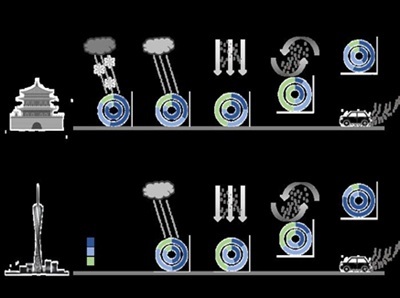
MP and NP abundances in aerosols and estimated fluxes across atmospheric compartments in semiarid (XA) and humid subtropical (GZ) urban environments. Credit: Institute of Earth Environment, CAS
A new study of two Chinese megacities has found the abundance of microplastics and nanoplastics in the atmosphere is up to 5 times more than previously identified.
According to the paper published in Science Advances, a team from the Institute of Earth Environment at the Chinese Academy of Sciences developed a semi-automated microanalytical method to quantify atmospheric plastic particles and their cross-compartmental fluxes—airborne, dustfall, rain, snow, and dust resuspension—in two major Chinese megacities: Guangzhou and Xi'an.
Using a computer-controlled scanning electron microscopy system, the team detected plastic concentrations in total suspended particulates (TSP) and dustfall fluxes that are 2 to 6 orders of magnitude higher than those reported by visual identification techniques like manual SEM-EDX, μ-FTIR, or μ-Raman.
Additionally, estimated fluxes of microplastics and nanoplastics varied by 2 to 5 orders of magnitude across key atmospheric compartments, driven largely by road‑dust resuspension and wet deposition. Furthermore, deposition samples contained more heterogeneously mixed plastic particles than aerosol and resuspension samples, indicating enhanced particle aggregation and removal during atmospheric transport.
This study marks the first detection of nanoparticles as small as 200 nm in complex environmental matrices. It provides a quantitative assessment of atmospheric plastics, the least understood reservoir in the global plastic cycle, and delivers new insights into their environmental transformation, fate and broader implications for climate dynamics, ecosystem integrity and human health.
Data from the Chinese Academy of Sciences