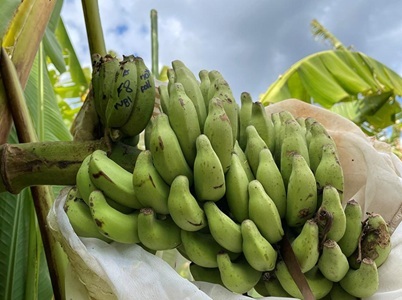
Generations of Calcutta 4 crosses were grown to identify STR4 resistance was carried in chromosome 5. Credit: Elizabeth Aitken
The fungus Fusarium wilt Sub Tropical Race 4 (STR4) is severely impacting global banana supplies by threatening roughly 80% of production. It causes in-field losses of 13.7 tons per hectare annually and has already cost nations over $400 million. The disease has decimated up to 10% of farms in affected regions like Peru, significantly raising production costs and reducing long-term export feasibility.
Now, scientists in the UK have identified the genomic region that controls resistance to STR4, garnering hope for the global banana farming and supply industry.
The complex project took 5 years to complete. Each generation of banana crosses needed to be grown for at least 12 months before it could be challenged, examined and then used for further breeding once it flowered.
“We’ve located the source of STR4 resistance in Calcutta 4, which is a highly fertile wild diploid banana, by crossing it with susceptible bananas from a different subspecies of the diploid banana group,” explained study author, Andrew Chen from the University of Queensland.
After exposing the new progeny plants to STR4, Chen and colleague Elizabeth Aitken examined and compared the DNA of those that succumbed to the pathogen and those that didn’t.
“We mapped STR4 resistance to chromosome 5 in Calcutta 4,” said Chen. “This is a very significant finding—it is the first genetic dissection of Race 4 resistance from this wild subspecies.”
The researchers used a combination of forward genetics (population development and disease screening), genome sequencing and bulked segregant analysis in the study, published in Horticulture Research.
The next step is to develop molecular markers to track the resistance trait efficiently so plant breeders can screen seedlings early and accurately before any disease symptoms appear.
Data from University of Queensland