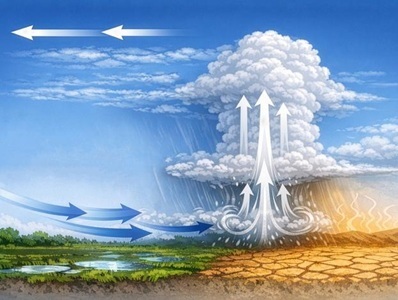
Air is moving from moist regions toward dry regions. Water moves up, in higher atmospheric regions the wind direction may be different. Credit: TU Wien
Meteorologists are often confronted with frustration when their forecasts are incorrect. But weather forecasting is difficult, especially when it comes to thunderstorms. Thunderstorms are known to form on warm, humid days with unstable air, but predicting where one will develop if a different story. Heavy rainfall often occurs very suddenly and locally—without warning.
By analyzing 2.2 million thunderstorm events in Africa over a 21-year period, researchers have finally identified a physical explanation for why thunderstorms form at one location while failing to develop elsewhere. It is the interplay between wind conditions in the atmosphere and spatial variations in soil moisture that determines whether a harmless cloud grows into a dangerous thunderstorm. This finding is a milestone for weather forecasting and safety.
“Large-scale air-mass movements can be calculated very well today,” said Wolfgang Wagner, professor for remote sensing at TU Wein (Austria). “But thunderstorms form on intermediate spatial scales—on the order of a few kilometers. And this is precisely where current models reach their limits.”
Wind and soil
The study, published in Nature, focused on sub-Saharan Africa, where regularly intense thunderstorms led to dangerous and deadly flash-flooding. The researchers studied satellite images of the atmospheric conditions leading up to 2.2 million storms spanning 21 years from 2004 to 2024.
While researchers at TU Wein have been studying thunderstorms for years, recent improvements in the spatial and temporal resolution of the satellite data made it possible to uncover finer-scale details of soil wetness and the resulting impact on thunderstorm origins.
It was already known how winds vary with height—known as shear—affects storm severity, and that high temperatures from parched soils located close to cooler, wetter ground favors the growth of storm clouds. The new satellite data and study results show that clouds are most likely to grow rapidly where soil moisture patterns align with wind shear. It’s under these conditions, convection is strongest.
“When this occurs, the relative velocity is at its maximum,” said principal author of the study Christopher Taylor from the UK Centre for Ecology and Hydrology. “The cloud comes into contact with the greatest possible amount of new, near-surface air per unit time—and this air then feeds the thunderstorm cell from below.”
In fact, the new study found there were 68% more explosive storms given favorable soil moisture patterns.
Future forecasting
The British-Austrian research team team validated the model using independent data sets. Satellite imagery showed rapid cloud growth exactly where the model predicted; and lightning observations confirmed the most intense thunderstorms formed over relatively dry soil areas when near-surface winds and winds at higher altitudes were oppositely directed.
The researchers say the principle they have identified will be applicable to the birth of thunderstorms in not only the worst-hit tropical regions of Africa, but Asia, the Americas, Australia and Europe, as well.
“The findings will support our continuing work with national meteorological agencies to develop more accurate, AI-based forecasting systems to improve local predictions of downpours and lightning, particularly in parts of the world that experience the most intense thunderstorms,” said Taylor.
This study relied on data from the European ASCAT instrument, which orbits the Earth aboard the Metop satellites operated by the European Organisation for the Exploitation of Meteorological Satellites. Using sophisticated, tailor-made physically based models, these measurements allow detailed estimates of local soil-moisture conditions.