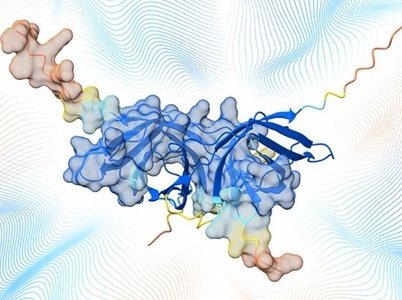
Slime mould Dictyostelium discoideum protein complex Q55DI5 (AF-0000000066503175), annotated as a transcription elongation factor. The single chain looked disordered, but modelling the homodimer revealed that two chains intertwine, each contributing half a domain to form a stable fold. An illustration of why predicting protein complexes can reveal biology that single-protein models miss. Credit: AlphaFold Database, background by Karen Arnott/EMBL
A new collaboration has made millions of AI-predicted protein complex structures openly available through the AlphaFold Database. To maximize global impact, the dataset prioritizes proteins important for understanding human health and disease. This is the largest dataset of protein complex predictions currently available.
The latest AlphaFold Database update spans millions of homodimers—protein complexes formed of two identical proteins. It focuses on 20 of the most studied species, including humans, as well as the World Health Organization’s bacterial priority pathogens list. This approach aims to bring significant and immediate value for global health challenges.
“By expanding the AlphaFold Database to include protein complexes, we are addressing a critical need expressed by the scientific community,” said Anna Koivuniemi, Head of the Google DeepMind Impact Accelerator. “We hope that by lowering the barrier to these complex predictions, we can empower researchers everywhere to pursue the next wave of discoveries that could ultimately improve human health on a global scale.”
The AlphaFold Database, an open resource that anyone can access, currently has over 3.4 million users from 190 countries. Through ongoing dialogue with the scientific community, a clear need emerged to expand the AlphaFold database to include protein complexes. In response to this need, the European Molecular Biology Laboratory, Google DeepMind, NVIDIA and Seoul National University teamed up, contributing specialist expertise and resources to calculate and integrate millions of protein complexes into the AlphaFold Database.
It takes a blend of AI-scale infrastructure and deep technical knowledge in accelerating complex workflows to generate AI predictions for protein complexes at this scale. The collaboration is centrally hosting data that would otherwise require around 17 million hours of GPU (graphics processing unit) computing to recreate.
This is the first step in an ambition to add a wide range of protein complex structure predictions to the AlphaFold Database. The partnership has already calculated predictions for 30 million complexes. Of these, 1.7 million high-confidence homodimer predictions have been added to the AlphaFold Database. Another 18 million are lower-confidence homodimers, which are available as a list and for bulk download. The rest are heterodimers, currently being analyzed and assessed. More protein complex predictions will be calculated and high-confidence predictions will be added to the AlphaFold Database in the coming months.
Data from European Molecular Biology Laboratory