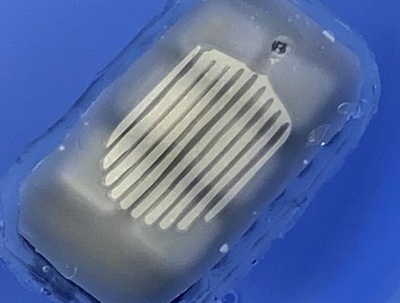
The implantable device encapsulates islet cells, protecting them from immune rejection. The device also carries an oxygen generator to keep the cells healthy. Credit: MIT
Most diabetes patients must carefully monitor their blood sugar levels and inject insulin to help keep their blood sugar from getting too high.
As a possible alternative to insulin injections, MIT researchers are developing an implantable device that contains insulin-producing cells. The device encapsulates the cells, protecting them from immune rejection. This device, the researchers hope, could offer a way to achieve long-term control of type 1 diabetes.
In a 2023 study, researchers reported an islet-encapsulation device that also carries an on-board oxygen generator. This generator consists of a proton-exchange membrane that can split water vapor into hydrogen and oxygen. The hydrogen diffuses harmlessly away, while oxygen goes into a storage chamber that feeds the islet cells through a thin, oxygen-permeable membrane.
In the new study, the researchers increased the lifespan of the devices by making them more waterproof and more resilient to cracking. They also improved the device electronics to deliver more power to the oxygen generator. The implant is powered wirelessly by an external antenna placed on the skin, which transfers energy to the device. By optimizing the circuitry, the researchers were able to increase the amount of power reaching the oxygen-generating system.
In rats and mice, the researchers showed that the new device could function for at least 90 days after being implanted under the skin. During this time, donor islet cells were able to produce enough insulin to keep the animals’ blood sugar levels within a healthy range.
The researchers saw similar results with islet cells derived from induced pluripotent stem cells, which could one day provide an indefinite supply that could be used for any patient who needs them. These islets didn’t fully reverse diabetes, but they did achieve some control of blood sugar levels.
The researchers now plan to study whether they can get the devices to last for even longer in the body—up to two years, or longer. They are also exploring the possibility of using this approach to deliver cells that could produce other useful proteins, such as antibodies, enzymes, or clotting factors.
Data from MIT