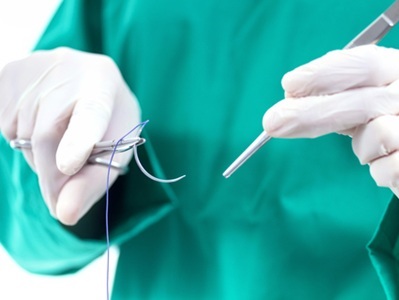
Deep cuts from accidents or surgeries require stitches, typically followed by oral anti-inflammatory medications. While these medications help with pain, they don’t act specifically on the wounds. Consequently, the site of the stitches can get inflamed, which could slow healing and lead to scarring.
Now, researchers at Ouachita Baptist University are creating stitches loaded with anti-inflammatory drugs to deliver medication directly to the injury.
In previous work, scientists have coated polydioxanone sutures with anti-inflammatory drugs by dipping the strands in solutions containing these medications. But the drug molecules don’t hold on to the polymers tightly, and the dipped strands release the anti-inflammatory drug quickly in the body, which can interfere with the synthesis of collagen.
Mieya Kirby, an undergraduate researcher working with chemist Sharon Hamilton, mitigated this problem by blending polydioxanone with another polymer that binds anti-inflammatory drugs during the electrospinning process. The drugs are attached to the new polymer by covalent bonds. The bonds break down gradually, ensuring that the attached anti-inflammatory drug is released into the wound slowly over weeks. The team is now experimenting with different polymers, probing how fast they release drugs and how adjustable those release rates are.
These new stitches could eliminate the need to remember to take oral pain medications. Moreover, by reducing inflammation and limiting scars, they could increase the success rates for anastomosis procedures. Surgical stitches loaded with anti-inflammatory medications
In the future, the researchers plan to scale up their solution from thin electrospun polymers to a fiber that is sufficiently strong and flexible for surgeons to stitch with.
The team is seeking collaborations that would allow them to test the new stitches in animal models.
Data from American Chemical Society