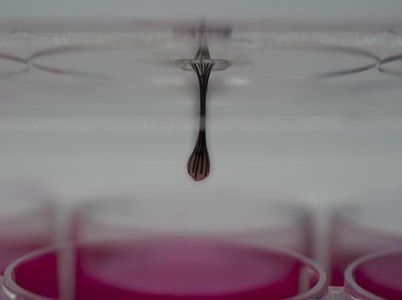
One of the new CAMEO sensors, holding a human cerebral organoid. Credit: Navya Mishra, NC State University
Researchers have demonstrated a new class of low-cost, scalable sensors that can be used to monitor electrical activity in human cerebral organoids. Because electrical signals are key to understanding brain function, this advance facilitates research into both neurodevelopment and genetic disorders, such as Angelman syndrome.
The new device—called CAMEO (Conformal Array for Monitoring Electrophysiology of Organoids)—comprises 12 carbon nanotube strands suspended in the shape of a basket. The carbon nanotubes are processed in a way that preserves the material’s flexibility and sensitivity to electrical signals. In practice, the organoid is suspended in the CAMEO, like an egg in a basket. The end of each strand is exposed, creating an electrode that can detect electrical signals from the organoid. The signals are then transmitted through the carbon nanotube strand to a device that can record electrical activity.
In proof-of-concept testing, the researchers demonstrated that CAMEO was capable of monitoring electrical activity in organoids, that it could detect the low-amplitude signals that are critical to biological research, and that it was able to detect signal changes that are triggered by chemicals that stimulate electrical activity in neurological systems.
The device was designed to address current limitations. One specific challenge in human cerebral organoid research is that there can be significant variation across organoid samples. As a result, it’s critical to have many samples in order to produce biologically meaningful results. However, the sensors currently used in organoid research are expensive, due to both the materials they are made from and the manufacturing process itself. This creates financial constraints that result in researchers often using fewer than 10 organoids for a given study.
“We have shown that CAMEO’s performance is comparable to previous technologies used to monitor electrical activity in organoids,” said Navya Mishra, first author of the paper and a Ph.D. student at NC State. “The big difference is that our microelectrode array uses relatively inexpensive materials and is much less difficult to manufacture, making it substantially less costly. This should make it much easier to scale up, allowing researchers to conduct more large-scale studies.”
Data from North Carolina State University