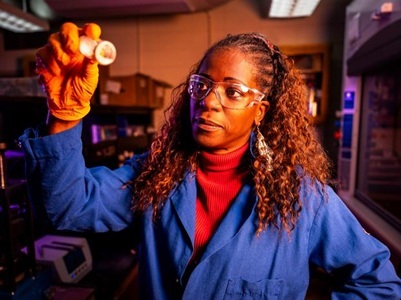
Mississippi State chemist Colleen Scott is the recipient of the Bayh-Dole Coalition's 2026 American Innovator Award for her award-winning technology that targets cancer cells. Credit: Grace Cockrell
Mississippi State University (MSU) chemist Colleen Scott has been selected for the Bayh-Dole Coalition’s 2026 American Innovator Award, one of the nation’s most prestigious honors given annually to researchers whose federally funded work leads to real-world impact.
“The American Innovator Award recognizes how careful fundamental research can grow into technology that can be paradigm changing, in this case impacting the way we do things in health diagnostics and imaging,” said Carl Lovely, head of MSU’s chemistry department.
Scott has pioneered the development of new protocols for synthesizing and applying emissive dyes, which could revolutionize the way clinicians detect and treat diseases—especially cancer. The shortwave infrared (SWIR) dyes Scott enable safe, high-resolution deep tissue visualization by operating at lower energy levels than traditional imaging methods.
One of the most innovative aspects of the research is that the technology selectively targets cancer cells, allowing clinicians to more clearly identify tumor boundaries.
“We're looking to tweak the dyes so they will respond only in environments where you have cancer. That's the goal—we can stain the cancer cells, so the surgeons have a better idea of where the cells are when they're doing surgery,” explains Scott.
This breakthrough is key for helping surgeons and doctors notice if any cancer is left in the patient without having to conduct invasive surgery or chemotherapy.
An additional innovative development in Scott’s research is the ability to simplify the dye synthesis process. What once took 10 steps can now be achieved in just two.
“We were able to cut down the synthetic steps significantly,” she says. “Now, more people can do it, which means more competition, but it also pushes us to be more creative and stay ahead.”
Beyond medical applications, Scott’s work has potential implications for other industries as well. Her team is investigating electrochromic applications, such as smart windows, that can change tint based on electrical signals.
The motivation behind the dye project and many others of Scott’s comes from the potential to help people and positively contribute to society.
“The big goal or the motivator is how we can change something in the world. Hopefully, at some point in your career, you can come up with something that makes a difference and significantly adds to the scientific community,” said Scott.
Past honorees of the American Innovator Award include the developers of mRNA vaccine technology, once-a-day HIV treatments and vision-restoring glasses.
“This award is a tremendous honor and a validation of the hard work of my team and students,” said Scott. “I hope it inspires the next generation of scientists and provides more opportunities to advance research that improves human health, technology and everyday life.”