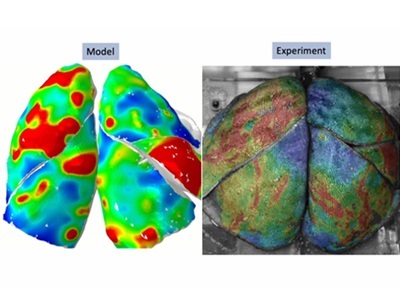
A digital model created from breathing experiments on a lung from a donor. Credit: Mona Eskandari/UCR
For the first time, scientists have directly measured how smoking changes the mechanical behavior of human lung tissue by making it substantially stiffer, resembling fibrosis.
The study, published in the Journal of the Royal Society Interface, examines human lung parenchyma, which is the soft, spongy tissue that makes up the bulk of the lung organ.
Using human lungs from donors, the researchers removed small square samples of the parenchyma, then mechanically stretched the tissue while measuring how much force it resisted.
The differences between smokers and nonsmokers were striking. Tissue from smokers became significantly stiffer as it stretched, resisting expansion more strongly than healthy tissue. This is similar to the way scar-like tissue makes breathing progressively more difficult in people suffering from fibrosis.
Though lungs expand in many directions simultaneously with each breath, previous studies stretched tissue in only one direction or relied entirely on animal models. Eskandari’s lab instead conducted tensile tests by extending tissue across multiple axes at once to better mimic the mechanics of real breathing.
The study also revealed that lungs are mechanically nonuniform. Tissue sampled from upper lung regions was generally stiffer than tissue from lower regions, even within the same lobe.
Researchers believe gravity may potentially explain the difference. Because humans stand upright, the upper lungs experience different long-term forces than the lower lungs.
Those uneven mechanics could have important medical consequences. The findings may help explain why certain forms of lung damage, including ventilator-induced lung injury, do not spread evenly throughout the organ. Some regions may be more vulnerable to overstretching than others.
The researchers also measured how much energy lung tissue loses during repeated stretching cycles. Human lung tissue dissipated more energy than researchers typically observe in mice, a finding that may help explain why animal studies do not always accurately represent human lung behavior.
That distinction is important because scientists are increasingly relying on digital twin lungs designed to simulate breathing, disease progression and medical interventions. If those models are based only on animal data, they may fail to capture critical aspects of human lung mechanics and make it more difficult to translate into clinical settings.
These findings could eventually improve computational lung models, ventilation strategies and surgical planning tools designed to predict how diseased lungs respond to physical stress.
Data from UC Riverside