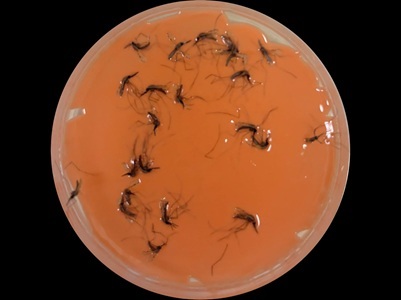
Female Anopheles gambiae mosquitoes stuck to a Petri dish containing a biofilm of the yeast Rhodotorula taiwanensis (orange). Credit: Diego Giraldo, Johns Hopkins Bloomberg School of Public Health
An orange-colored yeast species isolated from a Baltimore sidewalk could be the basis of eco-friendly mosquito traps that reduce malaria transmission, according to a new study out of Johns Hopkins.
In 2023, researchers in the Casadevall Lab at Johns Hopkins conducted a fungi study in the city of Baltimore. During their work, the team was surprised to find Rhodotorula taiwanensis—a unique species of yeast originally found in plant samples in Taiwan. Recognized for surviving highly extreme, hostile environments, such as acidic, radioactive waste, the yeast is valued for its bioremediation capabilities and its production of specialized biosurfactants.
Now, scientists have found another use for it: a trap for malaria-transmitting mosquitoes.
Smelly and stick
Yeasts and other fungal species are known to have an intertwined relationship with insects. Just as plants lure animals to consume their fruits and spread their seeds, fungi lure insects to land on them and spread their cells and spores. In this study, researchers in two Johns Hopkins labs investigated the ability of common yeasts to attract mosquitoes.
Out of seven tested yeast species, only R. taiwanensis stood out for its ability to attract female Anopheles gambiae, the principal malaria-transmitting mosquito in Africa. The yeast lures the mosquitoes through scent and then traps them with its sticky biofilm—akin to quicksand.
According to the study, published in PNAS, R. taiwanensis’ unique blend of scent chemicals—as described by the researchers—consists mainly of acetone and 3-methyl-1-butanol, a distinct and simple mix when compared with other common yeasts.
The team is now considering developing R. taiwanensis-based traps for malaria control, leveraging the yeasts’ fragrant and sticky qualities. They are currently evaluating the attractiveness of R. taiwanensis to other species of malaria mosquitoes, as well as nuisance-biting mosquitoes found in the U.S.
In addition to female A. gambiae, the researchers noted that male A. gambiae as well as Drosophila fruit flies were also attracted to R. taiwanensis in further laboratory tests—even going so far as to eat it. This confirmed that the yeast’s attraction does largely operate via an insect’s sense of smell, specifically a class of insect olfactory sensors called odorant receptors. It’s also further evidence that the approach could work for other species of mosquitoes.
In addition to being found in Maryland, R. taiwanensis is present in other regions around the world, commonly in soil and on plants. It also occurs on the surface of sugar cane and rice leaves, on the stems of mugwort herbs, on blueberries, as well as in fermentation starter cultures used for traditional alcohol production in India and Korean soy sauce.