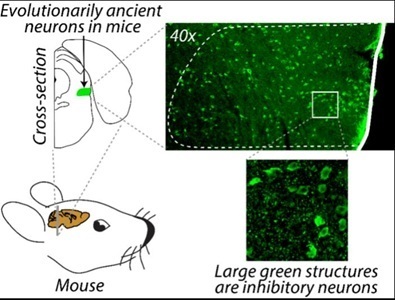
Johns Hopkins researchers found that attention in mice is controlled within the brainstem, by a circuit of inhibitory neurons that all vertebrates have, including birds and fish. Credit: Johns Hopkins University
Researchers have discovered that neurons—tucked away in an ancient part of the brain—control the ability to pay attention by suppressing distractions and directing focus. The discovery was made in mice, but the neurons are in a part of the brain that exists across all vertebrates including humans. The finding could be an initial step toward more targeted treatments for attention disorders.
It’s long been thought that matters of attention were driven only by the prefrontal cortex, a region of the brain that’s only highly developed in humans and primates. But that doesn’t explain how many other animals can also pay attention and focus.
“If we really go back in evolution, for hundreds of millions of years, birds have had this ability, fish have had this ability. And they do not typically have a highly developed prefrontal cortex, so how does the brain solve this problem?” said lead author Ninad Kothari, a postdoctoral fellow at Johns Hopkins. “We were able to identify an evolutionarily old region in the brainstem which affords this ability.”
In the study, published in Nature Communications, Kothari and team had mice perform a human-like attention task. Mice had to focus on visual information presented directly ahead on a screen, while ignoring distracting information to the side. They earned rewards if they touched the screen with their nose at a location signaled by the information ahead of them, rather than at the location signaled by the distracting information. The mice were very good at it until the team temporarily disabled the brainstem neurons—then they became hyper distractable.
The team tested further to confirm it wasn’t any sort of impairment in motor movements or in the animal’s ability to see objects that was keeping the mice from being successful at the task upon silencing these neurons.
Next, the team would like to figure out how these neurons are controlling spatial attention in vertebrates, and ultimately, to what degree they are involved in human attention. They’d like to measure the activity of these neurons in people with ADHD and autism, and if their function is indeed affected, it could lead to more targeted drugs and treatments.
Data from Johns Hopkins