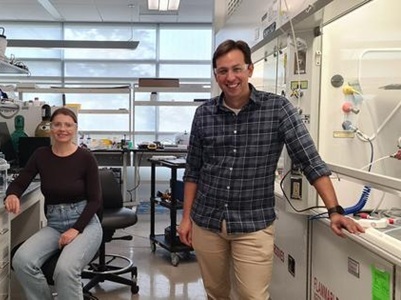
The research was led by Bordallo’s group at the University of Copenhagen in collaboration with her group members, Karina Kovalchuk and Leander Michels at Lawrence Berkeley National Laboratory. Credit: Finn Babbe/LBNL
Fruits and vegetables produce ethylene, a natural gas that controls their ripening—and allows them to travel all across the globe for distribution. But, when fruits and vegetables are confined in closed packaging or containers during transport and storage, the concentration of ethylene in the air increases, accelerating the ripening process. As a result, a large part of the cargo ends up rotting before it reaches its final destination.
Now, new research shows that ordinary clay could be part of the solution.
First, researchers tried to capture the gas with the clay in its natural form. Here, a small amount was captured. By increasing the voids in the clay's structure with a mild chemical treatment, the researchers made room for the clay to capture more gas—but without the gas escaping again—while keeping the material nontoxic.
Researchers have never succeeded in getting clay to absorb such large amounts of ethylene, which is why they believe the concept has potential for use in food packaging. The results provide a kind of design manual for how to develop sustainable materials for food packaging that tackle the problem of ethylene.
“We imagine small bags or pads of powdered clay that can be placed with fruit and vegetables during transport and absorb ethylene—in the same way as the moisture-absorbing silica bags that often come in the packaging when you buy, for example, shoes and electronics,” said Karina Kovalchuk, first author of the study and researcher at Lawrence Berkeley National Laboratory.
The clay material could also enhance the taste of the fruits and vegetables. Currently, most fruit is harvested early to avoid them rotting along the way. This means the fruit is not fully developed, affecting the taste and aroma. The clay bags would enable harvesting closer to fill natural ripening.
The research group is currently working on optimizing the chemical process to strike the right balance between effectiveness and environmental friendliness. They are also investigating whether they can make the clay capture even more ethylene and retain it for even longer.
Next, the clay material will be tested in food packaging, and perhaps then the concept can be brought to market.
Data from University of Copenhagen