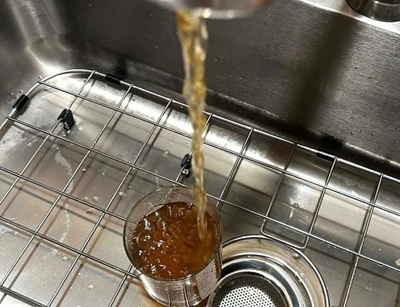
Discolored water runs from the tap at a home in Austin’s Colony neighborhood. Credit: Bianca Guerrero
For over a decade, residents of Austin's Colony, an unincorporated neighborhood outside Austin's city service area, have complained about tap water that is discolored and extremely hard.
After investigating, researchers from the University of Texas at Austin have concluded that the residents’ tap water is contaminated with lead, arsenic and other substances at levels that sometimes exceed state and international standards—even though the water meets regulatory requirements at its source.
Interestingly, the contamination appears to happen after the water—which is supplied from three different sources by a private water company—is mixed together in the neighborhood’s water system.
Uncovering the source
Austin's Colony draws its water from three separate sources: wells within the neighborhood itself, wells in the nearby city of Manor, and wells tapping the Carrizo-Wilcox Aquifer in Burleson County. Most households involved in the study receive a mix of two or three water sources, depending on their location.
Data from the Texas Commission on Environmental Quality showed that water from each of the three sources met regulatory standards—and it still met those standards when it reached the neighborhood's water entry points.
The contamination problem, researchers found, develops only after that point—once the water from multiple sources mixes inside the community's private plumbing system.
For the study, published in PLOS Water, researchers analyzed 81 water samples collected from eight households in the neighborhood between April 2024 and October 2025. Three of the samples were visibly discolored, and eight—including all three discolored ones—contained contaminant levels above state standards. Additionally, according to study results, three samples had lead levels exceeding the Texas limit of 15 parts per billion, and three others surpassed the World Health Organization's stricter standard of 10 parts per billion.
The team also found lead, manganese and iron suspended as particles in the water, a sign of corrosion building up inside pipes over time. The researchers say that buildup appears to periodically break loose, which would explain why residents experience discolored water only intermittently rather than constantly.
In addition to the contaminants, the researchers also determined that Austin’s Colony and Manor wells are sources of hard water, with both having high calcium and magnesium levels. Hard water issues could be mitigated by reducing water use from these sources and using more water from the Carrizo-Wilcox Aquifer, which has lower levels of these elements.
The researchers also found that household water treatment systems were effective at removing the contaminants and the minerals associated with hard water. However, these systems can be expensive and many households lack them. Even so, of the 100 households surveyed in the study, 70 said they had experienced discolored water and 71 already have a water treatment system installed.
Community partnership
The study was part of the UT BRIDGES program, which brings together UT faculty members and Austin community members for research projects that can benefit local residents.
“The community members are not just a research subject, but they’re also participants. They play an active role in the process,” said the study’s lead author David Bahamón-Pinzón, a research coordinator at the UT Jackson School of Geosciences. “This research is a participatory approach in collaboration between the university, the community organization and the residents.”
Resident Bianca Guerrero, who assisted with sample collection and community organizing, said the research helps validate the water issues that the community has been dealing with for years.
“With this paper finally coming out, one that’s academic and peer-reviewed, we finally have something that carries some weight,” she said. “Our words and what we’re going through should carry weight, but we’re not going to get anywhere unless we have something that’s based on science.”
Researchers and community members plan to use the findings to push for change.
Kelly Haragan, director of the Environmental Clinic at the UT School of Law, said students there are now helping residents weigh their options, which range from filing regulatory complaints to drafting legislation or even pursuing litigation.