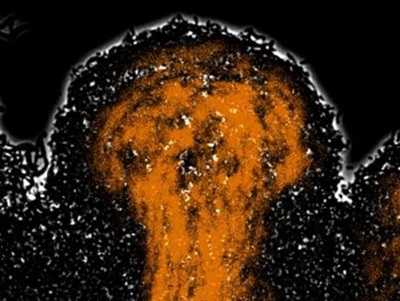
A community of hay bacillus bacteria ejects a group of mobile cells (shown in orange) with the potential to swim away and colonize in a new location. Credit: Süel Lab, UC San Diego
For the first time, researchers have documented the biofilm ejection phenomenon of a bacterium.
Previous views held that biofilms facing death simply dissolve and fade away. This study showed that, at the end of their life cycles, bacterial biofilms forcefully eject specific cells from the community as a survival mechanism.
“The biofilm senses that it is in trouble so it shoots cells out of the community like an escape pod,” said Gürol Süel, molecular biology professor at UC San Diego.
After capturing biofilm images at single-cell resolution, mathematical modeling allowed the researchers to deconstruct the physics of the ejection process, which was previously hidden.
They determined that the mechanical forces behind ejection are a self-generated network of polymers, known as hydrogels. Specifically, the production of a polymer comprised of poly-y-glutamic acid (y-PGA) forms a hydrogel, which can absorb 1,000 times its weight in water. The swelling of y-PGA propels interior cells through the outer layers to break free from the biofilm.
The researchers say the ejection capability allows a biofilm facing nutrient starvation or other threats to ensure that the community can survive by releasing mobile cells that have the potential to swim away and colonize a new location.
After breaking down the details of the ejection process, the researchers confirmed their findings by controlling and manipulating the function through genetics and chemical reactions. Importantly, the team showed that they can force the biofilm to rupture by overproducing y-PGA.
Since bacterial biofilms are highly resistant to antibiotics, posing a rising public health threat, forcing biofilms to rupture has potential for future applications as a novel method of eliminating harmful bacterial communities without the use of drugs.
The results could also be useful in conceptually understanding the spread of cancer, since tumors share features with bacterial biofilms, including metastasis.
Data from UCSD