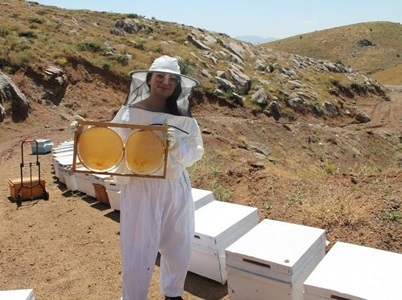
Fulya extracting multifloral honey from a field site. Credit: Fulya Kavak
Honey is already well known in the medical and cosmetic industries for its antioxidant, antimicrobial, anti-inflammatory and wound-healing properties. In fact, sterile honey-derived medical products already exist in the form of dressings, gels and ointments for burns and difficult-to-heal wounds.
Now, a team of researchers from Italy have shown that multifloral honey is a promising candidate for protecting human skin cells from premature aging and cell damage caused by UV radiation.
For this study, the team grew cultures of the cells that make up human skin. Before exposing the cultures to UV radiation, some of the cells were treated with 1% multifloral honey for 48 hours.
According to the study results, 1% multifloral honey pretreatment appeared to support a protective and regulatory response against UV-induced stress in both skin stem cells and fibroblasts. In these cells, honey treatment also reduced nitric oxide release and increased antioxidant capacity.
From the team’s genetic analysis, they discovered that the honey helped to regulate cell proliferation and renewal signals and increased expression of cell stress protection genes.
“What was particularly interesting was that honey seemed to help the cells find a healthier balance after UV stress,” said Fikiye Fulya Kavak, study author and member of the research team. “Rather than pushing the cells into an exaggerated repair response, it appeared to support protective mechanisms while keeping renewal-related signals under control.”
The team’s research is still ongoing, and they are further exploring the molecular mechanisms at work.
“We have been working on protein-level validation studies to confirm whether the molecular changes observed at the mRNA level are also reflected at the protein level,” said Kavak.
This knowledge could contribute to the development of new cosmetic or clinical skin formulations, especially if the active properties of honey can be delivered in a controlled and biocompatible way, such as through a nanofiber-based system—which the team is currently developing.
Data from Society for Experimental Biology