A rotational rheometer, also known as a shear rheometer, is an instrument used to determine how a liquid or slurry flows. Rotational rheometers can measure viscosity, thixotropy, shear stress, and shear strain. Used is the plastics, petroleum, cosmetic, food, and pharmaceutical industries, rotational rheometers help to maintain parameters such as consistency and fluidity, which in turn allow predictions to be made about stability, texture, and shelf life. Rotational rheometers apply a known force to the sample and measure how it reacts to the force and the force the sample then exerts on the rheometer.
Features that can vary between rotational rheometers include viscosity ranges measured, whether or not there is a built in temperature probe, and the user friendliness of the controls and read out screen.
Discover and compare Rotational Rheometers:
|  |  |
| Company | Waters Corporation | Waters Corporation |
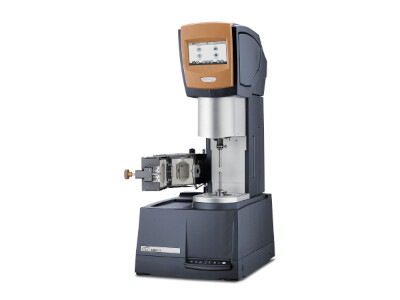
| Item | Waters TA Instruments™ ARES-G3™ Rheometer | Waters TA Instruments™ Auto-Trim Accessory |
| Catalog Number | ARES-G3 | |
| Price | | |
| Description | The advanced Waters TA Instruments ARES-G3 Rheometer pushes rheology further, delivering sharper data across more conditions. Building upon 55 years of rheology innovation, the ARES-G3 Rheometer’s cutting-edge technology and precision hardware capture real fluid behavior with fewer adjustments and The advanced Waters TA Instruments ARES-G3 Rheometer pushes rheology further, delivering sharper data across more conditions. Building upon 55 years of rheology innovation, the ARES-G3 Rheometer’s cutting-edge technology and precision hardware capture real fluid behavior with fewer adjustments and more accurate outcomes.
The ARES-G3 Rheometer features a modular design and high-performance core, offering a scalable platform that evolves with research and quality control needs.
-
Faster workflows can accelerate routine testing and data procession, helping improve lab efficiency
-
Expanded testing capabilities add support for solid material testing and advanced viscoelastic measurements
-
Enhanced data acquisition help capture more detailed, simultaneous data for deeper material insights
-
Advanced control features enable complex deformation profiles and waveform customization for cutting-edge research
... Read More | The auto-trim accessory for the DHR simplifies polymer melt rheology by automating the sample heating and trimming process. Instead of opening the furnace to manually trim samples during tests, users can simply attach the accessory, load their sample, and hit start to run the experiment to The auto-trim accessory for the DHR simplifies polymer melt rheology by automating the sample heating and trimming process. Instead of opening the furnace to manually trim samples during tests, users can simply attach the accessory, load their sample, and hit start to run the experiment to completion. TA’s proprietary technology automatically conditions the sample, adjusts the gap, and trims the sample at the appropriate time during the test without any operator intervention. As a result, operator walk-away time is increased by 80%, new user training is reduced from 2 weeks down to 30 minutes, and adverse operator influence on the results is greatly reduced. By saving valuable operator time without sacrificing data consistency, the auto-trim accessory provides return on investment in less than 2 years. The auto-trim accessory empowers your lab to run more tests with confidence, accelerating product development and time to market.
What will you accomplish with 80% more operator free time?
Features and Benefits
- Increases operator walk-away time by 80%, requiring less than two minutes of operator time per test with fully-programmed test methods.
- Excellent data consistency through automatic removal of excess material – Better data consistency than manual trimming, even when comparing data from an expert rheologist with results from multiple operators with limited experience
- Training time reduced from 2 weeks to under 30 minutes via plug and play accessories, while still achieving high quality data
- Realize the benefits of automation while maintaining the versatility to perform Dynamic Mechanical Analysis (DMA), extensional viscosity, and other rheological measurements thanks to SmartSwap technology.
- Eliminates the need to open the chamber during a test, preventing temperature fluctuations on the sample and maintaining the inert environment
- Suitable for testing pellets, disks, and flakes with no modification necessary
- Confirm pre-test process and trim quality with automatic before and after trimming photos from the optional ETC camera
... Read More |
| Torque Resolution | 1 nN.m | Inquire |
| Torque Range | 0.001 to 20 N | Inquire |
| Temperature Range | -150 °C to 600 °C (Forced Convection Oven, FCO),
-10 °C to 150 °C (Advanced Peltier System, APS) | 325 °C |
| Frequency Range | 1 x 10⁻⁷ rad/s to 628 rad/s | Inquire |
| Get Quote | | |