Biological safety cabinets (biosafety cabinets) come in several classes (I, II, and III) that offer varying levels of protection from hazardous or contagious materials. For all classes of biological safety cabinet, the air is HEPA (high efficiency particulate air)-filtered before being released as exhaust. A Class I biosafety cabinet is designed to protect the user and the environment, not the sample as negative pressure is used to pull outside air in across the workspace.
Class II biological safety cabinets are divided into four subtypes (A1, A2, B1, and B2) and have the additional feature of protecting the sample as the air supply is HEPA-filtered before passing over the workspace. The Class II subtypes differ in the amount of recirculated air within the cabinet.
Class III biosafety cabinets (also known as gloveboxes) provide maximum protection for work in biosafety level 4 containment labs. A class III biosafety cabinet is a hermetically-sealed glovebox with access through a dunk tank or double-door box that allows for decontamination.
| 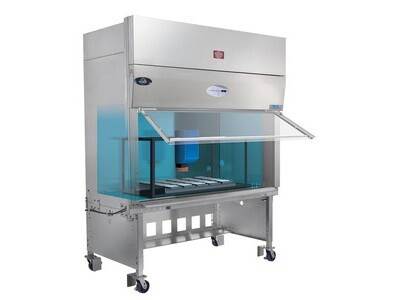 |  |
| Company | NuAire | NuAire |
| Item | LabGard NU-S543 Custom Lab Automation Enclosure | LabGard ES AIR Limited NU-545 Class II, Type A2 Biosafety Cabinet |
| Citations | | |
| Catalog Number | NU-S543 | NU-545 |
| Price | Inquire | Inquire |
| Class/Type | Inquire | Class II, Type A2 |
| Air Inflow Rate | Inquire | 105 fpm (0.53 m/s) |
| Size(s) | Inquire | 3, 4, 5, 6-foot (0.9, 1.2, 1.5, 1.8-meter) |
| Recirculated/Exhausted Air | Inquire | 70% / 30% |
| Exterior Dimensions | Inquire | Varies with model |
| Interior Dimensions | Inquire | Varies with model |
| Description | The LabGard NU-S543 is designed with custom dimensions to enclose your lab automation equipment while surrounding it with enough space for proper airflow. Furthermore, a reinforced work surface and hinged window facilitate the installation of your device, while cord pass-throughs in the side walls The LabGard NU-S543 is designed with custom dimensions to enclose your lab automation equipment while surrounding it with enough space for proper airflow. Furthermore, a reinforced work surface and hinged window facilitate the installation of your device, while cord pass-throughs in the side walls allow you to connect any external data or power cables your instrument requires. Contact NuAire to request a tailor-made biosafety cabinet for your lab’s specific needs.... Read More | The LabGard® ES (Energy Saver) AIR Limited Model NU-545 Biological Safety Cabinet (BSC) is a primary engineering control in obtaining the optimum product quality while reducing the potential for exposure of both product and personnel to airborne biological or particulate chemical agents in low to The LabGard® ES (Energy Saver) AIR Limited Model NU-545 Biological Safety Cabinet (BSC) is a primary engineering control in obtaining the optimum product quality while reducing the potential for exposure of both product and personnel to airborne biological or particulate chemical agents in low to moderate risk-hazard research and drug preparation or product operations, as prescribed by the Center for Disease Control (CDC) Atlanta, Georgia.... Read More |
| Get Quote | Inquire | Inquire |