|  |  |  |  |
| Company | RETSCH | RETSCH | RETSCH | RETSCH |
| Item | Ultra Centrifugal Mill ZM 200 | Knife Mill GRINDOMIX GM 300 | Mortar Grinder RM 200 | XRD-Mill McCrone Laboratory Mill |
| Citations | | | | |
| Catalog Number | ZM 200 | GM 300 | RM 200 | MCCrone |
| Price | | | | |
| Description | The Ultra Centrifugal Mill ZM 200 is a high speed rotor mill with unmatched performance. It is used for the rapid size reduction of soft to medium-hard and fibrous materials.
Because of the efficient size reduction technique the ZM 200 ensures the gentle preparation of analytical samples in a very The Ultra Centrifugal Mill ZM 200 is a high speed rotor mill with unmatched performance. It is used for the rapid size reduction of soft to medium-hard and fibrous materials.
Because of the efficient size reduction technique the ZM 200 ensures the gentle preparation of analytical samples in a very short time. The comprehensive range of accessories including a large variety of ring sieves and rotors as well as collection systems makes the Ultra Centrifugal Mill a versatile instrument that can be easily adapted to varying applications. The optional Vibratory Feeder is load-controlled via an interface and ensures a uniform grind at maximum output rate. With thousands of installations, the ZM 200 has become a standard for food and feeds, for the chemical industry as well as for agricultural testing.
Features - Powerdrive with optimally matched frequency converter and 3-phase motor
- Comfortable parameter setting via display and ergonomic 1-button operation
- Wide range of accessories including various collection and feeding systems, rotors and sieves
- Gentle and very rapid size reduction by pre- and fine grinding in one run
- Wide speed range
- Patented cassette system for maximum sample recovery and easy cleaning
- Easily exchangeable grinding and sieve inserts
- Defined final fineness due to ring sieves sieves with aperture sizes from 0.08 - 10 mm
- Comfortable safety housing with automatic cover closure
- Motor compartment and electronics protected against dust and material penetration
... Read More | The new knife mill GRINDOMIX GM 300 is the ideal instrument for the grinding and homogenization of foodstuffs. It allows to process sample volumes up to 4.5 liters quickly and reproducibly.
With four sharp, robust blades and a powerful motor which can reach temporary peaks of 3 kW, it is ideal for The new knife mill GRINDOMIX GM 300 is the ideal instrument for the grinding and homogenization of foodstuffs. It allows to process sample volumes up to 4.5 liters quickly and reproducibly.
With four sharp, robust blades and a powerful motor which can reach temporary peaks of 3 kW, it is ideal for homogenizing substances with a high water, oil or fat content as well as for grinding dry, soft and medium-hard products. The GRINDOMIX GM 300 meets and exceeds all special laboratory and analytical requirements and is a professional device superior to any commercial household mixer.
Features - Efficient size reduction of up to 4,500 ml feed quantity due to a powerful 1.1 kW motor (peak power input >3 kW)
- Pre- and fine-grinding in one mill: cutting action in regular mode, grinding by impact in reverse mode, pre-grinding in interval mode
- All parts which come into contact with the sample material are autoclavable
- Perfect adaptation to application requirements by variable speed from 500 to 4,000 min-1 with an increment of 100 min-1
- Optional gravitation lid for automatic reduction of the grinding chamber volume
- 10 SOPs can be stored
- Grinding jar in plastic and stainless steel available
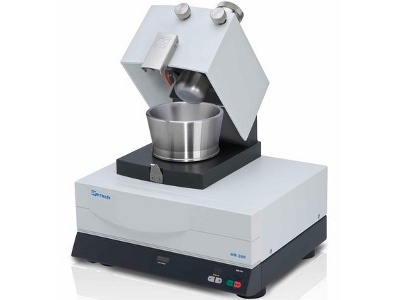
... Read More | The Mortar Grinder RM 200 can mix and homogenize powders, suspension and pastes even with high viscosity. The RM 200 is suitable for the proper and reproducible sample preparation to analytical fineness.
It substitutes cumbersome hand mortars by a high performance drive with electronic control. TheThe Mortar Grinder RM 200 can mix and homogenize powders, suspension and pastes even with high viscosity. The RM 200 is suitable for the proper and reproducible sample preparation to analytical fineness.
It substitutes cumbersome hand mortars by a high performance drive with electronic control. The grinding set can be cooled and heated and is very easy to clean. Grinding sets of various material qualities are available which can be exchanged easily for optimum adaptation to various grinding tasks.
Features - Dry, wet and cryogenic grinding
- Reproducible results due to adjustable pestle and scraper pressure
- Closed, dust tight grinding chamber with windows
- Easy exchange of mortar and pestle without tools
- Performance display for load cotrol
- Adjustable pestle and scraper pressure
- Wide range of materials for contamination free grinding
- 3 scraper materials (vulkollan, beech wood, PTFE)
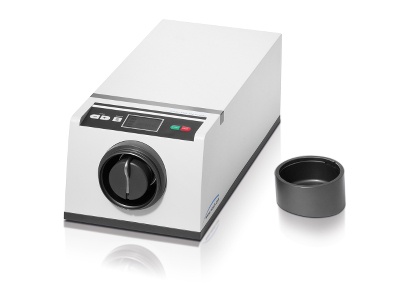
... Read More | The XRD-Mill McCrone was specially developed for the preparation of samples for subsequent X-ray diffraction (XRD). The mill is used for applications in geology, chemistry, mineralogy and materials science, quality control as well as R&D. Because of its unique grinding motion, the XRD-Mill McCrone The XRD-Mill McCrone was specially developed for the preparation of samples for subsequent X-ray diffraction (XRD). The mill is used for applications in geology, chemistry, mineralogy and materials science, quality control as well as R&D. Because of its unique grinding motion, the XRD-Mill McCrone is particularly effective for this analytical method: The 48 cylindrical grinding elements grind the samples gently via friction. The result is a short grinding time with almost no sample loss and an exceptionally narrow particle size distribution. The crystal lattice is almost entirely preserved during grinding operation, a pre-requisite for meaningful X-ray diffraction results.
Features: - Crystal lattice preserved during grinding operation
- Very narrow and reproducible particle size distribution
- Minimal cross contamination
- Compact, bench-top sized model
- Suitable for dry and wet grinding
... Read More |
| Principle | Impact and Shearing | Cutting | Pressure and Friction | Friction |
| Sample Size | < 10 mm | ~ 130 mm | < 8 mm | <0.5 mm |
| Sample Type | Soft, Medium-Hard, Brittle or Fibrous | Soft, Medium-Hard, Elastic, Containing Water/Fat/Oil, Dry or Fibrous | Soft, Hard, Brittle or Pasty | Medium-hard, Hard, Brittle, Fibrous |
| Applications | Fine Grinding: Agriculture, Biology, Chemistry / Plastics, Construction Materials, Engineering / Electronics, Environment / Recycling, Food, Geology / Metallurgy, Medicine / Pharmaceuticals | Size Reduction, Homogenization and Mixing: Agriculture, Biology, Food, Medicine / Pharmaceuticals | Grinding, Mixing and Triturating - Dry and Wet: Agriculture, Biology, Chemistry / Plastics, Construction Materials, Food, Geology / Metallurgy, Glass / Ceramics, Medicine / Pharmaceuticals | Grinding, Mixing and Triturating, Dry and Wet |
| Speed | 6,000 to 18,000 min-1 | 500 to 4000 min-1 | 100 min-1 | 1000 to 1500 min-1 |
| Rotor Type | 6, 12 or 24 tooth rotor, 8 tooth mini-rotor | Stainless steel knife, knife with titanium-niob coating | mortar and pestle | <0.5 mm |
| Final Fineness | < 80 nm | < 300 um | < 10 um | <1 µm |
| Get Quote | | | | |