Laboratory mills, used primarily for sample prep prior to analysis, use particle size reduction (comminution) to grind or homogenize wet, dry, hard, soft, elastic, brittle, and fibrous materials. Mills and grinders are used in labs in widely varying scientific areas, including chemistry, pharmaceuticals, food analysis, materials testing, and life science. Disk, hammer, mortar, planetary ball, rotor, and cutting mills are available to achieve coarse, mid-range, and fine results, all the way down to the nano range, <0.1 µm. Cryogenic mills, or freezer mills, are a type of unit that freezes a material prior to reducing its particle size.
What to consider when choosing a laboratory mill?
When purchasing a mill, power, speed, and cleanability are useful parameters; however, it is also important to keep in mind the instrument’s throughput, reproducibility, and yield, as well as the option of a cooling system, if necessary.
Compare and request a quote for laboratory mills from various manufacturers:
|  |  |  |  |
| Company | RETSCH | RETSCH | RETSCH | RETSCH |
| Item | Ultra Centrifugal Mill ZM 200 | CryoMill | Cyclone Mill TWISTER | Rotor Beater Mill SR 300 |
| Citations | | | | |
| Figures | | | | |
| Catalog Number | ZM 200 | CryoMill | Twister | SR 300 |
| Price | | | | |
| Description | The Ultra Centrifugal Mill ZM 200 is a high speed rotor mill with unmatched performance. It is used for the rapid size reduction of soft to medium-hard and fibrous materials.
Because of the efficient size reduction technique the ZM 200 ensures the gentle preparation of analytical samples in a very The Ultra Centrifugal Mill ZM 200 is a high speed rotor mill with unmatched performance. It is used for the rapid size reduction of soft to medium-hard and fibrous materials.
Because of the efficient size reduction technique the ZM 200 ensures the gentle preparation of analytical samples in a very short time. The comprehensive range of accessories including a large variety of ring sieves and rotors as well as collection systems makes the Ultra Centrifugal Mill a versatile instrument that can be easily adapted to varying applications. The optional Vibratory Feeder is load-controlled via an interface and ensures a uniform grind at maximum output rate. With thousands of installations, the ZM 200 has become a standard for food and feeds, for the chemical industry as well as for agricultural testing.
Features - Powerdrive with optimally matched frequency converter and 3-phase motor
- Comfortable parameter setting via display and ergonomic 1-button operation
- Wide range of accessories including various collection and feeding systems, rotors and sieves
- Gentle and very rapid size reduction by pre- and fine grinding in one run
- Wide speed range
- Patented cassette system for maximum sample recovery and easy cleaning
- Easily exchangeable grinding and sieve inserts
- Defined final fineness due to ring sieves sieves with aperture sizes from 0.08 - 10 mm
- Comfortable safety housing with automatic cover closure
- Motor compartment and electronics protected against dust and material penetration
... Read More | The CryoMill is a laboratory ball mill specifically designed for this application. It features an integrated cooling system which continually cools the grinding jar with liquid nitrogen before and during the grinding process. Thus, the sample is embrittled and volatile components are preserved.
The The CryoMill is a laboratory ball mill specifically designed for this application. It features an integrated cooling system which continually cools the grinding jar with liquid nitrogen before and during the grinding process. Thus, the sample is embrittled and volatile components are preserved.
The liquid nitrogen is continually supplied from an autofill system in the exact amount required to keep the temperature at –196 °C. The CryoMill's versatility makes it the ideal grinder for sample quantities up to 20 ml.- powerful grinding by impact and friction with up to 30 Hz
- pulverization of two samples down to 5 micron
- The user never comes into direct contact with LN2 which ensures a high degree of operational safety
- adapter for keeping 2 ml plastic tubes or 2 ml steel tubes available
- special jar zirconium oxide available for heavy-metal free grinding
- suitable forgrinding in interval
- 3 different grinding modes (dry, wet or cryogenic)
- memory for 9 SOPs
- Screw-Top jars
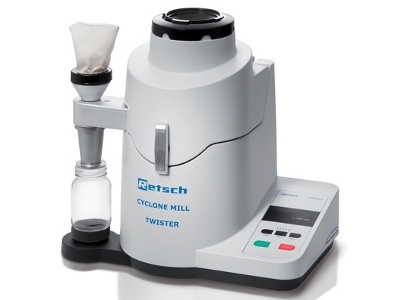
... Read More | The cyclone mill TWISTER is specially designed for the processing of foods and feeds for subsequent NIR analysis. The optimized form of rotor and grinding chamber generates an air jet which carries the ground sample through the integrated cyclone into the sample bottle. The air jet prevents the The cyclone mill TWISTER is specially designed for the processing of foods and feeds for subsequent NIR analysis. The optimized form of rotor and grinding chamber generates an air jet which carries the ground sample through the integrated cyclone into the sample bottle. The air jet prevents the material from heating up, thus preserving the moisture content.
The provided sieves guarantee an optimum particle size distribution so that it is not necessary to recalibrate the NIR spectrometer. The rotor speed can be adjusted in 3 steps allowing for perfect adaptation to the sample requirements. Cleaning the mill is quick and easy as the air jet effects a complete discharge of the material from the grinding chamber.
This new cyclone mill in proven RETSCH quality optimizes the reproducible sample preparation to NIR analysis thus allowing for meaningful and reliable analysis results.
Features - Ideal for grinding feeds, grains, forage and other similar products
- 3 controlled speeds
- Cyclone separator with 250 ml collecting bottle for quick extraction of sample
- No cross contamination thanks to easy cleaning
- Convenient operating panel
- Professional industrial design with long lifetime
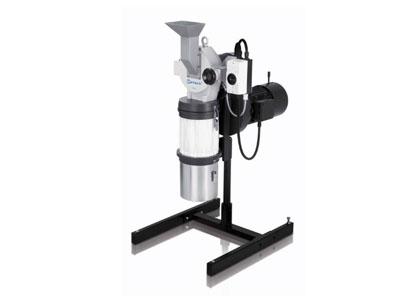
... Read More | The Rotor Beater Mill SR 300 is suitable for coarse and fine size reduction, either in batches or continuously. It can process dry, soft, medium-hard, organic and inorganic substances.
Its high speed in comparison to the SR 200 allows a significantly higher throughput and fineness.
The SR 300 isThe Rotor Beater Mill SR 300 is suitable for coarse and fine size reduction, either in batches or continuously. It can process dry, soft, medium-hard, organic and inorganic substances.
Its high speed in comparison to the SR 200 allows a significantly higher throughput and fineness.
The SR 300 is intended for universal use: from sample preparation in laboratories up to preparing sample batches in pilot plants or production facilities. The grinding chamber, the feed hopper and the material inlet are completely made from high quality stainless steel.
Features
- Suitable for batchwise operation of larger quantities
- Central locking device
- Wide range of accessories including various collection and feeding systems, rotors and sieves
- High final fineness
- Exchangeable grinding and sieve inserts
- Grinding chamber, feed hopper and material inlet and outlet of stainless steel
- Optional grinding inserts 180° for grinding of hard-brittle materials by additional impact
- Optional distance rotor to reduce frictional heat
- Removable hopper for easy cleaning
- Motor brake
- Defined final fineness due to bottom sieves with aperture sizes from 0.08 - 10 mm
... Read More |
| Principle | Impact and Shearing | Impact and Friction | Impact and Friction | Impact and Shearing |
| Sample Size | < 10 mm | ≤8 mm | <10 mm | < 15 mm |
| Sample Type | Soft, Medium-Hard, Brittle or Fibrous | Hard, Medium-Hard, Soft, Brittle, Elastic or Fibrous | Fibrous or Soft | Soft or Medium-Hard |
| Applications | Fine Grinding: Agriculture, Biology, Chemistry / Plastics, Construction Materials, Engineering / Electronics, Environment / Recycling, Food, Geology / Metallurgy, Medicine / Pharmaceuticals | mechanochemistry, mechanical alloying, size reduction, mixing, homogenization, cryogenic grinding; agriculture, biology, chemistry / plastics, construction materials, engineering / electronics, environment / recycling, food, geology / metallurgy, glass / ceramics, medicine / pharmaceuticals, cell disruption | Grinding Prior to NIR Analysis: Agriculture, Foods / Feeds, Medicine / Pharmaceuticals | Size Reduction and Deagglomeration: Agriculture, Chemistry / Plastics, Construction Materials, Environment / Recycling, Food, Medicine / Pharmaceuticals |
| Speed | 6,000 to 18,000 min-1 | 3 to 30 Hz | 10,000 to 14,000 min-1 | 8100 or 9700 min-1 |
| Rotor Type | 6, 12 or 24 tooth rotor, 8 tooth mini-rotor | grinding jar and balls | TWISTER rotor | Rotor Beater, Standard and Distance |
| Final Fineness | < 80 nm | ~ 5 um | < 500 um | < 50 um |
| Get Quote | | | | |