|  |  |  |  |
| Company | RETSCH | RETSCH | RETSCH | RETSCH |
| Item | Ultra Centrifugal Mill ZM 200 | High Energy Ball Mill Emax | Planetary Ball Mill PM 300 | XRD-Mill McCrone Laboratory Mill |
| Citations | | | | |
| Catalog Number | ZM 200 | Emax | PM 300 | MCCrone |
| Price | | | | |
| Description | The Ultra Centrifugal Mill ZM 200 is a high speed rotor mill with unmatched performance. It is used for the rapid size reduction of soft to medium-hard and fibrous materials.
Because of the efficient size reduction technique the ZM 200 ensures the gentle preparation of analytical samples in a very The Ultra Centrifugal Mill ZM 200 is a high speed rotor mill with unmatched performance. It is used for the rapid size reduction of soft to medium-hard and fibrous materials.
Because of the efficient size reduction technique the ZM 200 ensures the gentle preparation of analytical samples in a very short time. The comprehensive range of accessories including a large variety of ring sieves and rotors as well as collection systems makes the Ultra Centrifugal Mill a versatile instrument that can be easily adapted to varying applications. The optional Vibratory Feeder is load-controlled via an interface and ensures a uniform grind at maximum output rate. With thousands of installations, the ZM 200 has become a standard for food and feeds, for the chemical industry as well as for agricultural testing.
Features - Powerdrive with optimally matched frequency converter and 3-phase motor
- Comfortable parameter setting via display and ergonomic 1-button operation
- Wide range of accessories including various collection and feeding systems, rotors and sieves
- Gentle and very rapid size reduction by pre- and fine grinding in one run
- Wide speed range
- Patented cassette system for maximum sample recovery and easy cleaning
- Easily exchangeable grinding and sieve inserts
- Defined final fineness due to ring sieves sieves with aperture sizes from 0.08 - 10 mm
- Comfortable safety housing with automatic cover closure
- Motor compartment and electronics protected against dust and material penetration
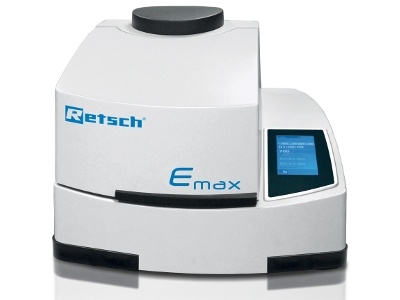
... Read More | The High Energy Ball Mill Emax from Retsch achieves fine particles in the nanometer range through high friction and impact, while maintaining a narrow particle size distribution through thorough sample mixture. This mill not only reduces grinding time, but also removes the need to cool down. The The High Energy Ball Mill Emax from Retsch achieves fine particles in the nanometer range through high friction and impact, while maintaining a narrow particle size distribution through thorough sample mixture. This mill not only reduces grinding time, but also removes the need to cool down. The High Energy Ball Mill Emax can be used across various application fields including agriculture, biology, chemistry, environmental, geology, pharmaceuticals, and more.
Features : - faster and finer grinding than any other ball mills
- speed of 2000 min-1
- unique water cooling system
- temperature-controlled grinding
- narrow particle size distribution
- patented drive concept
- range of jar materials allow for contamination free grinding
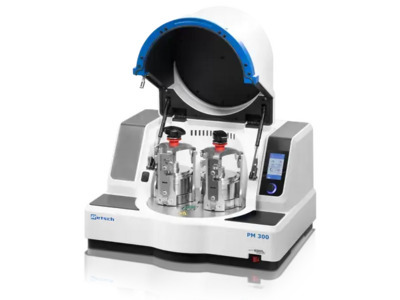
... Read More | The Planetary Ball Mill PM 300 is a powerful and ergonomic benchtop model with two grinding stations for grinding jar volumes up to 500 ml. This setup allows for processing up to 2 x 220 ml sample material per batch. Thanks to the high maximum speed of 800 rpm, extremely high centrifugal forces The Planetary Ball Mill PM 300 is a powerful and ergonomic benchtop model with two grinding stations for grinding jar volumes up to 500 ml. This setup allows for processing up to 2 x 220 ml sample material per batch. Thanks to the high maximum speed of 800 rpm, extremely high centrifugal forces result in very high pulverization energy and consequently in short processing times. The PM 300 is ideally suited for virtually all industries where the quality control process places the highest demands on purity, speed, fineness and reproducibility. Thanks to its enormous energy input of up to 64.4 times the acceleration of gravity, this mill is the perfect choice for tasks in research like mechanochemistry (mechanosynthesis, mechanical alloying and mechano-catalysis), or for ultrafine colloidal grinding on a nanometer scale.- powerful grinding by impact and friction with up to 800 rpm
- pulverization of two samples down to 100 nm
- jars from 12-500 ml
- adapter for keeping 2 ml gas chromatography glass vials for cocrystal screening
- high energy input of up to 64.4 g
- suitable for mechanochemistry applications and mechanical alloying
- Ergonomic clamping unit with smooth surfaces
- Automatic grinding chamber ventilation with directed air stream for perfect jar cooling
- The Safety Slider prevents starting the machine without securely clamped jars, perfect stability on the lab bench thanks to FFCS -technology
- Comfortable parameter setting via Touch display
- 2 different grinding modes (dry, wet)
- memory for 12 SOPs and 4 program cycles
- 5 different jar materials
jars of 12 – 80 ml can be stacked (two jars each)
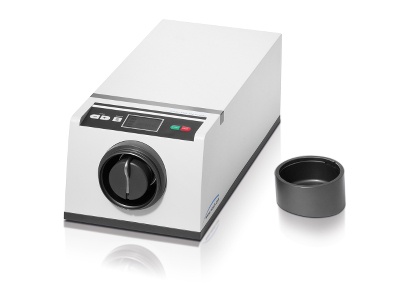
... Read More | The XRD-Mill McCrone was specially developed for the preparation of samples for subsequent X-ray diffraction (XRD). The mill is used for applications in geology, chemistry, mineralogy and materials science, quality control as well as R&D. Because of its unique grinding motion, the XRD-Mill McCrone The XRD-Mill McCrone was specially developed for the preparation of samples for subsequent X-ray diffraction (XRD). The mill is used for applications in geology, chemistry, mineralogy and materials science, quality control as well as R&D. Because of its unique grinding motion, the XRD-Mill McCrone is particularly effective for this analytical method: The 48 cylindrical grinding elements grind the samples gently via friction. The result is a short grinding time with almost no sample loss and an exceptionally narrow particle size distribution. The crystal lattice is almost entirely preserved during grinding operation, a pre-requisite for meaningful X-ray diffraction results.
Features: - Crystal lattice preserved during grinding operation
- Very narrow and reproducible particle size distribution
- Minimal cross contamination
- Compact, bench-top sized model
- Suitable for dry and wet grinding
... Read More |
| Principle | Impact and Shearing | Impact and Friction | Impact and Friction | Friction |
| Sample Size | < 10 mm | < 5 mm | ≤10 mm | <0.5 mm |
| Sample Type | Soft, Medium-Hard, Brittle or Fibrous | Medium-hard, hard, brittle, fibrous - dry or wet | Hard, Medium-Hard, Soft, Brittle, Fibrous | Medium-hard, Hard, Brittle, Fibrous |
| Applications | Fine Grinding: Agriculture, Biology, Chemistry / Plastics, Construction Materials, Engineering / Electronics, Environment / Recycling, Food, Geology / Metallurgy, Medicine / Pharmaceuticals | Nano grinding, size reduction, homogenizing, mechanical alloying, colloidal milling, high energy comminution | mechanochemistry, mechanical alloying, size reduction, mixing, homogenization, cryogenic grinding; agriculture, biology, chemistry / plastics, construction materials, engineering / electronics, environment / recycling, food, geology / metallurgy, glass / ceramics, medicine / pharmaceuticals, cocrystalscreening | Grinding, Mixing and Triturating, Dry and Wet |
| Speed | 6,000 to 18,000 min-1 | 300 to 2,000 min-1 | max 800 rpm | 1000 to 1500 min-1 |
| Rotor Type | 6, 12 or 24 tooth rotor, 8 tooth mini-rotor | Inquire | grinding jar and balls | <0.5 mm |
| Final Fineness | < 80 nm | < 80 nm | ~0.1 µm | <1 µm |
| Get Quote | | | | |