|  |  |  |  |
| Company | RETSCH | RETSCH | RETSCH | RETSCH |
| Item | Mortar Grinder RM 200 | High Energy Ball Mill Emax | Mixer Mill MM 500 Nano | Planetary Ball Mill PM 100 |
| Citations | | | | |
| Catalog Number | RM 200 | Emax | MM 500 nano | PM 100 |
| Price | | | | |
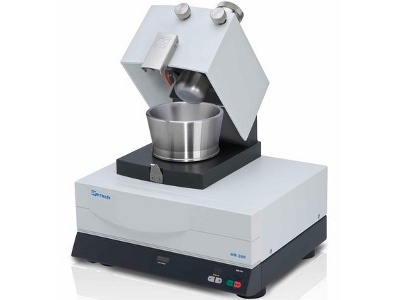
| Description | The Mortar Grinder RM 200 can mix and homogenize powders, suspension and pastes even with high viscosity. The RM 200 is suitable for the proper and reproducible sample preparation to analytical fineness.
It substitutes cumbersome hand mortars by a high performance drive with electronic control. TheThe Mortar Grinder RM 200 can mix and homogenize powders, suspension and pastes even with high viscosity. The RM 200 is suitable for the proper and reproducible sample preparation to analytical fineness.
It substitutes cumbersome hand mortars by a high performance drive with electronic control. The grinding set can be cooled and heated and is very easy to clean. Grinding sets of various material qualities are available which can be exchanged easily for optimum adaptation to various grinding tasks.
Features - Dry, wet and cryogenic grinding
- Reproducible results due to adjustable pestle and scraper pressure
- Closed, dust tight grinding chamber with windows
- Easy exchange of mortar and pestle without tools
- Performance display for load cotrol
- Adjustable pestle and scraper pressure
- Wide range of materials for contamination free grinding
- 3 scraper materials (vulkollan, beech wood, PTFE)
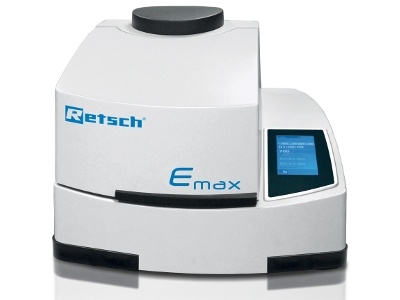
... Read More | The High Energy Ball Mill Emax from Retsch achieves fine particles in the nanometer range through high friction and impact, while maintaining a narrow particle size distribution through thorough sample mixture. This mill not only reduces grinding time, but also removes the need to cool down. The The High Energy Ball Mill Emax from Retsch achieves fine particles in the nanometer range through high friction and impact, while maintaining a narrow particle size distribution through thorough sample mixture. This mill not only reduces grinding time, but also removes the need to cool down. The High Energy Ball Mill Emax can be used across various application fields including agriculture, biology, chemistry, environmental, geology, pharmaceuticals, and more.
Features : - faster and finer grinding than any other ball mills
- speed of 2000 min-1
- unique water cooling system
- temperature-controlled grinding
- narrow particle size distribution
- patented drive concept
- range of jar materials allow for contamination free grinding
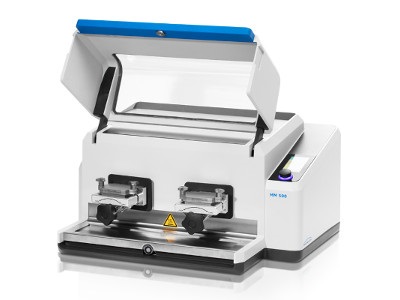
... Read More | The mixer mill MM 500 nano is a compact, versatile bench-top unit which has been developed specially for dry, wet and cryogenic grinding of up to 2 x 45 ml sample material within seconds. With a maximum frequency of 35 Hz, it generates enough energy to produce particles in the nanometer range. The The mixer mill MM 500 nano is a compact, versatile bench-top unit which has been developed specially for dry, wet and cryogenic grinding of up to 2 x 45 ml sample material within seconds. With a maximum frequency of 35 Hz, it generates enough energy to produce particles in the nanometer range. The robust high-performance drive makes the mill suitable for long-term grinding processes up to 99 hours. Hence, the MM 500 nano is the first mixer mill in the market to provide a real alternative to grinding in a planetary ball mill – with more comfortable handling and less warming effects. - powerful grinding by impact and friction with up to 35 Hz
- pulverization of two samples down to the nanometer range < 0.1 micron
- multi-cavity jars 2x 25 ml or 4 x 10 ml available
- adapter for keeping 2 ml plastic tubes or 2 ml steel tubes available
- suitable for long-term grinding processes up to 99 h
- suitable for mechanochemistry applications
- 3 different grinding modes (dry, wet or cryogenic)
- memory for 12 SOPs and 4 program cycles
- Screw-Lock jars, pressure-tight up to 5 bar
GrindControl to measure pressure and temperature available - grinding under inert gas (optional)
- jar design allows full use of the volume, also for wet grinding
- jars remain conveniently clamped for periodic sample extraction or visual checks
... Read More | Planetary Ball Mills are used wherever the highest degree of fineness is required. Apart from the classical mixing and size reduction processes, the mills also meet all the technical requirements for colloidal grinding and have the energy input necessary for mechanical alloying processes. The Planetary Ball Mills are used wherever the highest degree of fineness is required. Apart from the classical mixing and size reduction processes, the mills also meet all the technical requirements for colloidal grinding and have the energy input necessary for mechanical alloying processes. The extremely high centrifugal forces of the Planetary Ball Mills result in very high pulverization energy and therefore short grinding times.
The PM 100 CM is a convenient benchtop model with 1 grinding station. It operates in centrifugal mode mode, which leads to a more gentle size reduction process with less abrasion.
Features - Powerful and quick grinding down to nano range
- Perfect stability on lab bench thanks to FFCS technology
- Innovative counter weight and imbalance sensor for unsupervised operation
- Gentle grinding in centrifugal mode
- Comfortable parameter setting via display and ergonomic 1-button operation
- Automatic grinding chamber ventilation
- 10 SOPs can be stored
- Programmable starting time
- Power failure backup ensures storage of remaining grinding time
- Reproducible results due to energy and speed control
- Suitable for long-term trials and continuous use
- 2 different grinding modes (dry and wet)
- Optional pressure and temperature measuring system PM GrindControl
- Measurement of energy input
- Wide range of materials for contamination free grinding
- Safety Slider for safe operation
... Read More |
| Principle | Pressure and Friction | Impact and Friction | Impact and Friction | Impact and Friction |
| Sample Size | < 8 mm | < 5 mm | ≤10 mm | < 10 mm |
| Sample Type | Soft, Hard, Brittle or Pasty | Medium-hard, hard, brittle, fibrous - dry or wet | Hard, Medium-Hard, Soft, Brittle, Elastic or Fibrous | Soft, Hard, Brittle or Fibrous - Dry or Wet |
| Applications | Grinding, Mixing and Triturating - Dry and Wet: Agriculture, Biology, Chemistry / Plastics, Construction Materials, Food, Geology / Metallurgy, Glass / Ceramics, Medicine / Pharmaceuticals | Nano grinding, size reduction, homogenizing, mechanical alloying, colloidal milling, high energy comminution | mechanochemistry, mechanical alloying, size reduction, mixing, homogenization, cryogenic grinding; agriculture, biology, chemistry / plastics, construction materials, engineering / electronics, environment / recycling, food, geology / metallurgy, glass / ceramics, medicine / pharmaceuticals | Pulverizing, Mixing, Homogenizing and Colloidal Milling: Agriculture, Biology, Chemistry / Plastics, Construction Materials, Engineering / Electronics, Environment / Recycling, Geology / Metallurgy, Glass / Ceramics, Medicine / Pharmaceuticals |
| Speed | 100 min-1 | 300 to 2,000 min-1 | 3 to 35 Hz | 100 to 650 min-1 |
| Rotor Type | mortar and pestle | Inquire | grinding jar and balls | grinding jar and balls |
| Final Fineness | < 10 um | < 80 nm | ~0.1 µm | < 1 um or < 0.1 um for Colloidal Grinding |
| Get Quote | | | | |