|  |  |  |  |
| Company | RETSCH | RETSCH | RETSCH | RETSCH |
| Item | Vibratory Disc Mill RS 200 | Knife Mill Grindomix GM 200 | Mixer Mill MM 500 vario | XRD-Mill McCrone Laboratory Mill |
| Citations | | | | |
| Catalog Number | RS 200 | GM 200 | MM 500 vario | MCCrone |
| Price | | | | |
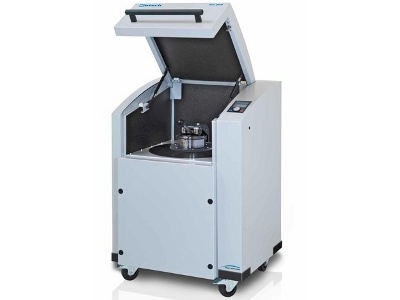
| Description | The Vibratory Disc Mill RS 200 is suitable for the extremely quick, loss-free and reproducible grinding of medium-hard, brittle and fibrous materials to analytical fineness. The instrument runs steadily and smoothly, even with heavy grinding sets, at maximum speed thanks to the new Stabilized-Plane-The Vibratory Disc Mill RS 200 is suitable for the extremely quick, loss-free and reproducible grinding of medium-hard, brittle and fibrous materials to analytical fineness. The instrument runs steadily and smoothly, even with heavy grinding sets, at maximum speed thanks to the new Stabilized-Plane-Drive.
With its robust design, the RS 200 has proven to be ideal for use in the building materials sector (cement), in geology, mineralogy, metallurgy and in power plants. Due to the high end fineness and speed the RS 200 is the perfect mill when it comes to preparing samples for spectral analysis.
Features - Reproducible results due to "Stabilized-Plane-Drive" (avoid tumbling of the grinding set)
- Safety interlock
- Variable speed 700 - 1,500 min-1
- Extremely short grinding time
- Agate recognition for automatic speed reduction
- 10 SOPs can be stored
- No sample loss thanks to optimum o-ring seal
- Wide range of materials for contamination free grinding
- Noise-insulated grinding chamber
- Quick-action grinding set clamping device
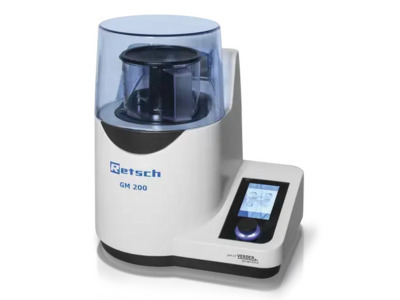
... Read More | The new knife mill GRINDOMIX GM 200 is the ideal instrument for the grinding and homogenization of foodstuffs. It allows to process sample volumes up to 1 liters quickly and reproducibly.
With two sharp, robust blades and a powerful motor which can reach temporary peaks of 1 kW, it is ideal for The new knife mill GRINDOMIX GM 200 is the ideal instrument for the grinding and homogenization of foodstuffs. It allows to process sample volumes up to 1 liters quickly and reproducibly.
With two sharp, robust blades and a powerful motor which can reach temporary peaks of 1 kW, it is ideal for homogenizing substances with a high water, oil or fat content as well as for grinding dry, soft and medium-hard products. The GRINDOMIX GM 200 meets and exceeds all special laboratory and analytical requirements and is a professional device superior to any commercial household mixer.
Features - Efficient size reduction of up to 700 ml feed quantity due to a powerful 1 kW motor
- Pre- and fine-grinding in one mill: cutting action in regular mode, grinding by impact in reverse mode, pre-grinding in interval mode
- All parts which come into contact with the sample material are autoclavable
- Perfect adaptation to application requirements by variable speed from 2,000 to 10,000 min-1
- CryoKit available for grinding embrittled or deeply frozen samples
- Optional gravitaty lid for automatic reduction of the grinding chamber volume
- Optional volume reduction lid available
- 8 SOPs and 4 sequences can be stored
- Grinding jar in plastic and stainless steel available
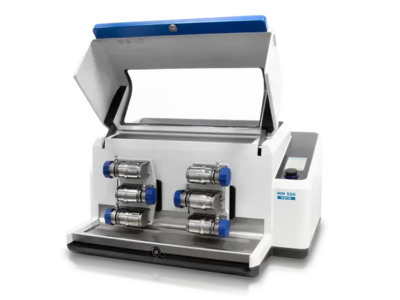
... Read More | The Mixer Mill MM 500 vario is a true multipurpose mill designed for dry, wet and cryogenic grinding of small volumes up to 6 x 20 ml. It mixes and homogenizes powders and suspensions with a frequency of 35 Hz within seconds – unbeatably fast and easy to operate. It is also very useful for The Mixer Mill MM 500 vario is a true multipurpose mill designed for dry, wet and cryogenic grinding of small volumes up to 6 x 20 ml. It mixes and homogenizes powders and suspensions with a frequency of 35 Hz within seconds – unbeatably fast and easy to operate. It is also very useful for mechanosynthesis applications and a grinding time up to 99 h. It is also the most suitable instrument for biological applications such as cell disruption for nucleic acids or protein extraction with a sample batch capacity of up to 50 samples- powerful grinding by impact and friction with up to 35 Hz
- pulverization of two samples down to 5 micron
- adapter for keeping 1.5, 2 or 5 ml plastic tubes or 2 ml steel tubes available
- adapter for keeping 4 x 50 ml conical tubes or 30 ml wide-mouth bottles available
- adapter for keeping 4 x 5 ml steel tubes available
- suitable for long-term grinding processes up to 8 h
- suitable for mechanochemistry applications
- 3 different grinding modes (dry, wet or cryogenic)
- memory for 8 SOPs and 4 program cycles
- Screw-Top jars from 5-50 ml
10 ml PMMA jars for RAMAN applications
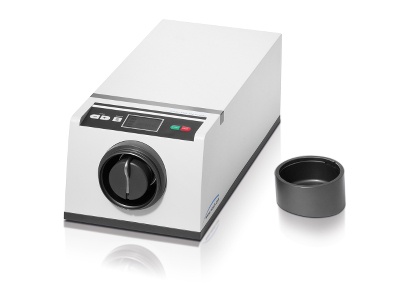
... Read More | The XRD-Mill McCrone was specially developed for the preparation of samples for subsequent X-ray diffraction (XRD). The mill is used for applications in geology, chemistry, mineralogy and materials science, quality control as well as R&D. Because of its unique grinding motion, the XRD-Mill McCrone The XRD-Mill McCrone was specially developed for the preparation of samples for subsequent X-ray diffraction (XRD). The mill is used for applications in geology, chemistry, mineralogy and materials science, quality control as well as R&D. Because of its unique grinding motion, the XRD-Mill McCrone is particularly effective for this analytical method: The 48 cylindrical grinding elements grind the samples gently via friction. The result is a short grinding time with almost no sample loss and an exceptionally narrow particle size distribution. The crystal lattice is almost entirely preserved during grinding operation, a pre-requisite for meaningful X-ray diffraction results.
Features: - Crystal lattice preserved during grinding operation
- Very narrow and reproducible particle size distribution
- Minimal cross contamination
- Compact, bench-top sized model
- Suitable for dry and wet grinding
... Read More |
| Principle | Pressure and Friction | Cutting | Impact and Friction | Friction |
| Sample Size | <15 mm | ~ 40 mm | ≤8 mm | <0.5 mm |
| Sample Type | Medium-Hard, Hard, Brittle or Fibrous | Soft, Medium-Hard, Elastic, Containing Water/Fat/Oil, Dry or Fibrous | Hard, Medium-Hard, Soft, Brittle, Elastic or Fibrous | Medium-hard, Hard, Brittle, Fibrous |
| Applications | Size Reduction, Mixing and Triturating: Construction Materials, Environment / Recycling, Geology / Metallurgy, Glass / Ceramics | Size Reduction, Homogenization and Mixing: Agriculture, Biology, Food, Medicine / Pharmaceuticals | mechanochemistry, mechanical alloying, size reduction, mixing, homogenization, cryogenic grinding; agriculture, biology, chemistry / plastics, construction materials, engineering / electronics, environment / recycling, food, geology / metallurgy, glass / ceramics, medicine / pharmaceuticals, cell disruption | Grinding, Mixing and Triturating, Dry and Wet |
| Speed | 700 to 1500 min-1 | 2,000 to 10,000 min-1 | 3 to 35 Hz | 1000 to 1500 min-1 |
| Rotor Type | grinding dish with disc (and ring) | Stainless steel knife, knife titanium; CryoKit | grinding jar and balls | <0.5 mm |
| Final Fineness | < 40 um | < 300 um | ~5 µm | <1 µm |
| Get Quote | | | | |