Laboratory mills, used primarily for sample prep prior to analysis, use particle size reduction (comminution) to grind or homogenize wet, dry, hard, soft, elastic, brittle, and fibrous materials. Mills and grinders are used in labs in widely varying scientific areas, including chemistry, pharmaceuticals, food analysis, materials testing, and life science. Disk, hammer, mortar, planetary ball, rotor, and cutting mills are available to achieve coarse, mid-range, and fine results, all the way down to the nano range, <0.1 µm. Cryogenic mills, or freezer mills, are a type of unit that freezes a material prior to reducing its particle size.
What to consider when choosing a laboratory mill?
When purchasing a mill, power, speed, and cleanability are useful parameters; however, it is also important to keep in mind the instrument’s throughput, reproducibility, and yield, as well as the option of a cooling system, if necessary.
Compare and request a quote for laboratory mills from various manufacturers:
|  |  |  |  |
| Company | RETSCH | RETSCH | RETSCH | RETSCH |
| Item | Vibratory Disc Mill RS 200 | Cyclone Mill TWISTER | Mixer Mill MM 500 vario | Planetary Ball Mill PM 100 |
| Citations | | | | |
| Catalog Number | RS 200 | Twister | MM 500 vario | PM 100 |
| Price | | | | |
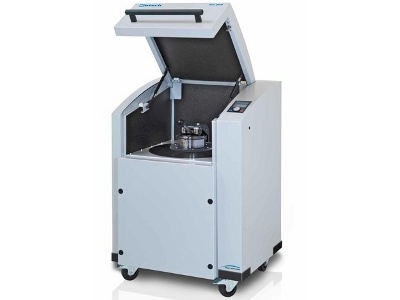
| Description | The Vibratory Disc Mill RS 200 is suitable for the extremely quick, loss-free and reproducible grinding of medium-hard, brittle and fibrous materials to analytical fineness. The instrument runs steadily and smoothly, even with heavy grinding sets, at maximum speed thanks to the new Stabilized-Plane-The Vibratory Disc Mill RS 200 is suitable for the extremely quick, loss-free and reproducible grinding of medium-hard, brittle and fibrous materials to analytical fineness. The instrument runs steadily and smoothly, even with heavy grinding sets, at maximum speed thanks to the new Stabilized-Plane-Drive.
With its robust design, the RS 200 has proven to be ideal for use in the building materials sector (cement), in geology, mineralogy, metallurgy and in power plants. Due to the high end fineness and speed the RS 200 is the perfect mill when it comes to preparing samples for spectral analysis.
Features - Reproducible results due to "Stabilized-Plane-Drive" (avoid tumbling of the grinding set)
- Safety interlock
- Variable speed 700 - 1,500 min-1
- Extremely short grinding time
- Agate recognition for automatic speed reduction
- 10 SOPs can be stored
- No sample loss thanks to optimum o-ring seal
- Wide range of materials for contamination free grinding
- Noise-insulated grinding chamber
- Quick-action grinding set clamping device
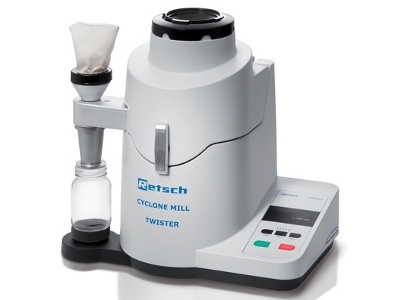
... Read More | The cyclone mill TWISTER is specially designed for the processing of foods and feeds for subsequent NIR analysis. The optimized form of rotor and grinding chamber generates an air jet which carries the ground sample through the integrated cyclone into the sample bottle. The air jet prevents the The cyclone mill TWISTER is specially designed for the processing of foods and feeds for subsequent NIR analysis. The optimized form of rotor and grinding chamber generates an air jet which carries the ground sample through the integrated cyclone into the sample bottle. The air jet prevents the material from heating up, thus preserving the moisture content.
The provided sieves guarantee an optimum particle size distribution so that it is not necessary to recalibrate the NIR spectrometer. The rotor speed can be adjusted in 3 steps allowing for perfect adaptation to the sample requirements. Cleaning the mill is quick and easy as the air jet effects a complete discharge of the material from the grinding chamber.
This new cyclone mill in proven RETSCH quality optimizes the reproducible sample preparation to NIR analysis thus allowing for meaningful and reliable analysis results.
Features - Ideal for grinding feeds, grains, forage and other similar products
- 3 controlled speeds
- Cyclone separator with 250 ml collecting bottle for quick extraction of sample
- No cross contamination thanks to easy cleaning
- Convenient operating panel
- Professional industrial design with long lifetime
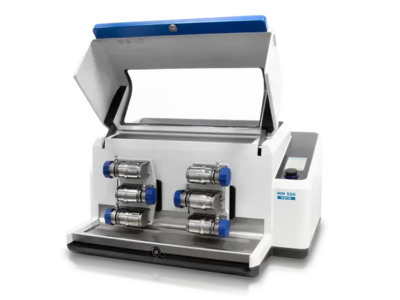
... Read More | The Mixer Mill MM 500 vario is a true multipurpose mill designed for dry, wet and cryogenic grinding of small volumes up to 6 x 20 ml. It mixes and homogenizes powders and suspensions with a frequency of 35 Hz within seconds – unbeatably fast and easy to operate. It is also very useful for The Mixer Mill MM 500 vario is a true multipurpose mill designed for dry, wet and cryogenic grinding of small volumes up to 6 x 20 ml. It mixes and homogenizes powders and suspensions with a frequency of 35 Hz within seconds – unbeatably fast and easy to operate. It is also very useful for mechanosynthesis applications and a grinding time up to 99 h. It is also the most suitable instrument for biological applications such as cell disruption for nucleic acids or protein extraction with a sample batch capacity of up to 50 samples- powerful grinding by impact and friction with up to 35 Hz
- pulverization of two samples down to 5 micron
- adapter for keeping 1.5, 2 or 5 ml plastic tubes or 2 ml steel tubes available
- adapter for keeping 4 x 50 ml conical tubes or 30 ml wide-mouth bottles available
- adapter for keeping 4 x 5 ml steel tubes available
- suitable for long-term grinding processes up to 8 h
- suitable for mechanochemistry applications
- 3 different grinding modes (dry, wet or cryogenic)
- memory for 8 SOPs and 4 program cycles
- Screw-Top jars from 5-50 ml
10 ml PMMA jars for RAMAN applications
... Read More | Planetary Ball Mills are used wherever the highest degree of fineness is required. Apart from the classical mixing and size reduction processes, the mills also meet all the technical requirements for colloidal grinding and have the energy input necessary for mechanical alloying processes. The Planetary Ball Mills are used wherever the highest degree of fineness is required. Apart from the classical mixing and size reduction processes, the mills also meet all the technical requirements for colloidal grinding and have the energy input necessary for mechanical alloying processes. The extremely high centrifugal forces of the Planetary Ball Mills result in very high pulverization energy and therefore short grinding times.
The PM 100 CM is a convenient benchtop model with 1 grinding station. It operates in centrifugal mode mode, which leads to a more gentle size reduction process with less abrasion.
Features - Powerful and quick grinding down to nano range
- Perfect stability on lab bench thanks to FFCS technology
- Innovative counter weight and imbalance sensor for unsupervised operation
- Gentle grinding in centrifugal mode
- Comfortable parameter setting via display and ergonomic 1-button operation
- Automatic grinding chamber ventilation
- 10 SOPs can be stored
- Programmable starting time
- Power failure backup ensures storage of remaining grinding time
- Reproducible results due to energy and speed control
- Suitable for long-term trials and continuous use
- 2 different grinding modes (dry and wet)
- Optional pressure and temperature measuring system PM GrindControl
- Measurement of energy input
- Wide range of materials for contamination free grinding
- Safety Slider for safe operation
... Read More |
| Principle | Pressure and Friction | Impact and Friction | Impact and Friction | Impact and Friction |
| Sample Size | <15 mm | <10 mm | ≤8 mm | < 10 mm |
| Sample Type | Medium-Hard, Hard, Brittle or Fibrous | Fibrous or Soft | Hard, Medium-Hard, Soft, Brittle, Elastic or Fibrous | Soft, Hard, Brittle or Fibrous - Dry or Wet |
| Applications | Size Reduction, Mixing and Triturating: Construction Materials, Environment / Recycling, Geology / Metallurgy, Glass / Ceramics | Grinding Prior to NIR Analysis: Agriculture, Foods / Feeds, Medicine / Pharmaceuticals | mechanochemistry, mechanical alloying, size reduction, mixing, homogenization, cryogenic grinding; agriculture, biology, chemistry / plastics, construction materials, engineering / electronics, environment / recycling, food, geology / metallurgy, glass / ceramics, medicine / pharmaceuticals, cell disruption | Pulverizing, Mixing, Homogenizing and Colloidal Milling: Agriculture, Biology, Chemistry / Plastics, Construction Materials, Engineering / Electronics, Environment / Recycling, Geology / Metallurgy, Glass / Ceramics, Medicine / Pharmaceuticals |
| Speed | 700 to 1500 min-1 | 10,000 to 14,000 min-1 | 3 to 35 Hz | 100 to 650 min-1 |
| Rotor Type | grinding dish with disc (and ring) | TWISTER rotor | grinding jar and balls | grinding jar and balls |
| Final Fineness | < 40 um | < 500 um | ~5 µm | < 1 um or < 0.1 um for Colloidal Grinding |
| Get Quote | | | | |