|  |  |  |  |
| Company | RETSCH | RETSCH | RETSCH | RETSCH |
| Item | CryoMill | Cutting Mill SM 50 | Mixer Mill MM 500 Nano | Planetary Ball Mill PM 100 |
| Citations | | | | |
| Figures | | | | |
| Catalog Number | CryoMill | SM 50 | MM 500 nano | PM 100 |
| Price | | | | |
| Description | The CryoMill is a laboratory ball mill specifically designed for this application. It features an integrated cooling system which continually cools the grinding jar with liquid nitrogen before and during the grinding process. Thus, the sample is embrittled and volatile components are preserved.
The The CryoMill is a laboratory ball mill specifically designed for this application. It features an integrated cooling system which continually cools the grinding jar with liquid nitrogen before and during the grinding process. Thus, the sample is embrittled and volatile components are preserved.
The liquid nitrogen is continually supplied from an autofill system in the exact amount required to keep the temperature at –196 °C. The CryoMill's versatility makes it the ideal grinder for sample quantities up to 20 ml.- powerful grinding by impact and friction with up to 30 Hz
- pulverization of two samples down to 5 micron
- The user never comes into direct contact with LN2 which ensures a high degree of operational safety
- adapter for keeping 2 ml plastic tubes or 2 ml steel tubes available
- special jar zirconium oxide available for heavy-metal free grinding
- suitable forgrinding in interval
- 3 different grinding modes (dry, wet or cryogenic)
- memory for 9 SOPs
- Screw-Top jars
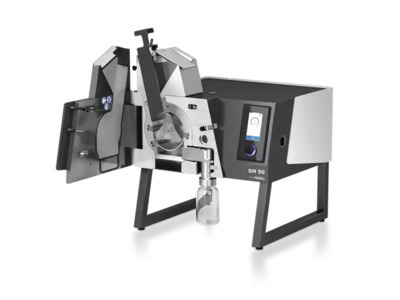
... Read More | The SM 50 is the world's most powerful benchtop cutting mill with a standard one phase power plug. Its 1.5 kW motor drives a large rotor, delivering impressive high-speed cutting power. The max. speed is 4,000 rpm and can be adjusted to suit various applications. The EasyInspect hopper operates on aThe SM 50 is the world's most powerful benchtop cutting mill with a standard one phase power plug. Its 1.5 kW motor drives a large rotor, delivering impressive high-speed cutting power. The max. speed is 4,000 rpm and can be adjusted to suit various applications. The EasyInspect hopper operates on a batch-wise feeding system and can process large sample pieces up to 50 mm with ease. The compact powerhouse features an internal cyclone system, ensuring effortless and efficient processing of various materials. The push-fit grinding chamber is the first in the world which can be taken out for proper cleaning. With its innovative design featuring a removable milling chamber, the SM 50 simplifies cleaning, saving up to 30 % process time. At the same time, the unrivaled powerful benchtop cutting mill with a single phase power plug allows up to 100 % sample recovery and contamination-free sample preparation.
- pulverization of samples down to 250 micron
- integrated cyclone technology
- easy cleaning thanks to push fit accessories including the grinding chamber
- for samples up to 50 mm
- less surfaces-less dust
- Superior cutting speed of 27 m/s.
- 3 double acting cutting bars result in 18 cutting events per round and a specific cutting length of 864 mm per round for superior cutting efficiency.
- Comprehensive and convenient door opening mechanisms with a pivoting handle
- 9 different sieve sizes from 10 mm down to 0.25 mm for standard application or for grinding without heavy-metal contamination
two different rotor types
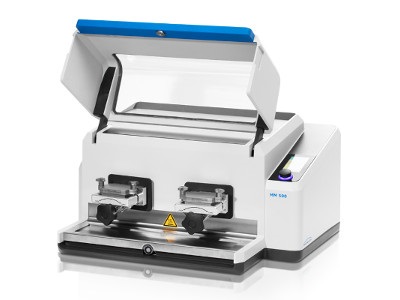
... Read More | The mixer mill MM 500 nano is a compact, versatile bench-top unit which has been developed specially for dry, wet and cryogenic grinding of up to 2 x 45 ml sample material within seconds. With a maximum frequency of 35 Hz, it generates enough energy to produce particles in the nanometer range. The The mixer mill MM 500 nano is a compact, versatile bench-top unit which has been developed specially for dry, wet and cryogenic grinding of up to 2 x 45 ml sample material within seconds. With a maximum frequency of 35 Hz, it generates enough energy to produce particles in the nanometer range. The robust high-performance drive makes the mill suitable for long-term grinding processes up to 99 hours. Hence, the MM 500 nano is the first mixer mill in the market to provide a real alternative to grinding in a planetary ball mill – with more comfortable handling and less warming effects. - powerful grinding by impact and friction with up to 35 Hz
- pulverization of two samples down to the nanometer range < 0.1 micron
- multi-cavity jars 2x 25 ml or 4 x 10 ml available
- adapter for keeping 2 ml plastic tubes or 2 ml steel tubes available
- suitable for long-term grinding processes up to 99 h
- suitable for mechanochemistry applications
- 3 different grinding modes (dry, wet or cryogenic)
- memory for 12 SOPs and 4 program cycles
- Screw-Lock jars, pressure-tight up to 5 bar
GrindControl to measure pressure and temperature available - grinding under inert gas (optional)
- jar design allows full use of the volume, also for wet grinding
- jars remain conveniently clamped for periodic sample extraction or visual checks
... Read More | Planetary Ball Mills are used wherever the highest degree of fineness is required. Apart from the classical mixing and size reduction processes, the mills also meet all the technical requirements for colloidal grinding and have the energy input necessary for mechanical alloying processes. The Planetary Ball Mills are used wherever the highest degree of fineness is required. Apart from the classical mixing and size reduction processes, the mills also meet all the technical requirements for colloidal grinding and have the energy input necessary for mechanical alloying processes. The extremely high centrifugal forces of the Planetary Ball Mills result in very high pulverization energy and therefore short grinding times.
The PM 100 CM is a convenient benchtop model with 1 grinding station. It operates in centrifugal mode mode, which leads to a more gentle size reduction process with less abrasion.
Features - Powerful and quick grinding down to nano range
- Perfect stability on lab bench thanks to FFCS technology
- Innovative counter weight and imbalance sensor for unsupervised operation
- Gentle grinding in centrifugal mode
- Comfortable parameter setting via display and ergonomic 1-button operation
- Automatic grinding chamber ventilation
- 10 SOPs can be stored
- Programmable starting time
- Power failure backup ensures storage of remaining grinding time
- Reproducible results due to energy and speed control
- Suitable for long-term trials and continuous use
- 2 different grinding modes (dry and wet)
- Optional pressure and temperature measuring system PM GrindControl
- Measurement of energy input
- Wide range of materials for contamination free grinding
- Safety Slider for safe operation
... Read More |
| Principle | Impact and Friction | Cutting and Shearing | Impact and Friction | Impact and Friction |
| Sample Size | ≤8 mm | < 50 mm | ≤10 mm | < 10 mm |
| Sample Type | Hard, Medium-Hard, Soft, Brittle, Elastic or Fibrous | Soft, Medium-Hard, Fibrous | Hard, Medium-Hard, Soft, Brittle, Elastic or Fibrous | Soft, Hard, Brittle or Fibrous - Dry or Wet |
| Applications | mechanochemistry, mechanical alloying, size reduction, mixing, homogenization, cryogenic grinding; agriculture, biology, chemistry / plastics, construction materials, engineering / electronics, environment / recycling, food, geology / metallurgy, glass / ceramics, medicine / pharmaceuticals, cell disruption | agriculture, chemicals / plastics, construction materials, electronics, environmental / recyling, food / feed, pharma / biotech / medtech, power generation / energy | mechanochemistry, mechanical alloying, size reduction, mixing, homogenization, cryogenic grinding; agriculture, biology, chemistry / plastics, construction materials, engineering / electronics, environment / recycling, food, geology / metallurgy, glass / ceramics, medicine / pharmaceuticals | Pulverizing, Mixing, Homogenizing and Colloidal Milling: Agriculture, Biology, Chemistry / Plastics, Construction Materials, Engineering / Electronics, Environment / Recycling, Geology / Metallurgy, Glass / Ceramics, Medicine / Pharmaceuticals |
| Speed | 3 to 30 Hz | 500 to 6,000 min-1 | 3 to 35 Hz | 100 to 650 min-1 |
| Rotor Type | grinding jar and balls | parallel section rotor / 3-disc rotor, 0.25-10 mm sieves | grinding jar and balls | grinding jar and balls |
| Final Fineness | ~ 5 um | < 0.25 mm | ~0.1 µm | < 1 um or < 0.1 um for Colloidal Grinding |
| Get Quote | | | | |