Laboratory mills, used primarily for sample prep prior to analysis, use particle size reduction (comminution) to grind or homogenize wet, dry, hard, soft, elastic, brittle, and fibrous materials. Mills and grinders are used in labs in widely varying scientific areas, including chemistry, pharmaceuticals, food analysis, materials testing, and life science. Disk, hammer, mortar, planetary ball, rotor, and cutting mills are available to achieve coarse, mid-range, and fine results, all the way down to the nano range, <0.1 µm. Cryogenic mills, or freezer mills, are a type of unit that freezes a material prior to reducing its particle size.
What to consider when choosing a laboratory mill?
When purchasing a mill, power, speed, and cleanability are useful parameters; however, it is also important to keep in mind the instrument’s throughput, reproducibility, and yield, as well as the option of a cooling system, if necessary.
Compare and request a quote for laboratory mills from various manufacturers:
|  |  |  |  |
| Company | RETSCH | RETSCH | RETSCH | RETSCH |
| Item | CryoMill | Cyclone Mill TWISTER | Mixer Mill MM 400 | XRD-Mill McCrone Laboratory Mill |
| Citations | | | | |
| Figures | | | | |
| Catalog Number | CryoMill | Twister | MM 400 | MCCrone |
| Price | | | | |
| Description | The CryoMill is a laboratory ball mill specifically designed for this application. It features an integrated cooling system which continually cools the grinding jar with liquid nitrogen before and during the grinding process. Thus, the sample is embrittled and volatile components are preserved.
The The CryoMill is a laboratory ball mill specifically designed for this application. It features an integrated cooling system which continually cools the grinding jar with liquid nitrogen before and during the grinding process. Thus, the sample is embrittled and volatile components are preserved.
The liquid nitrogen is continually supplied from an autofill system in the exact amount required to keep the temperature at –196 °C. The CryoMill's versatility makes it the ideal grinder for sample quantities up to 20 ml.- powerful grinding by impact and friction with up to 30 Hz
- pulverization of two samples down to 5 micron
- The user never comes into direct contact with LN2 which ensures a high degree of operational safety
- adapter for keeping 2 ml plastic tubes or 2 ml steel tubes available
- special jar zirconium oxide available for heavy-metal free grinding
- suitable forgrinding in interval
- 3 different grinding modes (dry, wet or cryogenic)
- memory for 9 SOPs
- Screw-Top jars
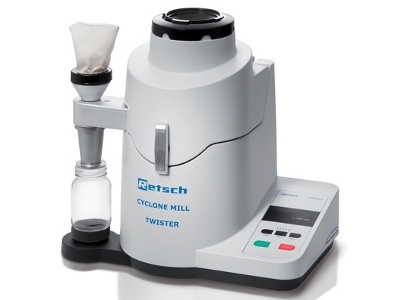
... Read More | The cyclone mill TWISTER is specially designed for the processing of foods and feeds for subsequent NIR analysis. The optimized form of rotor and grinding chamber generates an air jet which carries the ground sample through the integrated cyclone into the sample bottle. The air jet prevents the The cyclone mill TWISTER is specially designed for the processing of foods and feeds for subsequent NIR analysis. The optimized form of rotor and grinding chamber generates an air jet which carries the ground sample through the integrated cyclone into the sample bottle. The air jet prevents the material from heating up, thus preserving the moisture content.
The provided sieves guarantee an optimum particle size distribution so that it is not necessary to recalibrate the NIR spectrometer. The rotor speed can be adjusted in 3 steps allowing for perfect adaptation to the sample requirements. Cleaning the mill is quick and easy as the air jet effects a complete discharge of the material from the grinding chamber.
This new cyclone mill in proven RETSCH quality optimizes the reproducible sample preparation to NIR analysis thus allowing for meaningful and reliable analysis results.
Features - Ideal for grinding feeds, grains, forage and other similar products
- 3 controlled speeds
- Cyclone separator with 250 ml collecting bottle for quick extraction of sample
- No cross contamination thanks to easy cleaning
- Convenient operating panel
- Professional industrial design with long lifetime
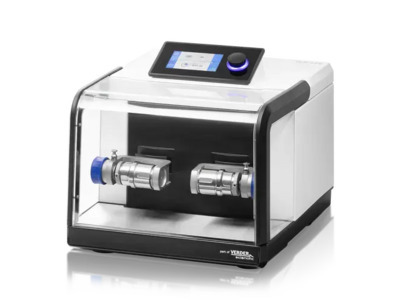
... Read More | The Mixer Mill MM 400 is a true multipurpose mill designed for dry, wet and cryogenic grinding of small volumes up to 2 x 20 ml. It mixes and homogenizes powders and suspensions with a frequency of 30 Hz within seconds – unbeatably fast and easy to operate. It is also very useful for The Mixer Mill MM 400 is a true multipurpose mill designed for dry, wet and cryogenic grinding of small volumes up to 2 x 20 ml. It mixes and homogenizes powders and suspensions with a frequency of 30 Hz within seconds – unbeatably fast and easy to operate. It is also very useful for mechanosynthesis applications with RAMAN readyness and a grinding time up to 8 h. It is also the most suitable instrument for biological applications such as cell disruption for nucleic acids or protein extraction. It is the first mixer mill wil calibrated frequency and time for most reproducible results- powerful grinding by impact and friction with up to 30 Hz
- pulverization of two samples down to 5 micron
- adapter for keeping 1.5, 2 or 5 ml plastic tubes or 2 ml steel tubes available
- adapter for keeping 4 x 50 ml conical tubes or 30 ml wide-mouth bottles available
- adapter for keeping 4 x 5 ml steel tubes available
- suitable for long-term grinding processes up to 8 h
- suitable for mechanochemistry applications
- 3 different grinding modes (dry, wet or cryogenic)
- memory for 8 SOPs and 4 program cycles
- Screw-Top jars from 5-50 ml
10 ml PMMA jars for RAMAN applications
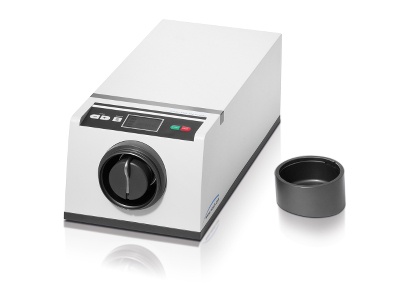
... Read More | The XRD-Mill McCrone was specially developed for the preparation of samples for subsequent X-ray diffraction (XRD). The mill is used for applications in geology, chemistry, mineralogy and materials science, quality control as well as R&D. Because of its unique grinding motion, the XRD-Mill McCrone The XRD-Mill McCrone was specially developed for the preparation of samples for subsequent X-ray diffraction (XRD). The mill is used for applications in geology, chemistry, mineralogy and materials science, quality control as well as R&D. Because of its unique grinding motion, the XRD-Mill McCrone is particularly effective for this analytical method: The 48 cylindrical grinding elements grind the samples gently via friction. The result is a short grinding time with almost no sample loss and an exceptionally narrow particle size distribution. The crystal lattice is almost entirely preserved during grinding operation, a pre-requisite for meaningful X-ray diffraction results.
Features: - Crystal lattice preserved during grinding operation
- Very narrow and reproducible particle size distribution
- Minimal cross contamination
- Compact, bench-top sized model
- Suitable for dry and wet grinding
... Read More |
| Principle | Impact and Friction | Impact and Friction | Impact and Friction | Friction |
| Sample Size | ≤8 mm | <10 mm | ≤8 mm | <0.5 mm |
| Sample Type | Hard, Medium-Hard, Soft, Brittle, Elastic or Fibrous | Fibrous or Soft | Hard, Medium-Hard, Soft, Brittle, Elastic or Fibrous | Medium-hard, Hard, Brittle, Fibrous |
| Applications | mechanochemistry, mechanical alloying, size reduction, mixing, homogenization, cryogenic grinding; agriculture, biology, chemistry / plastics, construction materials, engineering / electronics, environment / recycling, food, geology / metallurgy, glass / ceramics, medicine / pharmaceuticals, cell disruption | Grinding Prior to NIR Analysis: Agriculture, Foods / Feeds, Medicine / Pharmaceuticals | mechanochemistry, mechanical alloying, size reduction, mixing, homogenization, cryogenic grinding; agriculture, biology, chemistry / plastics, construction materials, engineering / electronics, environment / recycling, food, geology / metallurgy, glass / ceramics, medicine / pharmaceuticals, cell disruption | Grinding, Mixing and Triturating, Dry and Wet |
| Speed | 3 to 30 Hz | 10,000 to 14,000 min-1 | 3 to 30 Hz | 1000 to 1500 min-1 |
| Rotor Type | grinding jar and balls | TWISTER rotor | grinding jar and balls | <0.5 mm |
| Final Fineness | ~ 5 um | < 500 um | ~5 µm | <1 µm |
| Get Quote | | | | |