|  |  |  |  |
| Company | RETSCH | RETSCH | RETSCH | RETSCH |
| Item | CryoMill | Mortar Grinder RM 200 | Planetary Ball Mill PM 100 | XRD-Mill McCrone Laboratory Mill |
| Citations | | | | |
| Figures | | | | |
| Catalog Number | CryoMill | RM 200 | PM 100 | MCCrone |
| Price | | | | |
| Description | The CryoMill is a laboratory ball mill specifically designed for this application. It features an integrated cooling system which continually cools the grinding jar with liquid nitrogen before and during the grinding process. Thus, the sample is embrittled and volatile components are preserved.
The The CryoMill is a laboratory ball mill specifically designed for this application. It features an integrated cooling system which continually cools the grinding jar with liquid nitrogen before and during the grinding process. Thus, the sample is embrittled and volatile components are preserved.
The liquid nitrogen is continually supplied from an autofill system in the exact amount required to keep the temperature at –196 °C. The CryoMill's versatility makes it the ideal grinder for sample quantities up to 20 ml.- powerful grinding by impact and friction with up to 30 Hz
- pulverization of two samples down to 5 micron
- The user never comes into direct contact with LN2 which ensures a high degree of operational safety
- adapter for keeping 2 ml plastic tubes or 2 ml steel tubes available
- special jar zirconium oxide available for heavy-metal free grinding
- suitable forgrinding in interval
- 3 different grinding modes (dry, wet or cryogenic)
- memory for 9 SOPs
- Screw-Top jars
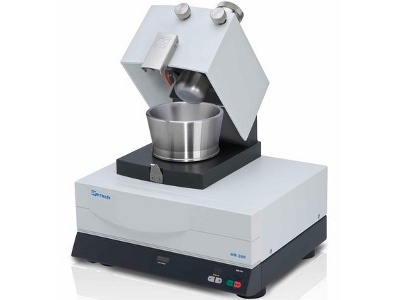
... Read More | The Mortar Grinder RM 200 can mix and homogenize powders, suspension and pastes even with high viscosity. The RM 200 is suitable for the proper and reproducible sample preparation to analytical fineness.
It substitutes cumbersome hand mortars by a high performance drive with electronic control. TheThe Mortar Grinder RM 200 can mix and homogenize powders, suspension and pastes even with high viscosity. The RM 200 is suitable for the proper and reproducible sample preparation to analytical fineness.
It substitutes cumbersome hand mortars by a high performance drive with electronic control. The grinding set can be cooled and heated and is very easy to clean. Grinding sets of various material qualities are available which can be exchanged easily for optimum adaptation to various grinding tasks.
Features - Dry, wet and cryogenic grinding
- Reproducible results due to adjustable pestle and scraper pressure
- Closed, dust tight grinding chamber with windows
- Easy exchange of mortar and pestle without tools
- Performance display for load cotrol
- Adjustable pestle and scraper pressure
- Wide range of materials for contamination free grinding
- 3 scraper materials (vulkollan, beech wood, PTFE)
... Read More | Planetary Ball Mills are used wherever the highest degree of fineness is required. Apart from the classical mixing and size reduction processes, the mills also meet all the technical requirements for colloidal grinding and have the energy input necessary for mechanical alloying processes. The Planetary Ball Mills are used wherever the highest degree of fineness is required. Apart from the classical mixing and size reduction processes, the mills also meet all the technical requirements for colloidal grinding and have the energy input necessary for mechanical alloying processes. The extremely high centrifugal forces of the Planetary Ball Mills result in very high pulverization energy and therefore short grinding times.
The PM 100 CM is a convenient benchtop model with 1 grinding station. It operates in centrifugal mode mode, which leads to a more gentle size reduction process with less abrasion.
Features - Powerful and quick grinding down to nano range
- Perfect stability on lab bench thanks to FFCS technology
- Innovative counter weight and imbalance sensor for unsupervised operation
- Gentle grinding in centrifugal mode
- Comfortable parameter setting via display and ergonomic 1-button operation
- Automatic grinding chamber ventilation
- 10 SOPs can be stored
- Programmable starting time
- Power failure backup ensures storage of remaining grinding time
- Reproducible results due to energy and speed control
- Suitable for long-term trials and continuous use
- 2 different grinding modes (dry and wet)
- Optional pressure and temperature measuring system PM GrindControl
- Measurement of energy input
- Wide range of materials for contamination free grinding
- Safety Slider for safe operation
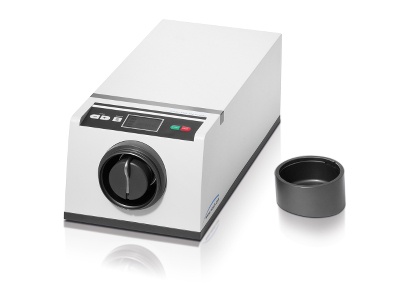
... Read More | The XRD-Mill McCrone was specially developed for the preparation of samples for subsequent X-ray diffraction (XRD). The mill is used for applications in geology, chemistry, mineralogy and materials science, quality control as well as R&D. Because of its unique grinding motion, the XRD-Mill McCrone The XRD-Mill McCrone was specially developed for the preparation of samples for subsequent X-ray diffraction (XRD). The mill is used for applications in geology, chemistry, mineralogy and materials science, quality control as well as R&D. Because of its unique grinding motion, the XRD-Mill McCrone is particularly effective for this analytical method: The 48 cylindrical grinding elements grind the samples gently via friction. The result is a short grinding time with almost no sample loss and an exceptionally narrow particle size distribution. The crystal lattice is almost entirely preserved during grinding operation, a pre-requisite for meaningful X-ray diffraction results.
Features: - Crystal lattice preserved during grinding operation
- Very narrow and reproducible particle size distribution
- Minimal cross contamination
- Compact, bench-top sized model
- Suitable for dry and wet grinding
... Read More |
| Principle | Impact and Friction | Pressure and Friction | Impact and Friction | Friction |
| Sample Size | ≤8 mm | < 8 mm | < 10 mm | <0.5 mm |
| Sample Type | Hard, Medium-Hard, Soft, Brittle, Elastic or Fibrous | Soft, Hard, Brittle or Pasty | Soft, Hard, Brittle or Fibrous - Dry or Wet | Medium-hard, Hard, Brittle, Fibrous |
| Applications | mechanochemistry, mechanical alloying, size reduction, mixing, homogenization, cryogenic grinding; agriculture, biology, chemistry / plastics, construction materials, engineering / electronics, environment / recycling, food, geology / metallurgy, glass / ceramics, medicine / pharmaceuticals, cell disruption | Grinding, Mixing and Triturating - Dry and Wet: Agriculture, Biology, Chemistry / Plastics, Construction Materials, Food, Geology / Metallurgy, Glass / Ceramics, Medicine / Pharmaceuticals | Pulverizing, Mixing, Homogenizing and Colloidal Milling: Agriculture, Biology, Chemistry / Plastics, Construction Materials, Engineering / Electronics, Environment / Recycling, Geology / Metallurgy, Glass / Ceramics, Medicine / Pharmaceuticals | Grinding, Mixing and Triturating, Dry and Wet |
| Speed | 3 to 30 Hz | 100 min-1 | 100 to 650 min-1 | 1000 to 1500 min-1 |
| Rotor Type | grinding jar and balls | mortar and pestle | grinding jar and balls | <0.5 mm |
| Final Fineness | ~ 5 um | < 10 um | < 1 um or < 0.1 um for Colloidal Grinding | <1 µm |
| Get Quote | | | | |