|  |  |  |  |
| Company | RETSCH | RETSCH | RETSCH | RETSCH |
| Item | CryoMill | High Energy Ball Mill Emax | Mixer Mill MM 500 Nano | Planetary Ball Mill PM 300 |
| Citations | | | | |
| Figures | | | | |
| Catalog Number | CryoMill | Emax | MM 500 nano | PM 300 |
| Price | | | | |
| Description | The CryoMill is a laboratory ball mill specifically designed for this application. It features an integrated cooling system which continually cools the grinding jar with liquid nitrogen before and during the grinding process. Thus, the sample is embrittled and volatile components are preserved.
The The CryoMill is a laboratory ball mill specifically designed for this application. It features an integrated cooling system which continually cools the grinding jar with liquid nitrogen before and during the grinding process. Thus, the sample is embrittled and volatile components are preserved.
The liquid nitrogen is continually supplied from an autofill system in the exact amount required to keep the temperature at –196 °C. The CryoMill's versatility makes it the ideal grinder for sample quantities up to 20 ml.- powerful grinding by impact and friction with up to 30 Hz
- pulverization of two samples down to 5 micron
- The user never comes into direct contact with LN2 which ensures a high degree of operational safety
- adapter for keeping 2 ml plastic tubes or 2 ml steel tubes available
- special jar zirconium oxide available for heavy-metal free grinding
- suitable forgrinding in interval
- 3 different grinding modes (dry, wet or cryogenic)
- memory for 9 SOPs
- Screw-Top jars
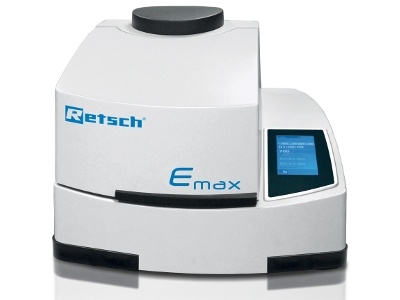
... Read More | The High Energy Ball Mill Emax from Retsch achieves fine particles in the nanometer range through high friction and impact, while maintaining a narrow particle size distribution through thorough sample mixture. This mill not only reduces grinding time, but also removes the need to cool down. The The High Energy Ball Mill Emax from Retsch achieves fine particles in the nanometer range through high friction and impact, while maintaining a narrow particle size distribution through thorough sample mixture. This mill not only reduces grinding time, but also removes the need to cool down. The High Energy Ball Mill Emax can be used across various application fields including agriculture, biology, chemistry, environmental, geology, pharmaceuticals, and more.
Features : - faster and finer grinding than any other ball mills
- speed of 2000 min-1
- unique water cooling system
- temperature-controlled grinding
- narrow particle size distribution
- patented drive concept
- range of jar materials allow for contamination free grinding
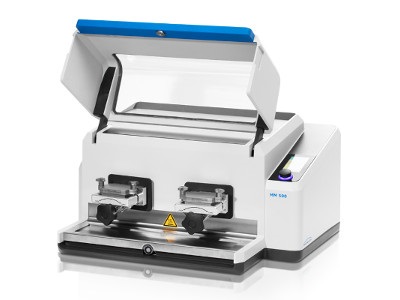
... Read More | The mixer mill MM 500 nano is a compact, versatile bench-top unit which has been developed specially for dry, wet and cryogenic grinding of up to 2 x 45 ml sample material within seconds. With a maximum frequency of 35 Hz, it generates enough energy to produce particles in the nanometer range. The The mixer mill MM 500 nano is a compact, versatile bench-top unit which has been developed specially for dry, wet and cryogenic grinding of up to 2 x 45 ml sample material within seconds. With a maximum frequency of 35 Hz, it generates enough energy to produce particles in the nanometer range. The robust high-performance drive makes the mill suitable for long-term grinding processes up to 99 hours. Hence, the MM 500 nano is the first mixer mill in the market to provide a real alternative to grinding in a planetary ball mill – with more comfortable handling and less warming effects. - powerful grinding by impact and friction with up to 35 Hz
- pulverization of two samples down to the nanometer range < 0.1 micron
- multi-cavity jars 2x 25 ml or 4 x 10 ml available
- adapter for keeping 2 ml plastic tubes or 2 ml steel tubes available
- suitable for long-term grinding processes up to 99 h
- suitable for mechanochemistry applications
- 3 different grinding modes (dry, wet or cryogenic)
- memory for 12 SOPs and 4 program cycles
- Screw-Lock jars, pressure-tight up to 5 bar
GrindControl to measure pressure and temperature available - grinding under inert gas (optional)
- jar design allows full use of the volume, also for wet grinding
- jars remain conveniently clamped for periodic sample extraction or visual checks
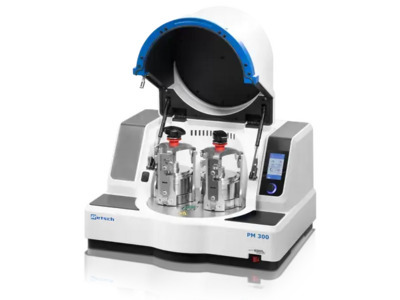
... Read More | The Planetary Ball Mill PM 300 is a powerful and ergonomic benchtop model with two grinding stations for grinding jar volumes up to 500 ml. This setup allows for processing up to 2 x 220 ml sample material per batch. Thanks to the high maximum speed of 800 rpm, extremely high centrifugal forces The Planetary Ball Mill PM 300 is a powerful and ergonomic benchtop model with two grinding stations for grinding jar volumes up to 500 ml. This setup allows for processing up to 2 x 220 ml sample material per batch. Thanks to the high maximum speed of 800 rpm, extremely high centrifugal forces result in very high pulverization energy and consequently in short processing times. The PM 300 is ideally suited for virtually all industries where the quality control process places the highest demands on purity, speed, fineness and reproducibility. Thanks to its enormous energy input of up to 64.4 times the acceleration of gravity, this mill is the perfect choice for tasks in research like mechanochemistry (mechanosynthesis, mechanical alloying and mechano-catalysis), or for ultrafine colloidal grinding on a nanometer scale.- powerful grinding by impact and friction with up to 800 rpm
- pulverization of two samples down to 100 nm
- jars from 12-500 ml
- adapter for keeping 2 ml gas chromatography glass vials for cocrystal screening
- high energy input of up to 64.4 g
- suitable for mechanochemistry applications and mechanical alloying
- Ergonomic clamping unit with smooth surfaces
- Automatic grinding chamber ventilation with directed air stream for perfect jar cooling
- The Safety Slider prevents starting the machine without securely clamped jars, perfect stability on the lab bench thanks to FFCS -technology
- Comfortable parameter setting via Touch display
- 2 different grinding modes (dry, wet)
- memory for 12 SOPs and 4 program cycles
- 5 different jar materials
jars of 12 – 80 ml can be stacked (two jars each)
... Read More |
| Principle | Impact and Friction | Impact and Friction | Impact and Friction | Impact and Friction |
| Sample Size | ≤8 mm | < 5 mm | ≤10 mm | ≤10 mm |
| Sample Type | Hard, Medium-Hard, Soft, Brittle, Elastic or Fibrous | Medium-hard, hard, brittle, fibrous - dry or wet | Hard, Medium-Hard, Soft, Brittle, Elastic or Fibrous | Hard, Medium-Hard, Soft, Brittle, Fibrous |
| Applications | mechanochemistry, mechanical alloying, size reduction, mixing, homogenization, cryogenic grinding; agriculture, biology, chemistry / plastics, construction materials, engineering / electronics, environment / recycling, food, geology / metallurgy, glass / ceramics, medicine / pharmaceuticals, cell disruption | Nano grinding, size reduction, homogenizing, mechanical alloying, colloidal milling, high energy comminution | mechanochemistry, mechanical alloying, size reduction, mixing, homogenization, cryogenic grinding; agriculture, biology, chemistry / plastics, construction materials, engineering / electronics, environment / recycling, food, geology / metallurgy, glass / ceramics, medicine / pharmaceuticals | mechanochemistry, mechanical alloying, size reduction, mixing, homogenization, cryogenic grinding; agriculture, biology, chemistry / plastics, construction materials, engineering / electronics, environment / recycling, food, geology / metallurgy, glass / ceramics, medicine / pharmaceuticals, cocrystalscreening |
| Speed | 3 to 30 Hz | 300 to 2,000 min-1 | 3 to 35 Hz | max 800 rpm |
| Rotor Type | grinding jar and balls | Inquire | grinding jar and balls | grinding jar and balls |
| Final Fineness | ~ 5 um | < 80 nm | ~0.1 µm | ~0.1 µm |
| Get Quote | | | | |