|  |  |  |  |
| Company | RETSCH | RETSCH | RETSCH | RETSCH |
| Item | Planetary Ball Mill PM 100 | Cutting Mill SM 300 | Knife Mill Grindomix GM 200 | Rotor Beater Mill SR 300 |
| Citations | | | | |
| Catalog Number | PM 100 | SM 300 | GM 200 | SR 300 |
| Price | | | | |
| Description | Planetary Ball Mills are used wherever the highest degree of fineness is required. Apart from the classical mixing and size reduction processes, the mills also meet all the technical requirements for colloidal grinding and have the energy input necessary for mechanical alloying processes. The Planetary Ball Mills are used wherever the highest degree of fineness is required. Apart from the classical mixing and size reduction processes, the mills also meet all the technical requirements for colloidal grinding and have the energy input necessary for mechanical alloying processes. The extremely high centrifugal forces of the Planetary Ball Mills result in very high pulverization energy and therefore short grinding times.
The PM 100 CM is a convenient benchtop model with 1 grinding station. It operates in centrifugal mode mode, which leads to a more gentle size reduction process with less abrasion.
Features - Powerful and quick grinding down to nano range
- Perfect stability on lab bench thanks to FFCS technology
- Innovative counter weight and imbalance sensor for unsupervised operation
- Gentle grinding in centrifugal mode
- Comfortable parameter setting via display and ergonomic 1-button operation
- Automatic grinding chamber ventilation
- 10 SOPs can be stored
- Programmable starting time
- Power failure backup ensures storage of remaining grinding time
- Reproducible results due to energy and speed control
- Suitable for long-term trials and continuous use
- 2 different grinding modes (dry and wet)
- Optional pressure and temperature measuring system PM GrindControl
- Measurement of energy input
- Wide range of materials for contamination free grinding
- Safety Slider for safe operation
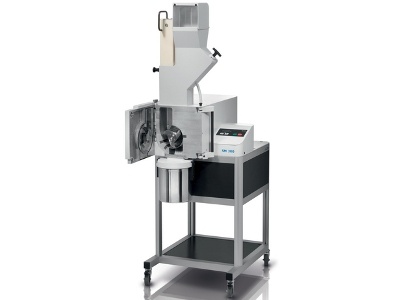
... Read More | Cutting mills are suitable for the grinding of soft, medium-hard, tough, elastic, fibrous, and heterogeneous mixes of products. The new Cutting Mill SM 300 excels especially in the tough jobs where other cutting mills fail.
The high torque of the new 3 kW drive with RES technology (additional Cutting mills are suitable for the grinding of soft, medium-hard, tough, elastic, fibrous, and heterogeneous mixes of products. The new Cutting Mill SM 300 excels especially in the tough jobs where other cutting mills fail.
The high torque of the new 3 kW drive with RES technology (additional flywheel mass) allows for an exceptionally effective preliminary size reduction of heterogeneous mixtures, such as waste or electronic components. Analytical fineness is often achieved in one working run.
The cutting mill is used successfully for a great variety of materials. The sample is only moderately warmed up during the grinding process so that the mill is perfectly suitable for grinding temperature-sensitive materials. Another innovation is the wide, freely selectable speed range from 700 to 3,000 min-1. In combination with the wide choice of bottom sieves, hoppers and collecting vessels, the mill can be easily adapted to varying application requirements.
Features - Powerful size reduction thanks to 3 kW drive with high torque and RES technology
- Perfect adaptation to application requirements by variable speed from 700 to 3,000 min-1
- Optimum cutting effects thanks to double acting cutting bars
- Quick and easy cleaning due to fold-back hopper, smooth surfaces and push-fit rotor
- Defined final fineness due to bottom sieves with aperture sizes from 0.25 - 20 mm
- Wide range of accessories including various hoppers, collection systems, rotors and sieves
- Highest safety standards due to engine brake, central locking device, electronic safety check and base frame
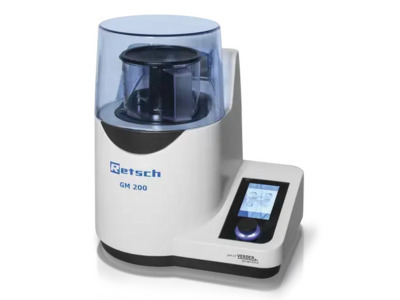
... Read More | The new knife mill GRINDOMIX GM 200 is the ideal instrument for the grinding and homogenization of foodstuffs. It allows to process sample volumes up to 1 liters quickly and reproducibly.
With two sharp, robust blades and a powerful motor which can reach temporary peaks of 1 kW, it is ideal for The new knife mill GRINDOMIX GM 200 is the ideal instrument for the grinding and homogenization of foodstuffs. It allows to process sample volumes up to 1 liters quickly and reproducibly.
With two sharp, robust blades and a powerful motor which can reach temporary peaks of 1 kW, it is ideal for homogenizing substances with a high water, oil or fat content as well as for grinding dry, soft and medium-hard products. The GRINDOMIX GM 200 meets and exceeds all special laboratory and analytical requirements and is a professional device superior to any commercial household mixer.
Features - Efficient size reduction of up to 700 ml feed quantity due to a powerful 1 kW motor
- Pre- and fine-grinding in one mill: cutting action in regular mode, grinding by impact in reverse mode, pre-grinding in interval mode
- All parts which come into contact with the sample material are autoclavable
- Perfect adaptation to application requirements by variable speed from 2,000 to 10,000 min-1
- CryoKit available for grinding embrittled or deeply frozen samples
- Optional gravitaty lid for automatic reduction of the grinding chamber volume
- Optional volume reduction lid available
- 8 SOPs and 4 sequences can be stored
- Grinding jar in plastic and stainless steel available
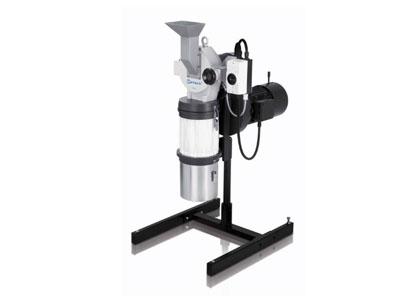
... Read More | The Rotor Beater Mill SR 300 is suitable for coarse and fine size reduction, either in batches or continuously. It can process dry, soft, medium-hard, organic and inorganic substances.
Its high speed in comparison to the SR 200 allows a significantly higher throughput and fineness.
The SR 300 isThe Rotor Beater Mill SR 300 is suitable for coarse and fine size reduction, either in batches or continuously. It can process dry, soft, medium-hard, organic and inorganic substances.
Its high speed in comparison to the SR 200 allows a significantly higher throughput and fineness.
The SR 300 is intended for universal use: from sample preparation in laboratories up to preparing sample batches in pilot plants or production facilities. The grinding chamber, the feed hopper and the material inlet are completely made from high quality stainless steel.
Features
- Suitable for batchwise operation of larger quantities
- Central locking device
- Wide range of accessories including various collection and feeding systems, rotors and sieves
- High final fineness
- Exchangeable grinding and sieve inserts
- Grinding chamber, feed hopper and material inlet and outlet of stainless steel
- Optional grinding inserts 180° for grinding of hard-brittle materials by additional impact
- Optional distance rotor to reduce frictional heat
- Removable hopper for easy cleaning
- Motor brake
- Defined final fineness due to bottom sieves with aperture sizes from 0.08 - 10 mm
... Read More |
| Principle | Impact and Friction | Shearing and Cutting | Cutting | Impact and Shearing |
| Sample Size | < 10 mm | Up to 60 x 80 mm | ~ 40 mm | < 15 mm |
| Sample Type | Soft, Hard, Brittle or Fibrous - Dry or Wet | Soft, Medium-Hard, Tough, Elastic or Fibrous | Soft, Medium-Hard, Elastic, Containing Water/Fat/Oil, Dry or Fibrous | Soft or Medium-Hard |
| Applications | Pulverizing, Mixing, Homogenizing and Colloidal Milling: Agriculture, Biology, Chemistry / Plastics, Construction Materials, Engineering / Electronics, Environment / Recycling, Geology / Metallurgy, Glass / Ceramics, Medicine / Pharmaceuticals | Size Reduction by Cutting: Agriculture, Biology, Chemistry / Plastics, Engineering / Electronics, Environment / Recycling, Food, Medicine / Pharmaceuticals | Size Reduction, Homogenization and Mixing: Agriculture, Biology, Food, Medicine / Pharmaceuticals | Size Reduction and Deagglomeration: Agriculture, Chemistry / Plastics, Construction Materials, Environment / Recycling, Food, Medicine / Pharmaceuticals |
| Speed | 100 to 650 min-1 | 700 to 3000 min-1 | 2,000 to 10,000 min-1 | 8100 or 9700 min-1 |
| Rotor Type | grinding jar and balls | Parallel Section Rotor and 6-Disc Rotor | Stainless steel knife, knife titanium; CryoKit | Rotor Beater, Standard and Distance |
| Final Fineness | < 1 um or < 0.1 um for Colloidal Grinding | 0.25 to 20 mm | < 300 um | < 50 um |
| Get Quote | | | | |