Differential scanning calorimetry analysis provides insight into critical physical properties of materials by testing their response to heat. The heating of both a sample and reference material provides a validated relative temperature response and heat capacity. These furnace-based systems are perfect for studying unique phase-change properties, such as with liquid crystals, determining quantitative enthalpy of materials, or testing the elasticity of products exposed to extreme temperatures and/or pressures. Differential scanning calorimeters offer temperature ranges as low as -180C and as high as 2400C, with the highest available heating rate at 300 K/min for DSC analysis. The principle models utilize heat flux systems, corrosion-free silver furnaces, or cylindrical high-conductivity silver block units, among others. The customer should keep an eye out for a differential scanning calorimeter that suppresses or prevents overlapping vaporization and/or simulates realistic temperature and pressure conditions.
Find, compare, and request a quote for DSC instruments across leading suppliers at Labcompare; including access to product citations, related published figures, and first-hand reviews from our scientific community.
|  |  |  | 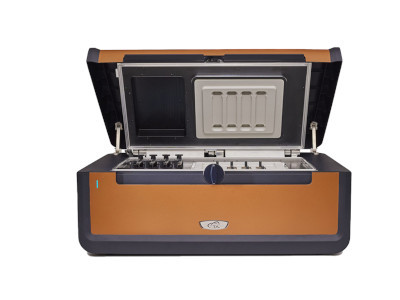 |
| Company | TA Instruments – a division of Waters Corporation | TA Instruments – a division of Waters Corporation | TA Instruments – a division of Waters Corporation | TA Instruments – a division of Waters Corporation |
| Item | Nano Differential Scanning Calorimeter | DSC 25 Differential Scanning Calorimeter | DSC 2500 Differential Scanning Calorimeter | Rapid Screening-Differential Scanning Calorimeter |
| Citations | | | | |
| Catalog Number | | DSC 25 | DSC 2500 | RS-DSC |
| Price | | | | |
| Type | High-resolution DSC | Differential Scanning Calorimeter | Differential Scanning Calorimeter | Inquire |
| Temperature Range | -10°C to 130°C | -180°C to 725°C | -180°C to 725°C | 20 to 100 °C |
| Description | The Nano DSC differential scanning calorimeter is designed to characterize the molecular stability of dilute in-solution biomolecules. The Nano DSC obtains data using less sample than competitive designs. Solid-state thermoelectric elements are used to precisely control temperature and a built-in The Nano DSC differential scanning calorimeter is designed to characterize the molecular stability of dilute in-solution biomolecules. The Nano DSC obtains data using less sample than competitive designs. Solid-state thermoelectric elements are used to precisely control temperature and a built-in precision linear actuator maintains constant or controlled variable pressure in the cell. Automated, unattended continuous operation with increased sample throughput is achieved with the optional Nano DSC Autosampler.... Read More | We invite you to experience the world’s finest line of Differential Scanning Calorimeters, the Discovery DSC 2500, DSC 250 and DSC 25. Discover the advanced engineering and attention to detail that provides enhancements in every aspect of DSC technology including a new level of user experience. FromWe invite you to experience the world’s finest line of Differential Scanning Calorimeters, the Discovery DSC 2500, DSC 250 and DSC 25. Discover the advanced engineering and attention to detail that provides enhancements in every aspect of DSC technology including a new level of user experience. From the most cost-effective DSC with industry-leading performance, to the most advanced DSC available, there is a Discovery DSC to meet your needs and exceed your expectations.... Read More | We invite you to experience the world’s finest line of Differential Scanning Calorimeters, the Discovery DSC 2500, DSC 250 and DSC 25. Discover the advanced engineering and attention to detail that provides enhancements in every aspect of DSC technology including a new level of user experience. FromWe invite you to experience the world’s finest line of Differential Scanning Calorimeters, the Discovery DSC 2500, DSC 250 and DSC 25. Discover the advanced engineering and attention to detail that provides enhancements in every aspect of DSC technology including a new level of user experience. From the most cost-effective DSC with industry-leading performance, to the most advanced DSC available, there is a Discovery DSC to meet your needs and exceed your expectations.... Read More | The Next Generation of Thermal Stability Testing for Biologic Drugs
The TA Instruments RS-DSC (Rapid Screening-Differential Scanning Calorimeter) is a powerful and versatile instrument that revolutionizes the thermal stability testing of biological drugs with its high efficiency and streamlined The Next Generation of Thermal Stability Testing for Biologic Drugs
The TA Instruments RS-DSC (Rapid Screening-Differential Scanning Calorimeter) is a powerful and versatile instrument that revolutionizes the thermal stability testing of biological drugs with its high efficiency and streamlined analysis.
For scientists in the demanding world of biological drug development, understanding biomolecule stability under thermal variations is crucial to ensure product quality, and support regulatory approval. Short-term thermal stability testing reveals a compound’s resilience to thermal stress, predicts shelf life, and ensures efficacy. The requirement for accurately measuring this in a high throughput environment is challenging without disrupting processes or meeting tight timelines. To meet this demand, we designed the TA Instruments RS-DSC (Rapid Screening-Differential Scanning Calorimeter), a new solution for the rapid characterization of biotherapeutic thermal stability.
How the TA Instruments RS-DSC Can Help:
- Accelerate thermal stability testing: The TA Instruments RS-DSC provides detailed insights into drug product thermal stability significantly quicker by analyzing up to 24 samples simultaneously. The TA Instruments RS-DSC’s technology also simplifies the characterization of highly concentrated drug products.
- Improve efficiency: The TA Instruments RS-DSC ensures materials are used efficiently by utilizing disposable MFCs (Micro microfluidic chips) to contain the sample. MFCs require <15 ul sample volume, and the design facilitates a cleaner, more streamlined operation by reducing the need for tedious sample dilution, repetitive instrument cleaning, and contamination risks.
- Make more informed decisions: NanoAnalyze™ Software effortlessly handles the increased data volume produced by the TA Instruments RS-DSC, providing in-depth, precise insights about a molecule’s thermal stability and thermodynamic properties.
... Read More |
| Quantity | EA | EA | EA | EA |
| Get Quote | | | | |