|  |  |  |
| Company | Waters | Wyatt Technology | Waters | Wyatt Technology | Waters | Wyatt Technology |
| Item | miniDAWN™ Multi-Angle Light Scattering (MALS) Detector for SEC-MALS | Aura CL System Particle Analyzers | microDAWN™ Multi-Angle Light Scattering Instrument for UHP-SEC-MALS |
| Citations | | | |
| Catalog Number | miniDAWN | Aura CL | microDAWN |
| Price | | | |
| Description | Couple the miniDAWN™ to your favorite HPLC or FPLC to determine the absolute molar masses and sizes of macromolecules and nanoparticles in solution from hundreds to millions of Daltons—without the need for column calibration standards. This sensitive unit requires as little as 25 ng injected Couple the miniDAWN™ to your favorite HPLC or FPLC to determine the absolute molar masses and sizes of macromolecules and nanoparticles in solution from hundreds to millions of Daltons—without the need for column calibration standards. This sensitive unit requires as little as 25 ng injected sample, 100 kDa polystyrene in THF (varies for other samples and solvents). The miniDAWN is engineered with self-contained modules that are easily replaced making it field serviceable. The system-ready monitors soise levels in real-time and an all-green status indicator lets you know when your system is ready for data collection. The optional DLS module uses the WyattQELS™ module, which fits inside the miniDAWN to providing on-line dynamic light scattering for determining radii down to 0.5 nm. All light scattering cells are subject to contamination by particles and to combat this issue the instrument has a self-cleaning, embedded COMET™ ultrasonic module. For maximum reliability and uptime, program the miniDAWN to automatically clean the cell after every run. The units may also be combined with a Calypso™ composition-gradient system to characterize biomolecular interactions.... Read More | Accurately identify, count, and characterize subvisible particle contaminants in minutes with Aura CL
Measuring particles in cell therapy manufacturing has always been a challenge, and the fact that the drug product itself is a particle makes it even harder.
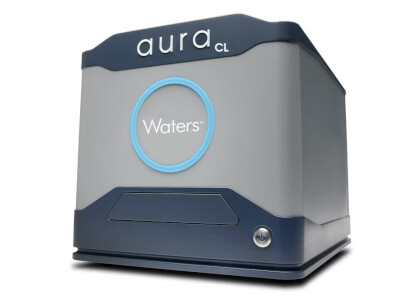
Waters Aura CL System is the first Accurately identify, count, and characterize subvisible particle contaminants in minutes with Aura CL
Measuring particles in cell therapy manufacturing has always been a challenge, and the fact that the drug product itself is a particle makes it even harder.
Waters Aura CL System is the first system that, unlike traditional methods, quickly identifies and distinguishes cells from protein aggregates or harm-causing particles while providing all required cytometric capabilities—counting cells, identifying types, and measuring viability in one simple assay.
Powered by innovative technology, Waters Aura CL System is the ultimate tool to identify, count, and characterize subvisible particle contaminants introduced in cell therapy manufacturing—so you can access high-throughput insights earlier in discovery to develop cell therapies faster, smarter, and safer.
Features:- Detect and count residual Dynabeads. Finding and counting Dynabeads™* is easier than ever with Aura CL System. Unlike traditional methods that can be subjective, cumbersome, inaccurate, and prone to error, this powerful, fully automated tool allows you to make an accurate count at high speed.
-
ID cells/non cells. Rather than spending hours manually sorting through images or learning how to use complex machine learning libraries, Aura CL System makes it easy to precisely ID cells from non-cell aggregates right out of the box.
-
Analyze small volumes. Analyze small volumes. You only need 5 µL of sample, which allows for particle and cell characterization earlier in development.
-
Learn more with innovative technology. Using backgrounded membrane imaging (BMI) and fluorescence membrane microscopy (FMM), Aura CL System performs cell viability assays with definitive cell identification for 96 40-µL samples in under an hour.
... Read More | The microDAWN™ MALS detector performs absolute characterization of macromolecules eluting from UHPLC (or UPLC), determining molar mass and size independently of retention time and molecular reference standards. This instrument offers superb sensitivity over a wide range of molar mass, size andThe microDAWN™ MALS detector performs absolute characterization of macromolecules eluting from UHPLC (or UPLC), determining molar mass and size independently of retention time and molecular reference standards. This instrument offers superb sensitivity over a wide range of molar mass, size and concentrations. In most respects, the microDAWN is similar to the well-established miniDAWN, a workhorse MALS instrument used in hundreds of labs around the world for characterizing proteins and other molecules smaller than 50 nm in radius. The microDAWN is uniquely suitable for use in conjunction with UHPLC Size Exclusion Chromatography (µSEC-MALS) thanks to its small interdetector dispersion and produces minimal band broadening in order to maintain the narrow peaks typical of UHPLC. In some cases it may be used with ion-exchange or other types of chromatography.... Read More |
| Type | MALS and optional DLS | Inquire | MALS and optional DLS |
| Particle Size | Inquire | Range from >1 µm (ECD) to <5 mm (ECD) | Inquire |
| Detector(s) | High-gain, high-dynamic range photodiodes at 3 detection angles for MALS. Optional avalanche photodiode for simultaneous dynamic light scattering measurements. | Inquire | High-gain, high dynamic range, static light scattering detectors at 3 angles |
| Measuring Time | Depedent on LC separation | 1 minute/sample (BMI read time). 3 FL channels, 30 seconds/sample (FMM read time) | Depedent on LC separation |
| Light Source | 658 nm laser, programmable from 10% to 100% maximum power. | Inquire | 660 nm laser, programmable 10% - 100% of maximum power. |
| Applications | With SEC/GPC: determination of distributions of absolute molar mass, size, conformation, conjugate ratio. With Calypso CG-MALS: characterization of biomolecular interactions. | Inquire | With SEC/GPC: determination of distributions of absolute molar mass, size, conformation, conjugate ratio. |
| Get Quote | | | |