|  |  |  |
| Company | Waters | Wyatt Technology | Waters | Wyatt Technology | Waters | Wyatt Technology |
| Item | miniDAWN™ Multi-Angle Light Scattering (MALS) Detector for SEC-MALS | DAWN™ Multi-angle Light Scattering (MALS) Instrument | omniDAWN™ Multi-angle Light Scattering (MALS) Instrument |
| Citations | | | |
| Reviews | | | |
| Catalog Number | miniDAWN | DAWN | omniDAWN |
| Price | | | |
| Description | Couple the miniDAWN™ to your favorite HPLC or FPLC to determine the absolute molar masses and sizes of macromolecules and nanoparticles in solution from hundreds to millions of Daltons—without the need for column calibration standards. This sensitive unit requires as little as 25 ng injected Couple the miniDAWN™ to your favorite HPLC or FPLC to determine the absolute molar masses and sizes of macromolecules and nanoparticles in solution from hundreds to millions of Daltons—without the need for column calibration standards. This sensitive unit requires as little as 25 ng injected sample, 100 kDa polystyrene in THF (varies for other samples and solvents). The miniDAWN is engineered with self-contained modules that are easily replaced making it field serviceable. The system-ready monitors soise levels in real-time and an all-green status indicator lets you know when your system is ready for data collection. The optional DLS module uses the WyattQELS™ module, which fits inside the miniDAWN to providing on-line dynamic light scattering for determining radii down to 0.5 nm. All light scattering cells are subject to contamination by particles and to combat this issue the instrument has a self-cleaning, embedded COMET™ ultrasonic module. For maximum reliability and uptime, program the miniDAWN to automatically clean the cell after every run. The units may also be combined with a Calypso™ composition-gradient system to characterize biomolecular interactions.... Read More | The DAWN™ instrument is an advanced detector for precise characterization of proteins, polymers, and nanoparticles including viral vectors, lipid nanoparticles and vesicles. Using multi-angle static light scattering (MALS) and optional dynamic light scattering (DLS), DAWN analyzes molar massThe DAWN™ instrument is an advanced detector for precise characterization of proteins, polymers, and nanoparticles including viral vectors, lipid nanoparticles and vesicles. Using multi-angle static light scattering (MALS) and optional dynamic light scattering (DLS), DAWN analyzes molar mass, size, conformation, particle concentration, conjugation (e.g. glycoproteins) or encapsulation (e.g. AAV capsid content). It stands out with exceptional sensitivity and the widest range of molecular weight, size, and concentration of any MALS instrument, paired with a broad selection of configurations and optional modules for enhanced capabilities.
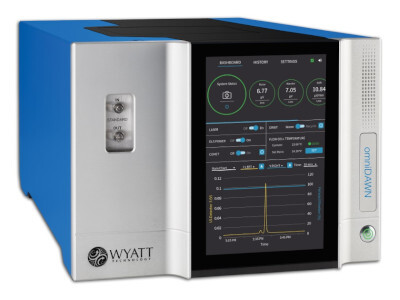
The DAWN is most often used in conjunction with gel permeation chromatography (GPC-MALS), size exclusion chromatography (SEC-MALS) or an EclipseTM, field-flow fractionation instrument (FFF-MALS) and may also be used with ion-exchange chromatography or reverse-phase chromatography. The instrument includes a high-resolution, touch-screen front panel to display data graphs, system health and instrument diagnostics and is accompanied by ASTRA™, the most versatile software package available for analysis of online multi-angle and dynamic light scattering.... Read More | Delivering up to 4× faster runs with half the sample, the omniDAWN™ multi-angle static light scattering (MALS) photometer is purpose-built for UPLC™ and UHPLC systems for non-destructive absolute molar mass and size characterization of macromolecules and nanoparticles in solution. It provides Delivering up to 4× faster runs with half the sample, the omniDAWN™ multi-angle static light scattering (MALS) photometer is purpose-built for UPLC™ and UHPLC systems for non-destructive absolute molar mass and size characterization of macromolecules and nanoparticles in solution. It provides exceptional sensitivity across a broad range of molecular weights, sizes, and concentrations, supported by advanced analysis modules, practical implementation guides, and intelligent system health monitoring to ensure reliable performance and streamlined workflows.... Read More |
| Type | MALS and optional DLS | MALS and optional DLS | Multi-Angle Light Scattering (MALS) photometer |
| Detector(s) | High-gain, high-dynamic range photodiodes at 3 detection angles for MALS. Optional avalanche photodiode for simultaneous dynamic light scattering measurements. | High-gain, high-dynamic-range photodiodes at 18 angles for MALS; optional avalanche photodiode that may be placed at any of four angles for DLS.
Fluorescence-blocking filters available for use with analytes that fluoresce when illuminated at the MALS wavelength. | Inquire |
| Measuring Time | Depedent on LC separation | Depedent on LC separation | Inquire |
| Light Source | 658 nm laser, programmable from 10% to 100% maximum power. | 658 nm laser, programmable 10% - 100% of maximum power.
Optional: 785 nm for fluorescence suppression | Inquire |
| Applications | With SEC/GPC: determination of distributions of absolute molar mass, size, conformation, conjugate ratio. With Calypso CG-MALS: characterization of biomolecular interactions. | With standard SEC/GPC or EclipseTM (FFF system): determination of distributions of molar mass, size, conformation, conjugation ratio and particle concentration.
With Calypso composition-gradient system: label-free characterization of biomolecular interactions including self- and hetero-association as well as non-specific interactions. | With standard SEC/GPC or EclipseTM (FFF system): determination of distributions of molar mass, size, conformation, conjugation ratio, and particle concentration. With the Calypso composition-gradient system: label-free characterization of biomolecular interactions, including self- and hetero-association as well as non-specific interactions. |
| Get Quote | | | |