Dynamic light scattering particle size analyzers are used to measure the size of very small particles (0.6 nm to 6 um) in solution. This class of particle size analyzer interprets particles’ sizes from the fluctuations in scattered laser light created by the particles’ Brownian motion. Dynamic light scattering analysis is used in medical, biological research and materials science applications, and is also known as photon correlation spectroscopy or quasi-electron light scattering.
Although requiring suspension in a solution, particle size analysis by dynamic light scattering offers the advantage of measuring particles across a wide range of densities, from parts-per-million up to 40% of solution. Other advantages include size analysis of particles in their native environment and micro-liter scale minimum sample sizes. In addition, dynamic light scattering particle size analyzers may also provide information on particle shape and require less user training. Analysis times typically vary from 30 seconds to 2 minutes per sample.
|  |  |
| Company | Brookhaven Instruments Corporation | Brookhaven Instruments Corporation |
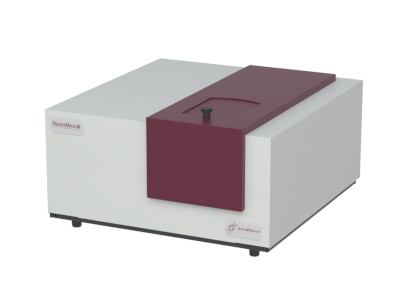
| Item | Nanobrook Series Size And Zeta Potential Analyzers | NanoBrook ZetaPALS |
| Catalog Number | Nanobrook | |
| Price | | |
| Description | The NanoBrook Series particle/molecule size and zeta potential analyzers incorporate all you need for fast, routine, sub-micron measurements of size and zeta potential. The instrument incorporates the principles of Dynamic Light Scattering (DLS) for particle sizing and distribution and Doppler The NanoBrook Series particle/molecule size and zeta potential analyzers incorporate all you need for fast, routine, sub-micron measurements of size and zeta potential. The instrument incorporates the principles of Dynamic Light Scattering (DLS) for particle sizing and distribution and Doppler Velocimetry (Electrophoretic Light Scattering, or ELS) for zeta potential measurement. The instrument also includes Phase Analysis Light Scattering (PALS) measurements for samples with low mobilities.
Rapid
Most measurements only take a minute or two.
Three Possible Scattering Angles
Measurements of colloids are traditionally made using a 90° scattering angle. For smaller nanoparticles, proteins including IgG, mAbs, and peptides, these < 50 nm samples can be measured using the backscattering angle (173°). Finally, the 15° detection angle can be selected for added sensitivity with aggregation measurements. Zeta potential measurements are always performed using the 15° detection angle to minimize diffusion broadening.
The NanoBrook Omni combines all of the most common configurations
With the NanoBrook Omni, measure samples in nearly every possible suspension environment from high salts such as PBS and sea water to organic solvents and aqueous solutions. Particle and protein sizing, with the highest sensitivity, utilize three measurement angles for truly unbiased measurement results.... Read More | Inquire |
| Type | Particle size and zeta potential analyzers | Phase Analysis Light Scattering (PALS), Electrophoretic Light Scattering (ELS) |
| Particle Size | < 0.3 nm to 10 µm (DLS), 1 nm to 100 µm (Zeta) | Inquire |
| Detector(s) | Avalanche Photo Diode (APD) | Avalanche Photodiode (APD) |
| Measuring Time | Inquire | Seconds to minutes |
| Light Source | 40 mW 640 nm temperature-controlled solid-state semiconductor laser. Alternative wavelengths available | 40 mW red diode laser, nominal 640 nm wavelength |
| Get Quote | | |