Thermal analyzers are used to measure mechanical properties as a function of temperature or time. Numerous types of thermal analyzers are available such as simultaneous thermal analyzers, dynamic mechanical analyzers, thermogravimetric analyzers, thermomechanical analyzers, and many more. For a high throughput lab with a need for both thermogravimetric and calorimetric data, consider a simultaneous thermal analyzer as this can provide simultaneous data for both measurements under the same testing conditions. Many materials testing laboratories opt for dynamic mechanical analyzers for their ability to accurately analyze the mechanical and viscoelastic properties of various materials including polymers, thermoplastics, and metals. When comparing thermal analysis equipment some key considerations to keep in mind could be temperature precision, accuracy, and many other application-specific specifications. Thermal analyzers have a wide range of applications in materials testing, pharmaceutical testing, food testing, and many other applications.
|  |  |  |  |
| Company | NETZSCH-Gerätebau GmbH | NETZSCH-Gerätebau GmbH | NETZSCH-Gerätebau GmbH | NETZSCH-Gerätebau GmbH |
| Item | TMA 512 Hyperion® Select Thermomechanical Analyzer | DSC 300 Caliris® Series- Differential Scanning Calorimeter | STA 319 Jupiter® Simultaneous Thermal Analyzer | TMA 512 Hyperion® Supreme Thermomechanical Analyzer |
| Catalog Number | TMA 512 | DSC 300 Supreme / DSC 300 Select / DSC 300 Classic | STA 319 | TMA 512 |
| Price | | | | |
| Temperature Range | -70°C to 1500°C/optional 1600°C | Supreme: -180°C to 750°C
Select: -170°C to 650°C
Classic: -170°C to 600°C | 10°C to 1100°C | -150°C to 1600°C |
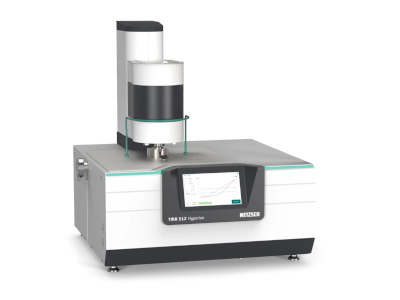
| Description | The TMA 512 Hyperion® Select - Detecting Even the Slightest Dimensional Changes for Ultimate Material InsightsFeatures:- Nanometer-Level Precision with Advanced LVDT Technology - The heart of the TMA 512 Hyperion® is a highly sensitive LVDT sensor that can measure length changes down to the nanometer
The TMA 512 Hyperion® Select - Detecting Even the Slightest Dimensional Changes for Ultimate Material InsightsFeatures:- Nanometer-Level Precision with Advanced LVDT Technology - The heart of the TMA 512 Hyperion® is a highly sensitive LVDT sensor that can measure length changes down to the nanometer scale. It boasts an impressive digital resolution of 0.125 nm. This ensures ultra-precise detection of dimensional changes, providing exceptional results for your thermal analysis needs.
-
Measurement Status Always in View with Innovative Display and LED Status Bar -
The LED status bar on the device clearly displays information about the current measurement, even from a distance. The user-friendly touchscreen display allows for easy control and real-time monitoring. It is seamlessly integrated into our Proteus® software, which enables quick setup and management of measurements.
-
Flexible Temperature and Atmosphere Control in a Vacuum-Tight TMA System -
Interchangeable furnaces support a wide temperature range. In the Select version, this spans from -70°C to 1500°C (optionally 1600°C). In addition, various gas atmospheres can be generated. The model with two furnaces allows quick changeover for different test requirements.
-
Force Modulation -
Digitally programmable force or displacement control up to 3 N with linear or stepwise force alteration and continuous force modulation for determining visco-elastic properties like Relaxation, Creep and Stress/Strain.
-
Hydrogen Research -
Measurements in up to 100% hydrogen atmosphere with maximum safety.
-
Seamless Instrument Compatibility -
Furnaces for the TMA 512 Hyperion® are fully compatible with other NETZSCH thermal analysers, such as the STA 509 Jupiter® and DSC 500 Pegasus®, enabling versatile laboratory integration.
... Read More | The DSC 300 Caliris® Supreme – The Future-Proof Choice
This version offers a choice of currently three modules and can be configured to achieve an unrivaled maximum temperature range of -180°C to 750°C. It is possible to update your device at any time to take advantage of the latest The DSC 300 Caliris® Supreme – The Future-Proof Choice
This version offers a choice of currently three modules and can be configured to achieve an unrivaled maximum temperature range of -180°C to 750°C. It is possible to update your device at any time to take advantage of the latest technological developments or to change your application. The choice of the module used remains unrestricted. Just choose between broad temperature range, fast heating rates or high sensitivity as needed.
The DSC 300 Caliris® Select – Tailor-Made for Your Applications
In the Select version of the DSC 300 Caliris®, there is an initial choice between three currently available modules. The maximum temperature range available in the DSC 300 Caliris® Select is -170°C to 650°C. The Select version allows for the exchange of modules of the same type avoiding instrument downtimes.
Both versions come with integrated color touch display, an LED status bar and can optionally be equipped with an automatic sample changer.
DSC 300 Caliris® Classic- Robust instrument with attractive price-performance ratio
Easy-to-use, robust, precise, optimized for everyday use – these are the features of the innovative DSC 300 Caliris® Classic. The unique design of this instrument encompasses everything needed for successful DSC investigations – regardless of whether the user is a beginner or an experienced professional. Above all, it is the innovative software that sets new standards: the already established AutoEvaluation and Identify now meet the next generation of data management LabV®, which keeps track of the collected data and organizes it for a smooth laboratory workflow.
The DSC 300 Caliris®Classic offers:
- A compact design for more space in your lab.
- Smart software that allows you to get started quickly with DSC measurements.
- Automated measurement and evaluation, making routine easy.
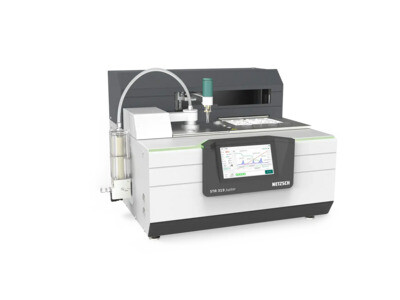
... Read More | The STA 319 Jupiter® is part of NETZSCH's Jupiter® range of STAs and offers several advantages:
- Temperature range of 10°C (RT) to 1025°C (or up to 1100°C): ideal for polymer, life science and inorganic measurements.
- Robust water-cooled ceramic furnace for fast heating and cooling.
The STA 319 Jupiter® is part of NETZSCH's Jupiter® range of STAs and offers several advantages:
- Temperature range of 10°C (RT) to 1025°C (or up to 1100°C): ideal for polymer, life science and inorganic measurements.
- Robust water-cooled ceramic furnace for fast heating and cooling.
- Advanced top-loading microbalance: Provides an impressive 20-ng resolution for long-term, high-quality measurements.
- Revolutionary ring sample holder design: eliminates the need for a standard reference crucible. Enables quick setup and minimizes handling errors.
- Defined atmospheric conditions thanks to vacuum-tight design.
- Coupling to gas analysis enables real-time identification of the composition of evolved gases.
... Read More | The TMA 512 Hyperion® Supreme - Detecting Even the Slightest Dimensional Changes for Ultimate Material Insights
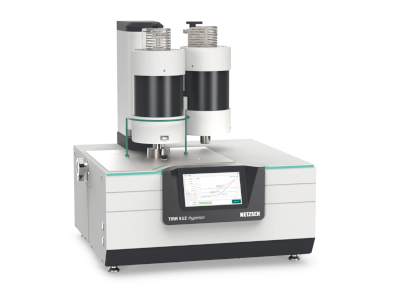
Features:- Nanometer-Level Precision with Advanced LVDT Technology -The heart of the TMA 512 Hyperion® is a highly sensitive LVDT sensor that can measure length changes down to the nanometer
The TMA 512 Hyperion® Supreme - Detecting Even the Slightest Dimensional Changes for Ultimate Material Insights
Features:- Nanometer-Level Precision with Advanced LVDT Technology -The heart of the TMA 512 Hyperion® is a highly sensitive LVDT sensor that can measure length changes down to the nanometer scale. It boasts an impressive digital resolution of 0.125 nm. This ensures ultra-precise detection of dimensional changes, providing exceptional results for your thermal analysis needs.
-
Measurement Status Always in View with Innovative Display and LED Status Bar -
The LED status bar on the device clearly displays information about the current measurement, even from a distance. The user-friendly touchscreen display allows for easy control and real-time monitoring. It is seamlessly integrated into our Proteus® software, which enables quick setup and management of measurements.
-
Flexible Temperature and Atmosphere Control in a Vacuum-Tight TMA System -
Interchangeable furnaces support a wide temperature range. In the Select version, this spans from -70 °C to 1500 °C (optionally 1600 °C). In addition, various gas atmospheres can be generated. The model with two furnaces allows quick changeover for different test requirements.
- Force Modulation -
Digitally programmable force or displacement control up to 3 N with linear or stepwise force alteration and continuous force modulation for determining visco-elastic properties like Relaxation, Creep and Stress/Strain.
- Hydrogen Research - Measurements in up to 100% hydrogen atmosphere with maximum safety.
-
Seamless Instrument Compatibility - Furnaces for the TMA 512 Hyperion® are fully compatible with other NETZSCH thermal analysers, such as the STA 509 Jupiter® and DSC 500 Pegasus®, enabling versatile laboratory integration.
... Read More |
| Measuring Range | Inquire | Supreme & Select ; ± 750 | Weight change up to 2000 mg | Inquire |
| Get Quote | | | | |