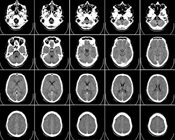
Computed tomography utilizes a motorized X-ray source that rotates around a gantry to capture a series of tomographic images that can be layered to generate an extremely accurate 3D image. Laboratory computed tomography instruments are used extensively for NDT testing and are capable of accurately imaging the entirety of a material. When comparing laboratory CT devices, scan times can be of paramount importance for keeping up with your throughput. Also, consider the detector of the CT device. Flat panel detectors tend to offer increased longevity and size, whereas CMOS detectors can offer increased scanning speed with improved resolution. Laboratory computed tomography devices are offered in several sizes ranging from benchtop to floor-standing models, the right choice will vary depending on laboratory space as well as the size of the object to be imaged.
Get Quote for All
Select up to 5 products from below to compare or request more information.
Rigaku Corporation
- (WxDxH) 2250 × 1800 x 2150 mm (PC, chiller not included)
- Maximum size of 600 mm diameter x 1200 mm height
- Flatpanel
- The shortest scan time 1 mon
Rigaku Corporation
- Benchtop
- (WxDxH) 980 x 700 x 580 mm (PC not included)
- 200 mm diameter x 270 mm height
- Flat panel; Detector pixel size 49.5 microns
- Shortest scan time 18 seconds
Rigaku Corporation
- (W×H×D) 1300 × 1880 × 655 mm (PC, chiller, vacuum pump not included)
- Maximum size of 20 mm diameter x 40 mm height
- High-resolution sCMOS
- Shortest scan time of 30 sec
Shimadzu
- (WxDxH) 2170 x 1350 x 1857 mm
- 400 mm dia. × H: 300 mm max.; 12 kg max.
- 16-inch flat panel detector
- Any value from 10 sec to 60 min
Shimadzu
- Benchtop
- 76" × 40" (WxD)
- f11.8"×H 12.6",22 lbs (Including sample setting jig)
- Flat panel detector
- 12 sec or 5 min
Select up to 5 products from above to compare or request more information.
Tags:
Please Login or Register to Create Tags