How Does a Scanning Electron Microscope Work?
A scanning electron microscope (also commonly abbreviated as SEM) uses beams of electrons to create magnified images of samples, as opposed to beams of light that a traditional microscope uses. SEMs use electrons that are bounced off near the surface region of a sample. Because the wavelength of electrons is notably smaller than that of light, the resolution of SEMs is greatly superior to that of a light microscope.
What Are Scanning Electron Microscopes Used For?
Because the SEM can magnify a sample up to 500,000 times its normal size and determine its chemical makeup, scanning electron microscopes have a wide range of applications. They are used for quality control in both the pharmaceutical and semiconductor industries, sample comparisons in forensics, diagnostics in medical labs, and in research labs to determine the composition of samples treated in different ways.
What Types of Scanning Electron Microscopes Are There?
Scanning electron microscopes have different kinds of signal detectors available that include back-scattered electrons (for imaging), characteristic X-rays (for determining types and amounts of elements present in the sample), transmitted electrons, and cathodoluminescence. Other variations in different scanning electron microscopes include availability of low or high vacuum mode and imaging options for bright field samples and/or dark field samples.

Check out this article "Integrated SEM Workflow Creates Powerful 'Nano-lab' " to see more ways in which SEM can be a valuable tool for your lab.
| 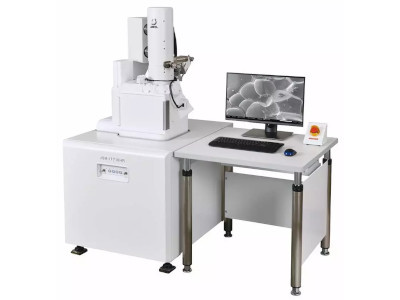 | 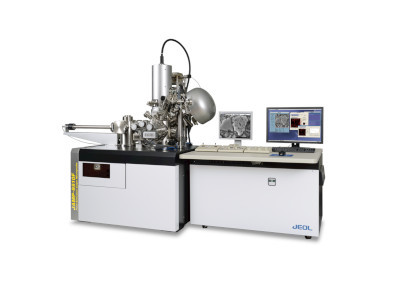 |
| Company | JEOL USA, Inc. | JEOL USA, Inc. |
| Item | JSM-IT710 High Resolution Large Chamber SEM | JAMP-9510F Field Emission Auger Microprobe |
| Catalog Number | JSM-IT710 | JAMP-9510F |
| Price | | |
| Description | High Resolution Large Chamber SEM
The JSM-IT710HR Field Emission SEM is a compact, versatile Schottky Field Emission SEM that delivers the next level of intelligent technology for high spatial resolution imaging and analysis.
Our unique in-lens field emission gun and advanced electron optics High Resolution Large Chamber SEM
The JSM-IT710HR Field Emission SEM is a compact, versatile Schottky Field Emission SEM that delivers the next level of intelligent technology for high spatial resolution imaging and analysis.
Our unique in-lens field emission gun and advanced electron optics deliver large probe currents while maintaining a small probe making this microscope ideally suited for high resolution applications. This highly versatile SEM is compact in design yet is equipped with a large chamber and both High and Low Vacuum modes for managing a wide variety of specimen types in their native state.
Smart – Flexible - Powerful - Smart – Accessible at any level with the latest innovations from JEOL’s intelligent technology. Best-in-class auto functions from alignment to focus delivers clear, high-resolution images in seconds. The workflow is fast with Zeromag, using our built-in optical camera for navigation and seamless transition to SEM imaging. View Live EDS both spectrum and X-ray maps with our analytical models. We’ve taken it to the next level by including Automation, from Montage (large area mosaics) to Simple SEM for automatic image collection at multiple locations, magnifications, and conditions. All this technology is packed into a compact platform for unprecedented ease-of-use.
- Flexible – The JSM-IT710HR is equipped with a large specimen chamber with multiple ports that are optimally positioned for analytical attachments such as: multiple EDS, EBSD (co-planar with EDS), WDS, CL, STEM, heating/cooling sub-stages etc. There is a large, internal, mechanically eucentric stage with the advantage of easy placement of large and heavy specimens and arranging their orientation prior to closing the door and evacuating the chamber.
- Powerful – The combination of JEOL’s unique in-lens field emission gun with up to 300nA of beam current and the aperture angle control lens which optimizes large probe currents to the smallest probe diameter delivers high spatial resolution imaging and analytical results. Our high-sensitivity, quadrant BSE detector provides a Live 3D surface reconstruction enhancing your view of specimens with complex topography. Analytical models include JEOL’s fully embedded EDS system for Real-Time, Live EDS spectra and Live X-ray maps. Built-in automation both streamlines and enhances throughput and internal Data Management software links all data for instant view of analysis locations. This SEM also supports live web viewing and remote control and is open to Python scripting.
... Read More | The JAMP-9510F offers the highest spatial resolution available in an Auger microprobe: (min. probe diameter of 3nm SEI; 8nm for Auger analysis). Employing a low-aberration condenser lens (in which an electrostatic field and a magnetic field are superposed), combined with a patented "in-lens' The JAMP-9510F offers the highest spatial resolution available in an Auger microprobe: (min. probe diameter of 3nm SEI; 8nm for Auger analysis). Employing a low-aberration condenser lens (in which an electrostatic field and a magnetic field are superposed), combined with a patented "in-lens' Schottky field emission gun, the JAMP-9510F obtains very small spot sizes with beam currents up to 200nA.
Key Features
- 3nm SEI resolution
- 8nm probe diameter for Auger analysis
- Variable energy resolution from 0.05% to 0.6%
- Chemical state analysis in several 10nm areas
- Neutralizing gun allows Auger analysis of insulating materials
- Large specimen stage - samples up to 95mm in diameter
... Read More |
| Type | Inquire | Auger microprobe |
| Resolution | High Vacuum Mode: 1.0 nm at 20 kV, 3.0 nm at 1.0 kV.
Low Vacuum Mode: 1.8 nm at 15 kV (using Backscattered Electron Detector). | 3nm(at 25kV, 10pA) |
| Specimen Size | 200 mm diameter, 75 mm height | Up to 20 mm in diameter (5 mm thick) |
| Probe Current | Few pA to 300 nA | 10-11 to 2×10⁻⁷ A |
| Applications | High spatial resolution imaging and analysis | Enables precise chemical bonding state analysis and compositional mapping, making it indispensable for researchers and engineers in materials science, nanotechnology, and related fields.? |
| Detector(s) | Quadrant BSE | Multi-channel detection |
| Get Quote | | |