How Does a Scanning Electron Microscope Work?
A scanning electron microscope (also commonly abbreviated as SEM) uses beams of electrons to create magnified images of samples, as opposed to beams of light that a traditional microscope uses. SEMs use electrons that are bounced off near the surface region of a sample. Because the wavelength of electrons is notably smaller than that of light, the resolution of SEMs is greatly superior to that of a light microscope.
What Are Scanning Electron Microscopes Used For?
Because the SEM can magnify a sample up to 500,000 times its normal size and determine its chemical makeup, scanning electron microscopes have a wide range of applications. They are used for quality control in both the pharmaceutical and semiconductor industries, sample comparisons in forensics, diagnostics in medical labs, and in research labs to determine the composition of samples treated in different ways.
What Types of Scanning Electron Microscopes Are There?
Scanning electron microscopes have different kinds of signal detectors available that include back-scattered electrons (for imaging), characteristic X-rays (for determining types and amounts of elements present in the sample), transmitted electrons, and cathodoluminescence. Other variations in different scanning electron microscopes include availability of low or high vacuum mode and imaging options for bright field samples and/or dark field samples.

Check out this article "Integrated SEM Workflow Creates Powerful 'Nano-lab' " to see more ways in which SEM can be a valuable tool for your lab.
|  |  |
| Company | JEOL USA, Inc. | JEOL USA, Inc. |
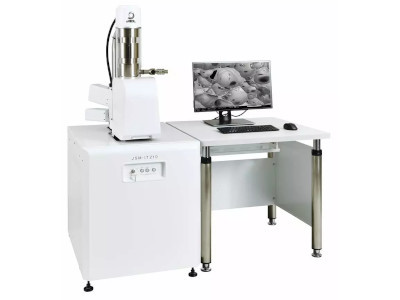
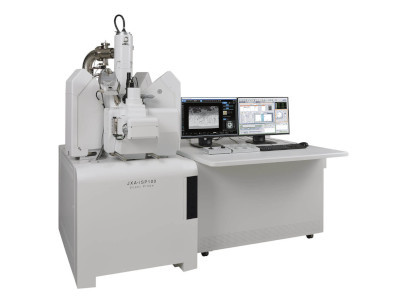
| Item | JSM-IT210 SEM | JXA-iSP100 Electron Probe Micro-Analyzer |
| Catalog Number | JSM-IT210 | JXA-iSP100 |
| Price | | |
| Description | InTouchScope™ Scanning Electron Microscope Series
The JSM-IT210 InTouchScope™ SEM Series incorporates the latest in JEOL intelligent technology and automation in a compact package.
Smart – Flexible – Powerful - Smart – The latest innovations with our InTouchScope™ series SEMs make them accessible at
InTouchScope™ Scanning Electron Microscope Series
The JSM-IT210 InTouchScope™ SEM Series incorporates the latest in JEOL intelligent technology and automation in a compact package.
Smart – Flexible – Powerful - Smart – The latest innovations with our InTouchScope™ series SEMs make them accessible at every level. A Specimen Exchange mode guides a new operator step-by-step from sample introduction to automatic condition setting and image formation. JEOL’s intelligent technology delivers best-in-class auto functions from alignment to focus for fast, clear, high-resolution images. With our built-in optical camera for navigation and seamless transition to SEM imaging the workflow is fast and easy. View Live EDS both spectrum and X-ray maps with our analytical models. Take it to the next level with built-in automation, from Montage (large area mosaics) to Simple SEM for automatic image collection at multiple locations, magnifications, and conditions. All this technology is packed into a compact platform for unprecedented ease-of-use.
- Flexible – Choose a platform that is right for you. We offer high vacuum and low vacuum models with or without our Live (embedded) EDS system. [JSM-IT210, JSM-IT210A, JSM-IT210LV, JSM-IT210LA].
- Powerful – High resolution tungsten source with unsurpassed low voltage performance. Enhanced algorithms for automatic beam alignment, auto focus and stigma correction allow you to focus on results. The high precision, 5-axis motorized stage enhances throughput. Zeromag with its integrated color camera allows for intuitive navigation to the area of interest and seamless transition to SEM imaging and analysis. Our high sensitivity quadrant BSE detector provides a Live 3D surface reconstruction enhancing your view of specimens with complex topography. Analytical models include JEOL’s fully embedded EDS system for Real-Time, Live EDS spectra and Live X-ray maps. Internal Data Management links all data for instant view of analysis locations.
... Read More | Research grade EPMA that provides both high imaging resolution and analytical resolution with a very high and stable probe current for optimum analytical performance. This new microprobe has a new SEM and EDS user interface (GUI) based on the FEG SEM's "SEM Center". It includes new algorithms for Research grade EPMA that provides both high imaging resolution and analytical resolution with a very high and stable probe current for optimum analytical performance. This new microprobe has a new SEM and EDS user interface (GUI) based on the FEG SEM's "SEM Center". It includes new algorithms for the auto functions of both the SEM column and the optical microscope. A new GUI provides a simplified work flow called "Easy EPMA" with built-in software and graphic-driven procedures for a broad range of user experience from the novice/occasional user to complete flexibility and capabilities for the very experienced EPMA scientist.
Key Features
- Customizable configuration of spectrometers and crystals optimized for the required application
- Performs both beam scanned line scans and maps as well as large area line scans and maps with stage scanning
- A 30mm2 integrated and embedded UTW-SDD-EDS system with high sensitivity including an in situ aperture wheel for ultrahigh beam current operation without compromising EDS spectrometer resolution and "Live" survey EDS acquisition to easily help find elements of interest
- Specimen chamber supports both a panchromatic high bandwidth imaging CL and a fully quantitative hyper-spectral CL (xCLent V System) with no loss of a WDS or any limitation on image collection
- Supports the installation of JEOL's Soft X-Ray Emission Spectrometers (SXES and SXES-ER) for ultralight elements and chemical state analysis
... Read More |
| Type | Inquire | Inquire |
| Resolution | High vacuum mode: 3.0 nm at 30 kV
Low vacuum mode: 4.0 nm at 30 kV (using Backscattered Electron Detector). | 6 nm (5 nm with LaB6 emitter) |
| Specimen Size | 150 mm diameter x 53 mm height | Inquire |
| Probe Current | 1 pA to 1 µA | Inquire |
| Applications | Compact stationary scanning electron microscope, embedded EDS, live analysis, heat-sensitive specimens, element maps | High-resolution imaging, quantitative elemental analysis, and chemical state analysis |
| Detector(s) | Small area EDS detector | Inquire |
| Get Quote | | |