How Does a Scanning Electron Microscope Work?
A scanning electron microscope (also commonly abbreviated as SEM) uses beams of electrons to create magnified images of samples, as opposed to beams of light that a traditional microscope uses. SEMs use electrons that are bounced off near the surface region of a sample. Because the wavelength of electrons is notably smaller than that of light, the resolution of SEMs is greatly superior to that of a light microscope.
What Are Scanning Electron Microscopes Used For?
Because the SEM can magnify a sample up to 500,000 times its normal size and determine its chemical makeup, scanning electron microscopes have a wide range of applications. They are used for quality control in both the pharmaceutical and semiconductor industries, sample comparisons in forensics, diagnostics in medical labs, and in research labs to determine the composition of samples treated in different ways.
What Types of Scanning Electron Microscopes Are There?
Scanning electron microscopes have different kinds of signal detectors available that include back-scattered electrons (for imaging), characteristic X-rays (for determining types and amounts of elements present in the sample), transmitted electrons, and cathodoluminescence. Other variations in different scanning electron microscopes include availability of low or high vacuum mode and imaging options for bright field samples and/or dark field samples.

Check out this article "Integrated SEM Workflow Creates Powerful 'Nano-lab' " to see more ways in which SEM can be a valuable tool for your lab.
| 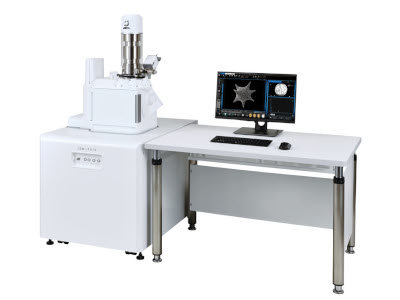 | 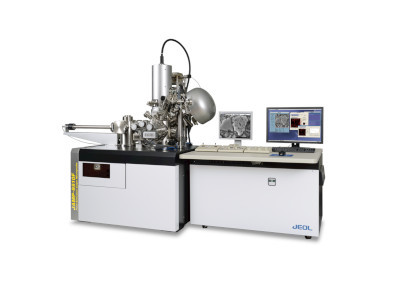 |
| Company | JEOL USA, Inc. | JEOL USA, Inc. |
| Item | JSM-IT510 Analytical SEM | JAMP-9510F Field Emission Auger Microprobe |
| Catalog Number | JSM-IT510 | JAMP-9510F |
| Price | | |
| Description | InTouchScope™ SEM Series
The JSM-IT510 InTouchScope™ SEM Series delivers the highest level of intelligent technology with built-in automation for the most versatile analytical SEM available today.
Smart – Flexible – Powerful - Smart – The latest innovations with our InTouchScope™ series SEMs make
InTouchScope™ SEM Series
The JSM-IT510 InTouchScope™ SEM Series delivers the highest level of intelligent technology with built-in automation for the most versatile analytical SEM available today.
Smart – Flexible – Powerful - Smart – The latest innovations with our InTouchScope™ series SEMs make them accessible at every level. JEOL’s Intelligent Technology delivers seamless navigation from optical to SEM imaging, Live EDS both spectrum and X-ray maps and the best auto functions from alignment to focus for fast, clear, and sharp images. We’ve taken it to the next level with Simple SEM, built-in automation for image collection at multiple locations and conditions. Simple SEM simplifies workflow for the most routine tasks. Our embedded Signal Depth display enhances understanding of analytical spatial resolution. All this technology packed into a compact platform for unprecedented ease-of-use.
- Flexible – Choose a platform that is right for you. We offer high vacuum and low vacuum models with or without our Live (embedded) EDS system. [JSM-IT510, JSM-IT510A, JSM-IT510LV, JSM-IT510LA]. This SEM series is equipped with a large specimen chamber that accommodates a wide variety of detectors and accessories such as: EDS, WDS, EBSD, CL, STEM, heating/cooling substages etc.
- Powerful – High resolution W filament source (LaB6 option) with unsurpassed low kV performance. The JSM-IT510 includes a large analytical chamber and stage. The stage is mounted inside the chamber enabling users to secure large, heavy and odd shaped objects on the stage with clear positioning prior to evacuating the chamber.
Zeromag, with our integrated color camera allows for intuitive navigation to the area of interest and seamless transition to SEM imaging and analysis. All data is linked for instant view of analysis locations. Our new high sensitivity quadrant BSE detector can provide a Live 3D surface reconstruction enhancing your view of specimens with complex topography such as a fracture surface, plating defect, etc. Analytical models include JEOL’s fully embedded EDS system for Real-Time, Live EDS spectra and Live X-ray maps.
... Read More | The JAMP-9510F offers the highest spatial resolution available in an Auger microprobe: (min. probe diameter of 3nm SEI; 8nm for Auger analysis). Employing a low-aberration condenser lens (in which an electrostatic field and a magnetic field are superposed), combined with a patented "in-lens' The JAMP-9510F offers the highest spatial resolution available in an Auger microprobe: (min. probe diameter of 3nm SEI; 8nm for Auger analysis). Employing a low-aberration condenser lens (in which an electrostatic field and a magnetic field are superposed), combined with a patented "in-lens' Schottky field emission gun, the JAMP-9510F obtains very small spot sizes with beam currents up to 200nA.
Key Features
- 3nm SEI resolution
- 8nm probe diameter for Auger analysis
- Variable energy resolution from 0.05% to 0.6%
- Chemical state analysis in several 10nm areas
- Neutralizing gun allows Auger analysis of insulating materials
- Large specimen stage - samples up to 95mm in diameter
... Read More |
| Type | Inquire | Auger microprobe |
| Resolution | High Vacuum: 3.0 nm at 30 kV, 15.0 nm at 1.0 kV
Low Vacuum (with Backscattered Electron Detector): 4.0 nm at 30 kV | 3nm(at 25kV, 10pA) |
| Specimen Size | 200 mm diameter, 90 mm height | Up to 20 mm in diameter (5 mm thick) |
| Probe Current | 1 pA to 1 µA | 10-11 to 2×10⁻⁷ A |
| Applications | Live analysis, simple EDS, high and low vacuum. | Enables precise chemical bonding state analysis and compositional mapping, making it indispensable for researchers and engineers in materials science, nanotechnology, and related fields.? |
| Detector(s) | Accommodates a wide variety of detectors and accessories such as: EDS, WDS, EBSD, CL, STEM, heating/cooling substages etc. | Multi-channel detection |
| Get Quote | | |