Fluorescence imaging is one of our most powerful tools for the study of molecular biology and biochemistry, whether the technique in question is epifluorescence microscopy (excitation and observation of fluorescence from above the specimen); more complex confocal microscopy, which provides a clean, 3-D image; or fluorescence-lifetime imaging microscopy (FLIM), in which the lifetime of the fluorophore signal is measured.
Considerations when choosing a Fluorescence Imaging System:
Key elements of all fluorescence imaging systems include a light source, such as a xenon or mercury lamp, excitation and emission filters, and a dichroic mirror or beamsplitter. Sensitive detection of biological molecules is a major benefit of the technique, as is multicolor detection, which eliminates sample-to-sample variation and is both time and cost effective.
Discover and compare Fluorescence Imaging Systems:
|  |  |
| Company | Thermo Fisher Scientific | Thermo Fisher Scientific |
| Item | EVOS™ M3000 Imaging System | CellInsight CX5 High-Content Screening (HCS) Platform |
| Citations | | |
| Catalog Number | AMF3000 | CX51110 |
| Price | | |
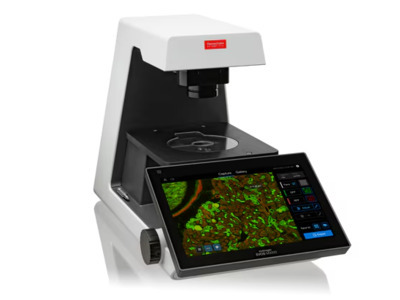
| Description | The EVOS M3000 Imaging system was designed to be the workhorse of any cell culture or research laboratory by democratizing the ability to produce reliable, stunning high-quality cell images and video.
Between its entry-level price point, compact design intended to fit easily in cell culture hoodsThe EVOS M3000 Imaging system was designed to be the workhorse of any cell culture or research laboratory by democratizing the ability to produce reliable, stunning high-quality cell images and video.
Between its entry-level price point, compact design intended to fit easily in cell culture hoods and the ability to exchange objectives and light cubes for new applications, the EVOS M3000 Imaging system serves as the go-to instrument for routine manual cell imaging.
Features
- Cell confluency in seconds – Built-in automated real-time image analysis for measuring cell confluency
- No training required – Simple user interface with touchscreen display
- Space-saving design – Smallest EVOS footprint fits easily on the lab bench or in a cell culture hood
- Versatile – Capture images in brightfield, phase contrast, color imaging, and fluorescence
- Flexible – Compatible with the full selection of EVOS objectives (1.25-60X) and light cubes
- Connectivity – Network-capable instrument facilitates seamless data transfer, storage and collaboration, enhancing productivity and data management
... Read More | The Thermo Scientific CellInsight CX5 is a compact benchtop high-content screening platform, offering automated quantitative cell analysis for every cell biology or screening lab. Designed for researchers looking to increase their screening throughput, the platform offers five multiplexable The Thermo Scientific CellInsight CX5 is a compact benchtop high-content screening platform, offering automated quantitative cell analysis for every cell biology or screening lab. Designed for researchers looking to increase their screening throughput, the platform offers five multiplexable wavelengths for fluorescence and white-light illumination for colorimetric samples. The system is compatible with 6-well through 1,536 microwell plates and can also be used to analyze slides and dishes. For groups requiring high-throughput screening, the CX5 can be automated with robotic handling for hands-free workflows. With proprietary autofocus and integrated plate-scanning intelligence methods, the CellInsight CX5 HCS Platform brings speed and accuracy to investigate cell populations and phenotypes without sacrificing sensitivity and resolution.
Applications - Intracellular to multicellular morphology measurements while measuring intensity of specific reporter molecules.
- Collect only the images and data you select and make multiple measurements per object, over time, if desired
- Measure subpopulations and reject undesired objects automatically
- Comprehensive pre-validated and user configurable image analysis without user scripting or programming
- Exploratory assay development tools and specific biology optimized tools built into the HCS Studio™ Cell Analysis Software
- Define biological thresholds for outputs based on control populations
- Ability to create multi-parameter gates from individual output measurements
... Read More |
| Type | Fluorescence, brightfield, color brightfield, and phase contrast | Inquire |
| Light Source | Adjustable intensity LED (>50,000-hour life per light cube) | Inquire |
| Get Quote | | |
Articles
- UltraMicroscope II Light Sheet Microscope
- Robust and Innovative LSFM for Large Samples
- Whole Brain Imaging
- MACSima™ Platform
- Economical Workhorse Scope for Research Laboratories
- Let’s Get Small
- No Slowing in Today’s Flowing
- Neuroscience 2019: Gene Therapy, Brain Organoids, Neuroinflammation, and Technology Highlights
- Nikon Instruments, Inc. and Agilent Technologies Announce Agreement to Deliver Cutting-Edge Technology for Laser-Based Biomedical Research Imaging Systems
- Macro to Micro Fluorescence In Vivo Imaging
- Professor Chad Mirkin Presented Plenary Lecture to Open the 2011 Pittsburgh Conference & Exposition in Atlanta, GA
- Carestream Molecular Imaging Offers New High Speed, Highly Sensitive, Multimodal Imaging System for In Vitro Applications
- Linkam temperature controlled cryo stage selected by the Leiden University Medical Center to study biological specimens
- NANOINK LAUNCHES THE NANOARRAY ASSAY SYSTEM
- T/MIP allies with Technology Business Consulting (TBC) to expand sales, marketing, and IP services
- Leica Microsystems Launches SCN400 F Combined Fluorescence and Brightfield Slide Scanner
- Brilliant Gel Visualization with Visi-Blue Technology
- Carl Zeiss Obtains Licence from University of California for Illumination Technique
- Olympus VS120® Virtual Microscopy Slide Scanning System Offers Significantly Faster Scans and New Deconvolution Capability
- PHOTONIS Introduces xSCELL Digital Scientific Camera
- Deep-Cooled, 640 x 512 InGaAs Camera Engineered for Advanced Low-Light NIR/SWIR Applications in Life and Physical Sciences
- FEI Buys ASPEX Corporation
- Max is the New Mini!
- Syngene Launches PXi Touch Range of Versatile Image Analysis Systems Quick and Simple Touch Screen Set-up for Perfect Blots, 1D and 2D Gel Images
- PerkinElmer Introduces a Novel Non-Invasive Near Infrared Imaging Agent for Toxicology Applications
- Axio Scan.Z1 Digital Slide Scanner Acheives Optimal Image Quality
- Powerful Imaging Microscope, but Not Easy to Learn
- How to Reduce Autofluorescence
- Very Powerful, Speedy & High Quality Imaging System
- Good Plate Reader
- Digital Microscope for Cell Culture
- EVOS M5000 - A Powerful, Fast, Fully Automated Cell Imaging System
- Safe and Collaborative Cell Culture Imaging
- Incucyte® CX3 Live-Cell Analysis System
- Overcoming Challenges in Live Imaging of 3D Cell Cultures
- New Research Into How Cells Self-Organize
- Achieving Accurate Raw Images with High-content Screening
- Novel Method Developed to Resolve Individual Monomers in Complex Polymers
- Equipment for Western blot
- Fast and Simple Documentation of Western Blots Using ChemiDoc™ MP Imaging System
- Excellent Protein Detection System for Western Blot
- New Microscopy Technique Enables Real-time 3D Imaging
- Nano-microscope Shows Promise in Hunt for 2D Magnetic Materials
- A Unit for Error-free and Sensitive Quantification-free and Sensitive Quantification
- Datacolor to Preview first-of-its-kind Color Calibration System for Microscopy
- Small but Accomplished Quantitation Unit
- Fluorescence Microscopy: Fundamentals and Resources
- Researchers Publish Comprehensive Atlas of Primary Motor Cortex
- Tech Compare: Light Sheet vs. Super Resolution Microscopy for Live-cell Imaging
- Three-Dimensional Volumetric Imaging of Living Cells
- Groundbreaking New Cancer Diagnostic Tool
- Researchers Develop The World's Most Sensitive Method For Observing Single Molecules
- Screening System Evaluates Drug Candidates Early for Safety
- Overcoming Challenges in STEM to Build a Successful Career
- Leveraging the Power of Multiomics in Spatial Tissue Imaging
- Modified Phone Can Detect Drugs, Pathogens and Chemicals
- LabTips: The Best Tips and Tricks for Spectroscopy