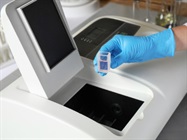
When light strikes matter, one of three outcomes will occur: It will be absorbed, reflected or transmitted. Ultraviolet or UV spectrophotometry is a type of absorption spectroscopy which is used to measure the absorbance of light across the ultraviolet ranges of the electromagnetic spectrum. UV spectrophotometers are relied upon in numerous disciplines including analytical chemistry, forensics, DNA and RNA-related work, pharmaceuticals, biology, environmental sciences and more.
Before choosing a spectrophotometer, however, purchasers should consider three aspects: range of the detection wavelength, working absorbance range, and measurement time. Other considerations include lab requirements and total costs.
Get Quote for All
Select up to 5 products from below to compare or request more information.
Shimadzu
- 220 to 800 nm
- +/- 1 nm
- Single Beam
- ±1 nm
Shimadzu
- 240 to 2600 nm
- 0.1 nm
- Double Beam
- +/- 0.2 nm (UV VIS), +/- 0.8 nm (NIR)
Shimadzu
- 190 to 1,100 nm
- ±1 nm
- Single Beam
- ±1 nm
Shimadzu
- 190 to 1100 nm
- 1 nm
- Double beam
- ± 0.1 nm at D2 peak 656.1 nm, ± 0.3 nm for entire range
Shimadzu
- 185 to 900 nm or 220 to 1400 nm (when the ISR-2600Plus Integrating Sphere Attachment is used)
- 0.1 nm
- Double Beam, Single Monochromator
- +/-0.1 nm (656.1 nm D2), +/-0.3 nm (all range)
Shimadzu
- 185 to 900 nm
- 0.1 nm
- Double Beam, Double Monochromator
- +/-0.1 nm (656.1 nm D2), +/-0.3 nm (all range)
Shimadzu
- 185 to 3,300 nm
- Maximum resolution: 0.1 nm
- High-performance double monochromator
- Inquire
Select up to 5 products from above to compare or request more information.
Tags:
Please Login or Register to Create Tags