In Raman microscopy, also called confocal Raman microscopy, an optical microscope and a Raman spectrometer are combined into one instrument in order to provide high resolution images of small samples. This high resolution imaging has applications that include materials science, earth science, cell biology, medicine, cosmetics, and art analysis.
A Raman microscope consists of a basic optical microscope, a Raman spectrometer, a laser, a light source, and a detector such as a CCD camera. The optical microscope uses light to magnify and identify samples while the Raman spectrometer scatters light and measures the excitation vibration. When selecting a microscope, it is important to consider the qualities of each of the microscope's components and their optimal configuration for a particular application.
Find, compare, and request a quote for Raman and confocal Raman microscopes across leading suppliers at Labcompare; including access to product citations, related published figures, and first-hand reviews from our scientific community.
|  |  | |  | |
| Company | Bruker Optics | Bruker Optics | Bruker Optics | Bruker Optics | Bruker Optics |
| Item | RAMANwalk Confocal Raman Microscope | HYPERION Series Microscopes | RAMANdrive Wafer Analysis System | RamanScopeIII FT-Raman Microscope | RAMANtouch Confocal Laser Scanning Raman Microscope |
| Citations | | | | | |
| Figures | | | | | |
| Catalog Number | | BOPT HYPERION 1000 / HYPERION 2000 / HYPERION 3000 | | BOPT RamanScopeIII | |
| Price | | | | | |
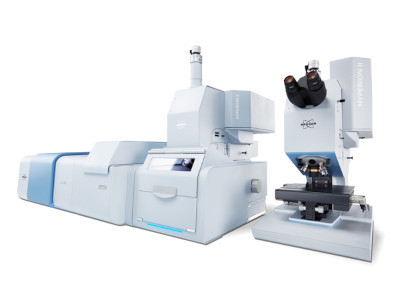
| Description | Inquire | The HYPERION II is an innovation force in infrared microscopy. It provides IR imaging down to the diffraction limit and sets the benchmark in ATR microscopy. It combines FT-IR and Infrared Laser Imaging (ILIM) microscopy for the first time ever in a single device, offering all three measurement The HYPERION II is an innovation force in infrared microscopy. It provides IR imaging down to the diffraction limit and sets the benchmark in ATR microscopy. It combines FT-IR and Infrared Laser Imaging (ILIM) microscopy for the first time ever in a single device, offering all three measurement modes: transmission, reflection, and ATR.
Features:
- Selection of detectors for µ-FT-IR: Broad-, mid, narrow-band LN2-MCTs, thermoelectrically cooled (TE) MCT.
- Focal-plane array detector for infrared imaging (64 x 64 or 128 x 128 pixel).
- Optional QCL implementation by Laser Infrared Imaging Module (ILIM, laser class 1)
- Objective lens selection: 3.5x/15x/36x IR, 20x ATR, 15x GIR, 4x/40x VIS.
- Spectral range extension – from Near-Infrared (NIR) to Far-Infrared (FIR)
- Selection of apertures: manual knife-edge, automated knife-edge aperture wheel. Metal apertures for NIR
- Selection of accessories and sample stages: macro IR imaging accessory, cooling/heating stage, sample compartment, etc.
- Selection of visual/optical tools: Darkfield illumination, Fluorescence illumination, VIS polarizers, IR polarizers, etc.
... Read More | Inquire | Today, with the culmination of more than 20 years experience, Bruker Optics offers state-of-the-art infrared and Raman microscopes. RamanScopeIII is based on a next generation, 'hybrid' platform that can accommodate multiple wavelengths of Raman excitation. The new RamanScopeIII system can be Today, with the culmination of more than 20 years experience, Bruker Optics offers state-of-the-art infrared and Raman microscopes. RamanScopeIII is based on a next generation, 'hybrid' platform that can accommodate multiple wavelengths of Raman excitation. The new RamanScopeIII system can be coupled to Bruker Optics' multi-range fully digital FT-Raman module, the RAM II, as well as the standalone MultiRAM FT-Raman spectrometer.
Optical Microscopy
The RamanScopeIII is based on the Olympus BX series optical microscope, all the necessary tools for sample visualization and contrast enhancements such as the Koehler brightfield and darkfield illumination, polarized light, Nomarski differential interference contrast (DIC) and fluorescence are available.
Minimize Fluorescence Interference
When sample fluorescence is a problem, FT-Raman microanalysis with near infrared excitation (1064 nm) is frequently the only solution. As sample fluorescence can be orders of magnitude more intense than Raman scattering, the presence of fluorescence often precludes observation of Raman scattering. Excitation at 1064 nm is low enough in excitation energy such that fluorescence is rarely generated.
Sensitivity and Stability
High throughput optics and Bruker Optics’ unique liquid nitrogen cooled Germanium detector offers ultra-low signal detection with minimal noise assuring excellent sensitivity. The long hold time of the refrigerant provides hassle free operation for an entire week. The inherent precision of the Bruker Optics FT-Raman instruments provides reliable long term stability, which is especially important for sample analyses requiring long acquisition times.
Combined Fourier Transform and Dispersive Raman Spectroscopy
The base system offers the long wavelength benefits of the fluorescence-free, non-destructive 1064 nm Fourier transform Raman excitation. The RamanScopeIII sits on an optical microscope, which can also accommodate the SENTERRA™ grating based dispersive Raman spectrometer. This combination provides full spectroscopic characterization and optimizes the strengths of the both techniques for your complex micro-analysis samples. By utilizing the multiple wavelengths, from 1064 nm to 532 nm on a single microscopic spot, the RamanScopeIII delivers excellent insight into many demanding applications, including forensics, pharmaceutical and polymer science.
... Read More | Inquire |
| Measurement Mode(s) | Inquire | Inquire | Inquire | FT-Raman spectrometer | Inquire |
| Focal Length | Inquire | Inquire | Inquire | Inquire | Inquire |
| Detector(s) | Inquire | Inquire | Inquire | InGaAs detector or Ge diode detector | Inquire |
| Laser Sources | Inquire | Inquire | Inquire | Diode-pumped, air-cooled Nd:YAG laser source | Inquire |
| Get Quote | | | | | |