Multispectral imaging systems are used by the food industry, the pharmaceutical industry, and in medical, biology, and chemistry labs for analysis and quality control. Types of multispectral imaging include NIR (near infrared), which can provide a quick and accurate analysis of samples within the 700–2500 nm wavelength range, and Raman, which measures the scattering of near infrared, visible, or near ultraviolet light. In both cases, the photons that are emitted and absorbed by the sample allow identification of specific molecules.
Considerations for purchasing a Multispectral Imaging System
Sensitivity, specificity, and resolution of images can vary between chemical imaging systems. Another feature to be aware of is what type of imaging the system is capable of and whether other types of imaging can be integrated into the system.
Discover and compare Multispectral Imaging Systems:
|  |  |
| Company | Bruker Optics | Bruker Optics |
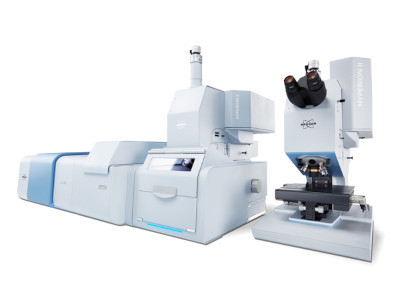
| Item | HYPERION Series Microscopes | SENTERRA II Dispersive Raman Microscope |
| Citations | | |
| Figures | | |
| Reviews | | |
| Catalog Number | BOPT HYPERION 1000 / HYPERION 2000 / HYPERION 3000 | BOPT SENTERRA |
| Price | | |
| Description | The HYPERION II is an innovation force in infrared microscopy. It provides IR imaging down to the diffraction limit and sets the benchmark in ATR microscopy. It combines FT-IR and Infrared Laser Imaging (ILIM) microscopy for the first time ever in a single device, offering all three measurement The HYPERION II is an innovation force in infrared microscopy. It provides IR imaging down to the diffraction limit and sets the benchmark in ATR microscopy. It combines FT-IR and Infrared Laser Imaging (ILIM) microscopy for the first time ever in a single device, offering all three measurement modes: transmission, reflection, and ATR.
Features:
- Selection of detectors for µ-FT-IR: Broad-, mid, narrow-band LN2-MCTs, thermoelectrically cooled (TE) MCT.
- Focal-plane array detector for infrared imaging (64 x 64 or 128 x 128 pixel).
- Optional QCL implementation by Laser Infrared Imaging Module (ILIM, laser class 1)
- Objective lens selection: 3.5x/15x/36x IR, 20x ATR, 15x GIR, 4x/40x VIS.
- Spectral range extension – from Near-Infrared (NIR) to Far-Infrared (FIR)
- Selection of apertures: manual knife-edge, automated knife-edge aperture wheel. Metal apertures for NIR
- Selection of accessories and sample stages: macro IR imaging accessory, cooling/heating stage, sample compartment, etc.
- Selection of visual/optical tools: Darkfield illumination, Fluorescence illumination, VIS polarizers, IR polarizers, etc.
... Read More | The SENTERRA is a high performance Raman microscope spectrometer designed for the most demanding analytical and research applications. Its most important innovation is certainly its internal continuous calibration as it ensures highest wavenumber accuracy without the need for calibrations with The SENTERRA is a high performance Raman microscope spectrometer designed for the most demanding analytical and research applications. Its most important innovation is certainly its internal continuous calibration as it ensures highest wavenumber accuracy without the need for calibrations with external standards.
Features - Continuous calibration with Sure_Cal®
- Compact design with spectrometer included in the microscope
- Multiple wavelengths: 1064nm, 830nm, 785nm, 633nm, 532nm and 488nm
- High performance confocal depth profiling with FlexFocusTM
- Automatic Fluorescence Rejection (AFR) using SERDS
- Open architecture version for the study of larger samples (e.g. in art) with high lateral resolution
- Inverted version for the investigation of living cells
- Coupling with Atomic Force Microscopy (AFM)
Compact and Rugged Design
Most commercial Raman microscopes employ spectrometers that are separate from the microscope. Therefore, alignment and maintenance of these devices is time consuming. SENTERRA integrates a multi-laser Raman spectrometer between the reflected light illuminator and the binocular of the microscope. SENTERRA’s compact design provides a short beam path, which increases sensitivity and makes it more robust and stable.... Read More |
| Type | FT-IR Chemical Imaging | Inquire |
| Wavelength Range | 80 to 25,000 cm-1 (far-IR to VIS) | Multiple Wavelengths: 1064, 830, 785, 633, 532 and 488 nm |
| Scan Time | Inquire | Inquire |
| Spectral Bandwidth | Inquire | Inquire |
| Detector(s) | Inquire | Grating |
| Get Quote | | |