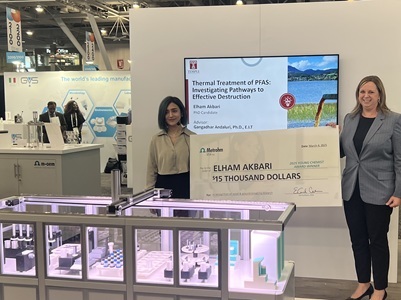
What happens when the water meant to keep us alive starts making us sick? That’s the question Temple Ph.D. graduate student Elham Akbari leads with when speaking about her research into the destruction of per- and polyfluoroalkyl substances (PFAS).
Today, the USGS estimates that at least 45% of the nation’s tap water contains one or more types of PFAS. To remediate these “forever chemicals,” water and wastewater treatment plants use adsorption with granular activated carbon and ion exchange (IX) resins. However, these methods do not completely destroy PFAS chemicals, and also come with their own negative side effects.
Akbari’s research, titled “Thermal Treatment of PFAS: Investigating Pathways to Effective Destruction,” explores the use of supercritical water oxidation (SCWO) reactors for PFAS remediation. By leveraging thermal degradation techniques at temperatures exceeding 500°C, 750°C and 1000°C, Akbari’s work demonstrates the potential for SCWO to break the carbon-fluorine bonds in PFAS compounds and convert them into less hazardous byproducts like carbon dioxide, water and inorganic fluorides.
Using real-world samples from water utilities, under a variety of operational conditions, Akbari was able to achieve nearly 70% fluorine recovery for PFBA and PFOS at 1000°C. However, 100% fluorine recovery was not achieved, indicating incomplete mineralization and suggesting the formation of products of incomplete combustion (PICs). PIC formation highlights the need for further optimization of thermal incineration processes—a future direction of Akbari’s work.
Akbari’s study also showed SCWO achieved almost 100% removal of all carboxylic PFAS compounds, but less than 60% removal of sulfonic PFAS. Akbari says further optimization is required for sulfonic PFAS removal.
In recognition of this work, Metrohm USA announced Akbari as the winner of the 2025 Young Chemist Award. The Young Chemist Award, which comes with a $15,000 cash prize, is a prestigious accolade that Metrohm awards annual to celebrate outstanding research that transforms the landscape of chemistry. This year, Metrohm specially asked for research that addressed a current environmental or sustainability challenge using chemical analysis.
At Pittcon 2025, Metrohm awarded Akbari her $15,000 Young Chemist prize, and gave her the opportunity to present her research at the conference. Labcompare also caught up with Akbari at Pittcon to discuss her award-winning research.
Labcompare: Tell me about the research that helped you win the Young Chemist award?
Akbari: My research mainly is on PFAS. Made around 1940s, the problem with PFAS chemicals is that they are everywhere, and they are linked to many health risks like cancer, thyroid disease, miscarriage, developmental problems in children, and more. The more challenging problem is that conventional treatment methods cannot remove them completely. So, my research is on thermal degradation of these compounds with super critical water oxidation in a way that it doesn't produce any harmful byproducts during this procedure.
Labcompare: How is your PFAS destruction method different than the conventional methods used today?
Akbari: Right now, the current practices are absorption in wastewater treatment or water treatment plants. They are using carbon active or ion exchange, but this only transfers PFAS from liquid waste to solid waste. We should be doing something with the solid phase. Solid waste can be disposed by landfilling, but landfilling causes secondary contamination. There’s also incineration, but that causes air pollution. And again, this is incomplete combustion—it doesn't remove PFAS completely and it's not efficient at all. Whereas supercritical water oxidation can be a closed system and—using the properties of super critical state of water—we can completely break down the organic bonds in PFAS as opposed to just remediation of PFAS.
Labcompare: How does your research address critical knowledge gaps?
Akbari: With the experiments, I was focused on getting the complete data on PFAS destruction and ensuring it was done with real-world samples. At the end of the research, I was focused on the reaction kinetics so we could check if the project is scalable or not. It’s not right now, but I think it will be in the future.
Labcompare: What's next for your research?
Akbari: Right now, I'm barely halfway through my research—I'm not even close to the end. I’ll move forward with different, more complex samples to check the destruction pathways. I will also be identifying optimized parameters for PFAS thermal degradation, including residence time—pH and temperature—as well as analyzing reaction rates and mechanisms of PFAS degradation during thermal treatment. I will investigate byproducts for targeted PFAS compounds, and study degradation mechanisms for intermediate compounds. Importantly, I will be investigating the scalability of SCWO for municipal water treatment. This is my last year of Ph.D., so I have a lot to do.
Labcompare: When you're done with your Ph.D., what do you want to do?
Akbari: I will not go for academia. I think—at this point at least—I'm not going. I want to take a 3-to-4 year gap. I want to go into industry, maybe do something that actually goes beyond lab-scale. I’d like to do something that you can see the results of it. Then, I’ll see what happens. I’d like to go to law school.
Labcompare: What do you see for PFAS remediation/destruction in the future? What are you hoping to see?
Akbari: I don't think PFAS remediation is a thing that's going fast enough. Maybe in 10 years, we’ll at least have remediation methods in all the water treatment plants. Hopefully something is going to come along and the problem will be solved, but right now, there are so many moving parts and the regulations are only for 6-7 PFAS compounds. I think everything is going to grow—but not fast enough. I hope it's going to be fast, but who knows? We have so many other problems, too, so we cannot focus on just this one thing.