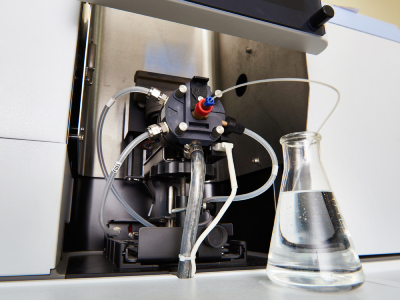
Atomic absorption spectrophotometry is an analytical technique used to determine the concentration of target elements in a sample by detecting and measuring the amount of light absorbed by the atomized sample.
Atomic absorption spectrophotometry primarily utilizes one of two methods to achieve sample atomization. In flame atomic absorption spectrophotometers (FAAS), acetylene (C₂H₂ ) is mixed with an oxidant, either oxygen or nitrous oxide (N₂O), to create a flame which atomizes the sample. Alternatively, In graphite furnace atomic absorption spectrophotometers (GFAAS), samples are heated within a hollow graphite tube until vaporization occurs.
To determine the concentrations of target elements, an AAS analyzes the amount of light absorbed by the atomic vapor created during atomization. Elements characteristically absorb light at different wavelengths allowing for precision identification and quantification of their concentration. To achieve this, an AAS uses a light source (typically hollow cathode lamps) to emit light at different wavelengths and passes that beam of light through the atomic vapor. Once light passes through the atomic vapor, the instrument will then analyze the amount of light absorbed at a specified wavelength and calculate the concentration of the target element.
While each type of AAS works on the same principle of light absorption, each can provide slight benefits and drawbacks when compared to the other. While a flame AAS is more tolerant of challenging sample matrices, the sensitivity of the instrument is typically limited to the PPM range. For laboratories that require trace analysis, graphite furnace instruments can operate in the PPB range if the sample matrix is kept clean. Many modern instruments are combo units that can perform both graphite furnace or flame atomization.
The primary drawback of an AAS is analysis time. Since elements absorb light at different wavelengths, multiple lamps are needed to cover the full range of neccesary wavelengths. In some instruments this could require changing the bulb to achieve a full range of analysis, making AAS analysis a poor fit for screening work. To remedy this, many instruments can now have multiple lamps installed at once enabling sequential analysis of the same sample, enabling faster sample throughput and general elemental screening.
Below you will find a few of our top-rated atomic absorption spectrophotometers, you can compare specifications or request a quote from leading suppliers.
Articles
- The TORION TRIDION™-9 GC-TMS Receives New Product Showcase Award
- Hiden Membrane Inlet Dissolved Gas and Vapour Monitor
- Thermo Scientific Mass Spectrometers Drive Proteomics Breakthroughs Reported in Nature and Nature Methods
- Edinburgh Instruments’ Spectrometer Helps Identify New Electronic State In Carbon Nanotube Research
- Waters UltraPerformance Convergence Chromatography Ushers in New Category of Separation Science at Pittcon
- Mass Spectrometers for Use in Clinical Diagnostics
- Doping Detection Stays a Neck Ahead
- AB SCIEX Announces Biologics Initiative
- Thermo Fisher Scientific Introduces Next-Generation Immunoaffinity Sample Preparation Solution for Downstream Mass Spectrometry
- Quotient Bioresearch Investment in Bioanalytical Facility
- IonSense, Inc. Issued Two Patents on Direct Analysis in Real Time Mass Spectrometry. Introduces New Product at International Mass Spectrometry Conference, Kyoto, Japan.
- New GC/TOF-Related Website Offers Analytical Chemists a Wealth of Information
- Business as Usual for Markes International as Schauenburg International Acquires a Majority Share
- Waters Publishes New Beginners Guide to Solid Phase Extraction (SPE)
- Thermo Fisher Scientific Introduces Automated Sample Prep/LC System Designed to Make LC-MS/MS Analysis Accessible to More Clinical Researchers
- Enhanced Analysis and Imaging Capabilities on Display at JEOL Pittcon Booth #2224
- AB SCIEX and LECO Partner to Offer Combined Solutions for GC/MS and LC/MS to Metabolomics Researchers
- ISOLUTE® Myco SPE Columns, a Dedicated Product for The Efficient Extraction of Mycotoxins from Food Matrices
- 908 Devices and IQT Enter Strategic Partnership to Develop New Mass Spectrometry Analyzers
- Microsaic Systems Signs Commercial Agreement for Novel Miniaturised Chip-based Scientific Instrument
- Waters Biopharmaceutical, Bioanalysis and Screening Solutions Now Shipping with UNIFI 1.6
- New Chemical Ionization Application Notes from LECO
- LECO Announces Special Events at ASMS
- JEOL and Zoex Partnership Combines Comprehensive Two-Dimensional Gas Chromatography with High Sensitivity Mass Spectrometer
- Waters Introduces the SYNAPT G2-Si to Its Mass Spectrometer Product Line
- Thermo Fisher Scientific Launches World’s First “Tribrid” LC-MS, Transforming Life Sciences Research with Revolutionary Depth of Analysis and Usability
- Pegasus® HT GC-TOFMS
- Pegasus® 4D GCxGC-TOFMS: Comprehensive Two-Dimensional Gas Chromatography
- Chemical Ionization Source for Pegasus® GC-HRT
- Pegasus® GC-HRT (High Resolution TOFMS)
- Bruker Debuts High-Performance LC Triple Quadrupole Mass Spectrometers
- AB SCIEX, Genedata & LECO Announce Partnership for New Cross-Platform Metabolomics Data Analysis Solution
- Thermo Fisher Scientific Signs Distribution Agreement with MKI for Lipidomics Software
- Bruker CAM to Showcase Award Winning EVOQ, SCION and PACER Technology at North American Chemical Residue Workshop 2013
- LECO GCxGC Technology Used in Award-Winning Paper
- LECO to Host Webinar on GC-TOFMS Flavor Analysis
- LECO and CDS Analytical Announce Relationship to Deliver Pyrolysis and High Performance GC-TOFMS
- IONICON Launches the New Super-fast PTR-TOF 1000 Trace Gas Analyzer
- Biognosys’ Spectronaut™ software now supports Thermo Scientific™ Q Exactive™
- New Dimensions in Isotope Ratio MS Using ESI-FT Technology
- How MS Improves Biopharma QC and Speed to Market
- Pittcon Announces 2014 Editors' Awards: Journalists Select Gold, Silver and Bronze
- Shimadzu Introduces New Triple Quadrupole Mass Spectrometer
- Perspectives from ASMS 69: Part I
- MALDI-TOF/TOF System Exceeds Your Expectations
- Expensive to Maintain, but Performs Great
- Buyers’ Guide: Best Buys for Mass Spectroscopy
- New Mass Spectrometry Technology Simplifies Solid Sample Analysis
Looking for more? Be sure to read our Atomic Absorption Spectroscopy Buyers Guide which can help you make informed decisions for your laboratory with overviews of popular products and solutions, as well as recent trends and applications.