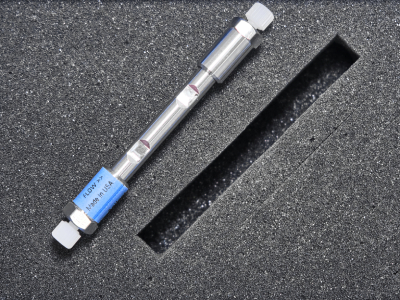
Liquid chromatography columns use molecule size, polarity, and elution time to separate and analyze target compounds within a given sample. Common column construction includes a stainless-steel housing filled with densely packed chemically functionalized beads or particles called the stationary phase.
When deciding which LC column is right for your application first consider the phase of the column and ensure that you match polarity. Common phase materials include reversed phase (such as C18) which can be used for polar analytes, normal phase which can be used for non-polar analytes, ion exchange columns which separate charged species, and size-exclusion columns which only separate based on molecular size and not interaction.
Along with phase material, column dimensions can play a role in your chromatography analysis. While a wide column offers higher load capacity, using a narrower column usually results in better sensitivity.
Lastly, pore and particle size must also be considered. Pore size, often measured in angstroms and abbreviated Å, is a measure of the pore size of the packing material found within your column. As your target molecules size increase, so must your pore size to allow for proper diffusion into and out of the packing material.
In contrast to pore size, particle size is a measure of the particles themselves. In general, smaller particles improve resolution but can create increased backpressure and could require slightly longer times for analysis. For routine analysis most scientists will use a 5 µm particle size as their standard column configuration in their instrument, however, recent advancements in chromatography tech have led to 3 µm and even as small as 1.7 µm particle sizes being used more often.
Below you will find a few examples of columns popular amongst our scientific community, you can compare specifications or request a quote from leading suppliers.
|  |  |  |
| Company | Shimadzu | Phenomenex | MilliporeSigma |
| Item | Shim-pack Arata LC Columns | Luna HPLC Columns | BIOshell™ UHPLC and HPLC Columns for Biomolecules |
| Citations | | | |
| Price | | Inquire | |
| Description | Unprecedented Resolution and Peak Shape for High pH Compounds
Even for LC columns that claim to be designed for basic compounds, adequate resolution | One of the World’s Leading LC Columns
Explore resolution with 10 unique Luna selectivities and find your next selectivity tool. Combined with high | BIOshell™ columns deliver maximum speed and efficiency for the separation of biomolecules on both UHPLC and HPLC systems. The Fused-Core® |
| Mode of Separation | Reversed Phase | Hydrophilic Interaction, Ion Exchange, Normal Phase, Reversed Phase, No Separation Mode | Reversed-phase, Hydrophilic interaction chromatography (HILIC), Normal phase |
| Pore Size | 12 nm (120 Å) | 100 Å or 200 Å | 90 Å up to 1000 Å |
| Particle Size | 2.2 µm, 5 µm | 2.5, 3, 5, 10, 15 µm | 2.0 µm to 5.0 µm |
| End Capping | Proprietary | Inquire | Inquire |
| Flow Rate | Inquire | Inquire | Inquire |
| Applications | Basic Compounds & Peptides | Inquire | Inquire |
| Get Quote | | Inquire | |
For additional reading be sure to check out our recent LABtips article, LABTips: HPLC Column Storage, which delves into the topic of column storage, a necessary step in extending a columns life while maintaining its performance.