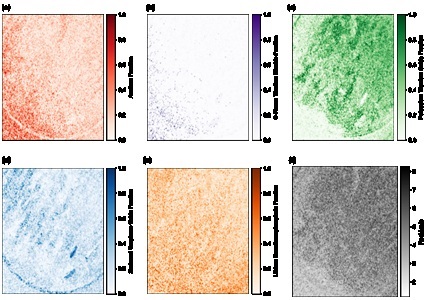
Confocal Raman and NNLS analysis of the cycled TiO2/K2Ti4O9/rGO electrode. NNLS fraction maps for (a) TiO2 anatase, (b) TiO2 (B), (c) K2Ti4O9, (d) rGO, and (e) LiPF6-derived SEI, which provide clear spatial separation of the overlapping components. (f) NNLS residual map, where low residual intensity confirms that the linear model captures the principal spectral variation across the cycled electrode surface.
As demand for higher-performance, longer-lasting and safer batteries continues to grow, researchers are increasingly relying on Raman spectroscopy and microscopy to better understand the complex chemical and structural changes that occur within battery materials. Because Raman is non-destructive and requires minimal sample preparation, it enables scientists to characterize electrode materials, electrolytes and solid-state components without significantly altering the sample, making it particularly valuable throughout the battery development lifecycle.
Unlike techniques that primarily report bulk composition, macroscopic electrochemical response or elemental distribution, Raman probes vibrational signatures that are directly linked to molecular structure, crystallinity, bonding, phase composition, lattice dynamics and local chemical environment. This combination of chemical specificity and flexibility makes Raman particularly well suited to the heterogeneous, dynamic and often strongly non-equilibrium systems thar mar modern electrochemistry and energy storage research.
One of Raman’s greatest strengths is its ability to provide molecular-level information about chemical bonding and crystal structure. Researchers use Raman spectra to identify active materials, monitor phase transitions during charge and discharge cycles, detect degradation products and evaluate the formation of the solid electrolyte interphase (SEI)—the critical layer that influences battery performance, longevity and safety.
Another vital advantage is Raman’s ability with in situ measurements, allowing researchers to observe chemical transformations in real-time while a battery is cycling. This capability provides a dynamic view of electrochemical processes that is difficult to achieve with traditional analyses.
Additionally, Raman spectroscopy is applicable across a wide range of battery chemistries. The versatile technique is suited for characterizing multiple traditional and non-traditional materials that comprise today and tomorrow’s batteries, including photoelectrodes, potassium-ion, zinc and more.
Photo-rechargeable batteries
A photo-rechargeable battery (PBR) is a dual functionality electronic device that can harvest solar energy and store it as chemical energy. Photoelectrodes—which function as both a light-harvesting material and an electrode—give the battery its dual functionality. Because of this, PRBs need to have a long cycle life and operate independently. Thus, photoelectrodes must be robust enough to withstand simultaneous electrochemical cycling and photoexcitation.
During cycling, lithium-metal electrodes undergo substantial redistribution of material. Plating and stripping can produce dendritic structures, mossy lithium, void formation and surface roughening. These changes alter local chemical environments and can be mapped through variations in Raman spectra and intensity. Raman microscopy also provides a chemically specific, spatially resolved method for examining how photorechargeable battery electrodes evolve during repeated charge and discharge.
A key target is the SEI. Raman microscopy can track changes in vibrational bands associated with organic decomposition products and reaction intermediates, revealing how the interphase develops during cycling. Changes in peak position, linewidth and relative intensity can indicate altered bonding environments, crystallinity, stress or composition.
For photorechargeable systems, Raman imaging is particularly valuable because electrode behavior is coupled to light-driven processes. Illumination can modify charge-carrier generation, reaction kinetics and local current distribution, potentially producing structural changes that differ from those observed under conventional electrochemical cycling. Comparing Raman maps collected before cycling, after charging and after discharge can help distinguish reversible transformations from permanent degradation.
The technique also supports correlative analysis. Raman images can be compared with electron microscopy, atomic force microscopy, X-ray methods and electrochemical data to connect molecular-scale chemical changes with nanoscale morphology and cell-level performance. For example, localized spectral changes may be correlated with regions of increased roughness or with areas where lithium deposition becomes non-uniform.
Potassium-ion batteries
The development of high-performance potassium-ion batteries depends on more than identifying suitable electrode materials. Electrolyte chemistry is equally critical, influencing ion transport, interfacial reactions and the stability of the electrode–electrolyte interface.
Potassium ions interact strongly with their surrounding solvent molecules and counterions. These interactions influence the structure of the electrolyte, the ease with which K⁺ migrates through the liquid phase and the energy required for desolvation at the electrode surface. Raman spectroscopy, particularly in operando configurations, offers researchers a direct way to observe these molecular processes.
This molecular perspective is particularly important for concentrated and localized high-concentration electrolytes. In these systems, the balance between free solvent, coordinated solvent and ion aggregates can determine both transport properties and interfacial stability. Raman measurements help identify how changes in salt concentration or solvent composition alter the local chemical environment surrounding K⁺, providing information that cannot be obtained from conductivity measurements alone.
But perhaps the greatest analytical value emerges when Raman spectroscopy is integrated with electrochemical cycling. Operando Raman measurements allow researchers to monitor electrolyte chemistry as a battery is charged and discharged, rather than examining the electrolyte only before or after cycling. Spectral changes reveal evolving solvation structures, electrolyte decomposition and the formation of interphase species at electrode surfaces.
This capability is especially valuable for understanding the solid-electrolyte interphase, which can determine long-term cycling performance. A chemically unstable or heterogeneous interphase may promote continued electrolyte consumption and uneven potassium-ion transport. Conversely, a stable interphase can suppress parasitic reactions and improve reversibility. Operando Raman spectroscopy helps establish the relationship between interphase chemistry and electrochemical behavior by tracking these changes as they develop.
For potassium-ion battery research, operando Raman spectroscopy is essentially a mechanistic tool for connecting molecular-scale electrolyte chemistry with interfacial stability and cell performance. By revealing how electrolyte components interact and evolve under realistic operating conditions, Raman measurements can accelerate the design of safer, more stable and higher-performing potassium-ion battery systems.
Case study: Flexible zinc-air battery design
Flexible zinc-air batteries (FZABs) are a potential energy source to power wearable technologies, medical devices and aerospace components, and there has been significant progress in their development in recent years. FZABs have the advantage of being low-cost, safe, environmentally friendly and having a large theoretical energy density.
But despite the technology’s advantages, research has found that the mechanical properties and conductivity of the FZAB electrolyte decreases significantly when exposed to low temperatures because of the formation of ice crystals.
To overcome this limitation, researchers at Guangxi University in China recently designed a FZAB with a cellulose nanofiber (CNF)-based flexible hydrogel electrolyte containing lithium chloride (LiCl).
According to the team’s paper, published in Journal of Materials Chemistry A, the spectral signatures of note in the gels were bands at 1117 cm-1, 1295 cm-1, 1344 cm-1, 1443 cm-1, and 1655 cm-1, which were assigned to C-C skeletal stretching, CH2 twisting, CH bending, CH2 bending, and C=O stretching, respectively.
As the concentration of LiCl in the CN-FH was increased, various changes were noted in the Raman spectrum of the material. The intensity of the CH bending mode increased, the CH2 twisting and C=O stretching modes decreased in intensity, and splitting occurred in the CH2 bending mode. These changes were all attributed to Cl–ions becoming embedded in the hydrogel structure and changing the hydrogen bonding.
To better understand why LiCl reduced ice crystal formation in the FZAB electrolyte at low temperatures, researchers also analyzed the region corresponding to water vibrational modes in the Raman spectra of the different electrolytes.
The results showed that as the LiCl concentration was increased in the CNF-FH, the intensity ratio between the symmetric OH stretching band at 3263 cm-1 and the asymmetric OH stretching band at 3433 cm-1 decreased. The ratio between these bands is a key marker of the water-ice phase transition, with the symmetric band dominant in ice and the asymmetric band dominant in water. This difference is attributed to the degree of order in the sample, with asymmetric OH stretching being much more common when hydrogen bonds can both form and break in a flexible structure and symmetric OH stretching being common in rigid structures such as ice. This suggests that LiCl is weakening the ability of the water molecules to form the hydrogen bonds required for crystallization. Overall, the results confirm the ability of the LiCl to inhibit ice formation at low temperatures.
Last thoughts
As battery technologies diversify, the challenge is no longer simply to identify what materials are present, but to understand how complex chemical systems evolve under realistic operating conditions. This is where Raman spectroscopy and microscopy thrive. By linking molecular information with spatial and temporal resolution, the technique provides a way to examine battery behavior as a dynamic process rather than a sequence of isolated measurements.
Looking ahead, the next major development in battery characterization is likely to come not only from advances in instrumentation, but also from improvements in workflow automation and data analysis. Modern battery experiments can generate thousands of spectra, images and time-resolved measurements, creating a growing demand for techniques that can automatically identify regions of interest, track chemical changes and focus analyst attention on the most meaningful results.
Recent developments (highlighted in Edinburgh Instruments' battery research webinar) have demonstrated how automated Raman imaging and intelligent data-driven workflows can help accelerate this process by reducing manual intervention while still capturing chemically significant features across complex electrode materials. As datasets continue to grow in both size and complexity, these automated approaches will become increasingly important for enabling faster, more reproducible battery research.
For researchers developing the next generation of energy storage technologies, Raman is therefore not just another characterization tool. Increasingly, it is becoming part of an integrated experimental workflow that combines advanced spectroscopy, automated analysis and real-time measurements to accelerate materials discovery, improve device performance and support the development of safer, more sustainable batteries.