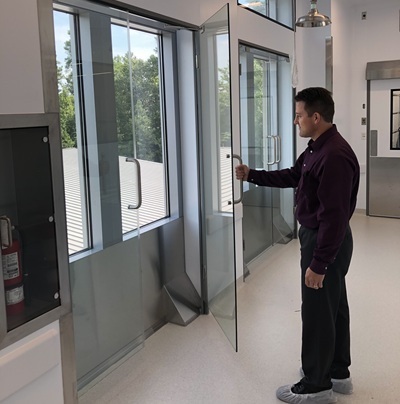
The author showing how a retrofit can create a low wall return on the exterior out of glass panels.
Whether supporting aseptic fill-finish operations, cell therapy manufacturing, medical device production, or advanced research environments, cleanrooms have become one of the most critical infrastructure investments in the life sciences industry. While many organizations focus on process equipment and production capabilities, the cleanroom itself often serves as the foundation for product quality, regulatory compliance, and operational reliability.
At its core, cleanroom technology represents far more than filtered air and stainless steel finishes. Today's cleanrooms have evolved into highly engineered environments designed to control particulate contamination, airflow, temperature, humidity, pressure relationships, personnel movement, material flows, and facility maintenance activities.
As advanced technologies continue to expand and project delivery schedules become increasingly compressed, organizations are also reevaluating how cleanrooms are designed, constructed, and maintained throughout their lifecycle. We are seeing an unprecedented cycle in North America for new construction of clean rooms in life science, semiconductor or other emerging science technologies.
What is a cleanroom?
A cleanroom is an engineered environment specifically designed to maintain extremely low levels of airborne contamination. Through specialized filtration systems, controlled airflow patterns, and carefully selected finishes, cleanrooms reduce the presence of dust, microbes, aerosols, and other contaminants that could negatively impact products, processes, or personnel.
In addition to contamination control, modern cleanrooms often regulate:
- Air cleanliness classifications
- Temperature
- Relative humidity
- Differential pressure
- Airflow velocity and direction
- Occupancy and process interactions
These environments are commonly used throughout pharmaceutical manufacturing, biotechnology research, cell and gene therapy production, medical device manufacturing, laboratory operations, and food processing applications.
The importance of cleanroom performance cannot be overstated. In highly regulated operations, even small contamination events can compromise product quality, disrupt manufacturing schedules, or create significant regulatory concerns. Cleanrooms also serve as a critical engineering control for protecting personnel from potentially hazardous materials and processes.
From construction to technology
Historically, many cleanrooms were constructed using traditional stick-built methods consisting of metal studs, gypsum board, field-applied finishes, and extensive on-site installation activities.
Today, many owners are shifting toward modular cleanroom technologies that leverage prefabricated wall systems, ceiling systems, integrated utilities, factory-produced components, and off-site manufacturing techniques.
This evolution is being driven by several industry realities:
- Shorter project schedules
- Increasing labor shortages
- Growing quality expectations
- Demand for facility flexibility
- Expansion of manufacturing
The cleanroom is increasingly viewed as a manufactured product rather than a traditionally constructed space.
Understanding the rise of modular cleanrooms
One of the most significant developments in cleanroom technology is the widespread adoption of modular systems. Modular cleanrooms generally fall into two categories: panelized modular systems and volumetric modular systems.
Panelized systems utilize prefabricated wall and ceiling components that are assembled on-site. These systems can often be modified or reconfigured with limited impact to surrounding spaces. Volumetric systems take prefabrication further by manufacturing large portions of the cleanroom off-site as complete modules that can be transported and installed as integrated units.
Compared with conventional construction, modular cleanrooms can offer:
- Improved consistency and quality
- Reduced field labor
- Faster installation
- Lower construction waste
- Greater schedule predictability
- Increased opportunities for future expansion or reconfiguration
These advantages become particularly valuable as organizations seek to accelerate facility deployment while managing project risk.
Modular technology has become one of the most significant advancements in cleanroom delivery strategies.
Cleanroom materials matter more than ever
Another important trend in cleanroom technology involves material performance.
Modern cleanroom environments require materials that can withstand continuous cleaning, repeated disinfection cycles, chemical exposure, and routine operational impacts. Panel systems commonly incorporate coated steel finishes, aluminum honeycomb cores, prefabricated corner systems, and sealed joints designed to support cleanability while minimizing particulate generation.
Design teams must evaluate materials based on multiple factors, including:
- Chemical resistance
- Cleaning protocols
- Impact resistance
- Operational durability
- Environmental conditions
- Lifecycle costs
In cell therapy and biopharmaceutical facilities especially, cleaning regimens often involve aggressive disinfectants and sporicidal agents that can quickly degrade inappropriate materials. The result is a growing emphasis on lifecycle performance rather than simply first cost.
Above-ceiling access is changing facility operations
One area that receives increasing attention during planning is facility maintainability.
Traditionally, routine maintenance activities such as HEPA filter replacement, lighting access, and equipment servicing frequently required entering classified clean spaces. This could disrupt manufacturing activities and increase contamination risks.
Many modern facilities now incorporate interstitial spaces or walkable ceiling systems that allow maintenance personnel to access building systems from above the cleanroom. These areas can significantly improve operational flexibility while reducing disruptions to critical manufacturing processes.
Interstitial spaces have become an important design strategy for supporting long-term facility operations.
However, these systems require careful architectural, structural, and MEP coordination. Load limitations, fall protection requirements, utility routing, equipment access, and overall building geometry must all be considered early in the planning process.
Designing for flexibility
Perhaps the most important trend shaping cleanroom technology today is flexibility.
Many life science organizations no longer expect facilities to perform a single function for 25 years. Product portfolios evolve, processes change, and emerging therapies create new manufacturing requirements.
As a result, cleanroom systems are increasingly being designed to support:
- Future reconfiguration
- Equipment replacement
- Capacity expansion
- Phase-based growth
- Process modifications
Planning for these future scenarios often requires careful consideration of utility infrastructure, room configurations, removable panels, airflow strategies, and material movement pathways long before construction begins.
The most successful projects are not necessarily those designed solely for today's manufacturing process. They are the facilities designed to meet tomorrow's unknown requirements.
Material and product flows: The foundation of cleanroom efficiency
"A well-designed cleanroom is not just a series of classified rooms. It is a carefully planned sequence of material, personnel, and product movements that supports manufacturing efficiency while reducing contamination risk."
While contamination control is often associated with air changes, filtration, and room classifications, successful cleanroom operations also depend heavily on the movement of materials, consumables, equipment, personnel, and product. Poorly designed flow patterns can create contamination risks, increase handling requirements, and reduce operational efficiency regardless of the cleanliness level achieved by the HVAC system.
Raw materials entering GMP facilities typically pass through receiving, quarantine, sampling, testing, and warehouse functions before being released for manufacturing. Consumables such as tubing, single-use bags, and gowning supplies follow similar pathways. Prior to entering classified spaces, these materials are commonly transferred through Material Airlocks (MALs) where cleaning, wipe-down, and disinfection procedures help minimize the introduction of contaminants.
The design of Material Airlocks requires careful planning. Airlocks should provide sufficient space for staging, wipe-down activities, cart maneuvering, and pallet movement. Whenever possible, separate airlocks for personnel and materials help reduce traffic conflicts and lower contamination risk. Facilities with high material volumes may benefit from dedicated inbound and outbound MALs to support unidirectional flow and prevent cross-contamination.
Ultimately, cleanroom performance depends not only on air cleanliness but also on the ability of the facility design to support safe, efficient, and controlled movement of materials throughout the manufacturing process. Early evaluation of material and product flows can significantly improve operational efficiency, reduce contamination risks, and enhance regulatory compliance.
Looking ahead
Cleanroom technology continues to move beyond simple contamination control. Today's cleanrooms are sophisticated engineered environments that integrate architecture, process requirements, building systems, operational strategy, and long-term maintainability.
As life science organizations pursue faster project delivery, greater manufacturing flexibility, and increasingly complex therapies, modular construction, advanced materials, and integrated facility planning will continue to reshape how cleanrooms are designed and delivered.
For owners, operators, and project teams alike, understanding these evolving technologies is becoming just as important as understanding the scientific processes occurring within the cleanroom itself.