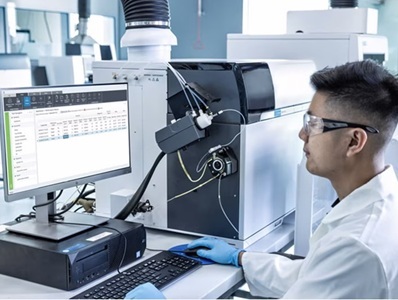
Credit: Agilent
Inductively coupled plasma mass spectrometry (ICP-MS) is an analytical technique used to identify and quantify elements at trace and ultra-trace concentrations. It combines a high-temperature plasma ion source with a mass spectrometer, enabling laboratories to measure multiple elements in a sample, often at concentrations as low as parts per trillion.
ICP-MS is widely used in environmental testing, food and beverage analysis, pharmaceutical quality control, semiconductor manufacturing and materials science. It is particularly useful when laboratories need high sensitivity, multielement analysis and reliable measurements of elemental impurities.
Choosing an ICP-MS begins with evaluating analytical requirements. Consider the following factors:
- Detection limits: Determine the concentrations the method must measure and whether the required sensitivity justifies ICP-MS over alternatives such as inductively coupled plasma optical emission spectrometry (ICP-OES).
- Sample matrix: High dissolved-solids content, acids, organic compounds, and complex matrices can affect performance and may require specialized sample introduction, dilution, or additional preparation.
- Throughput and automation: Consider sample volume, autosampler capacity, analysis time, and how easily the instrument fits into existing workflows.
- Operating requirements: Account for argon supply, laboratory infrastructure, maintenance, consumables, training, and service support.
“Buying any instrument is a big decision, but I would say don't underestimate your lab's needs for the future,” said Glenn Woods, ICP-MS Marketing Manager at Agilent Technologies. “Buying an instrument to cover what you do now will work fine, but buying an instrument that will still be relevant in 5 years is arguably even more important.”
Avoid this mistake:
It is imperative to know “what else” is in the sample matrix. There is a tendency to focus on known-unknowns rather than on unknown-unknowns. For example, if a sample contains an unexpected matrix component not typically included in an analytical suite, there can be overreporting of important elements such as As and Se.
What every new ICP-MS user should know:
“Don't worry and use some HCl,” said Woods. “I recommend adding 0.5% HCl to the nitric acid matrix normally used for ICP-MS. This should be in the samples, standards, and washes. The HCl helps stabilize most elements (yes, even Ag!)—I've always said, get the chemistry right, and the numbers will follow. We use our cell and, if available, MS/MS technology to remove Cl-based interferences.”
When to upgrade:
For many routine applications, single quadrupole ICP-MS (SQ ICP-MS) remains fully capable of meeting laboratory requirements. But increasing detection limits, more complex sample matrices and difficult spectral interferences can push conventional systems toward their limits. Triple quadrupole ICP-MS (TQ ICP-MS), also known as ICP-MS/MS or ICP-QQQ, adds a second mass filter around the collision/reaction cell. The result is greater control over ion-molecule chemistry and, for some challenging analytes, a more reliable path to accurate trace and ultra-trace measurements.
The strongest case for migrating from SQ ICP-MS to TQ ICP-MS generally comes from applications in which spectral interferences, rather than basic sensitivity, are limiting analytical performance. TQ ICP-MS provides another level of interference control. By mass-filtering the ion beam before it enters the reaction cell, the instrument can limit unwanted reactions and make mass-shift chemistry more selective. This can be valuable in applications ranging from high-purity chemicals and semiconductor materials to environmental, food, pharmaceutical and life science.