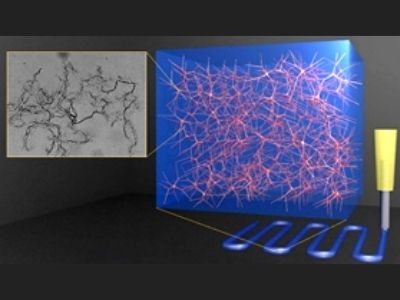
Researchers at North Carolina State University have merged micro- and nano-sized networks of the materials harnessed from seaweed to create 3D-printable gels with improved and highly controlled properties. The merging of the differently sized networks of the same alginate eliminates the fragility that can sometimes occur when differing materials are placed together in a hydrogel.
Described in the journal Nature Communications, the findings show that these water-based gels—called homocomposite hydrogels—are both strong and flexible. They are composed of alginates—chemical compounds found in seaweed and algae that are commonly used as thickening agents and in wound dressings.
"We are reinforcing a hydrogel material with the same material, which is remarkable because it uses just one material to improve the overall mechanical properties," said Lilian Hsiao, an assistant professor of chemical and molecular engineering at NC State and a co-author of the paper. "Alginates are used in wound dressings, so this material potentially could be used as a strengthened 3D-printed bandage or as a patch for wound healing or drug delivery."
The findings could have applications in biomedical materials—think of biological scaffolds for growing cells—and soft robotics. The researchers say future work will attempt to fine-tune this method of merging of homocomposite materials to advance 3D printing for biomedical applications or biomedical injection materials.
Photo: The hydrogel material comes from different-sized seaweed particles. Credit: Orlin Velev, NC State University