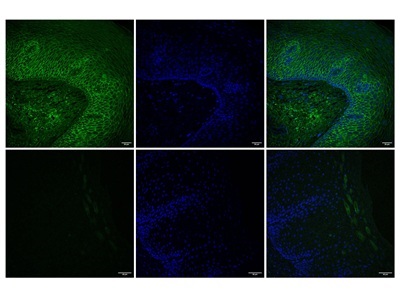
In these images of human esophageal tissue, green staining shows E-cadherin, a protein involved in maintaining connections between epithelial cells. In untreated tissue (top row), the E-cadherin signal is strong, reflecting an intact epithelial barrier. After treatment with a gel-like drug formulation (bottom row), the E-cadherin signal is reduced, suggesting a temporary loosening of cell–cell junctions. Credit: MIT researchers
There are few treatment options available for people with disorders of the esophagus. Delivering drugs directly to this part of the body is difficult, so patients are usually treated with systemic drugs, which can have unwanted side effects. Delivering drugs directly to the esophageal tissue could reduce side effects, but it is challenging because drugs taken orally pass through the esophagus so quickly. The esophagus is also lined by a layer of tissue called stratified squamous epithelium, which is nearly impermeable to drugs.
In a new study published in Nature Biomedical Engineering, MIT engineers report the development of an hydrogel oral drug formulation that can coat the mucosal lining of the esophagus, allowing drugs to better pass through the tissue.
First, the team designed a screening system that mimics the structure of the esophagus. Using the system, the researchers were able to measure how different excipients affect the permeability of the esophageal tissue. They tested about 100 different compounds and identified several top candidates. Then, they tested pairs of these excipients and found that the most effective combination was a pair of bile salts called sodium chenodeoxycholate and sodium cholate.
These salts appear to work together to loosen up the cell-cell junctions that normally act as a barrier to drug molecule entry. The researchers added those bile salts to a polysaccharide-derived hydrogel, which has a viscous consistency that allows it to lightly coat the lining of the esophagus.
In tests in animals, the researchers showed that this formulation could be used to effectively deliver infliximab to the esophagus. They also found that the loosening of the cell-cell junctions was temporary, and the cells returned to normal within three days.
The researchers are now working on further optimizing the formulation for potential testing in humans. One key goal is to ensure that the gel adheres for long enough to deliver the drugs, but not so long as to cause discomfort for patients. The researchers are also exploring the possibility of using this approach to deliver other types of drugs.
Data from MIT