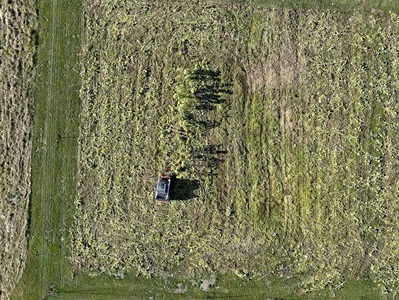
Aerial photo of a farmer’s field in Maine. Credit: The researchers via Yale
A Yale-led research team has developed a cheaper, more environmentally friendly way to remove certain PFAS from contaminated farmland, while also pulling carbon dioxide out of the atmosphere in the process.
The two-step system starts by spreading a thin layer of crushed alkaline rock across contaminated soil. That raises the soil's pH, which speeds up the uptake of PFOS into plants growing in the field. These plants are then harvested and heated into biochar—a process that destroys both PFOS and PFOA.
For the study, published in Proceedings of the National Academy of Sciences, researchers based the model on data from contaminated agricultural sites in Maine, where forever chemicals entered farmland for decades through sewage sludge marketed to farmers as fertilizer.
Existing remediation methods—excavating soil or burning it with specialized equipment—cost between $800,000 and $1.6 million per hectare, and removing PFAS from all affected U.S. cropland this way would total roughly $8 trillion. The new approach costs an estimated $1,460 per hectare per year and, over 20 years of repeated treatment, would run about $29,000 per hectare, including compensation for farmers' lost income.
Importantly, unlike current methods, this approach allows the land to stay in agricultural use throughout treatment. The researchers estimate the system could remove 10.5 million metric tons of carbon dioxide annually if deployed nationally, thanks to the enhanced weathering of the crushed rock and biochar involved.
“This is a real pathway to actually give farmers in this situation some agency over their land, and leave the soil in better condition than it was before,” said first author Jake Thompson, associate professor at Yale.
The project recently received a Yale Planetary Solutions Impact Accelerator grant, which will provide mentorship and commercialization support as the team works to scale the approach beyond the Maine test sites.
Data from Yale University